

Introduction
The TG-iPASS ransomware attack disrupted Telangana’s industrial approvals portal in October 2026, raising concerns about data availability, system security and the resilience of critical digital services. Although officials subsequently reported that the encrypted data had been recovered, the incident highlights important questions about how organisations investigate attacks and restore operations safely.
According to Telangana Today’s report, the portal had been inaccessible since 22 October after its database and related files were reportedly encrypted. A subsequent report by The Economic Times CISO stated that specialists had successfully recovered the data, with officials reporting no data loss.
The development marked an important step towards recovery. However, restoring encrypted information is only one part of resolving a cybersecurity incident. Understanding how the attack occurred, determining whether information was exposed and ensuring that affected systems can operate securely are equally important.
This incident offers a useful case study in the relationship between service disruption, forensic investigation, data recovery and long-term cyber resilience.
What Happened in the TG-iPASS Ransomware Attack?
The Telangana State Industrial Project Approval and Self-Certification System, commonly known as TG-iPASS, is a single-window platform that enables businesses to access industrial approvals and related clearances.
The portal supports government-to-business services, making its availability important for organisations seeking permissions, registrations and licence renewals.
The Initial Disruption
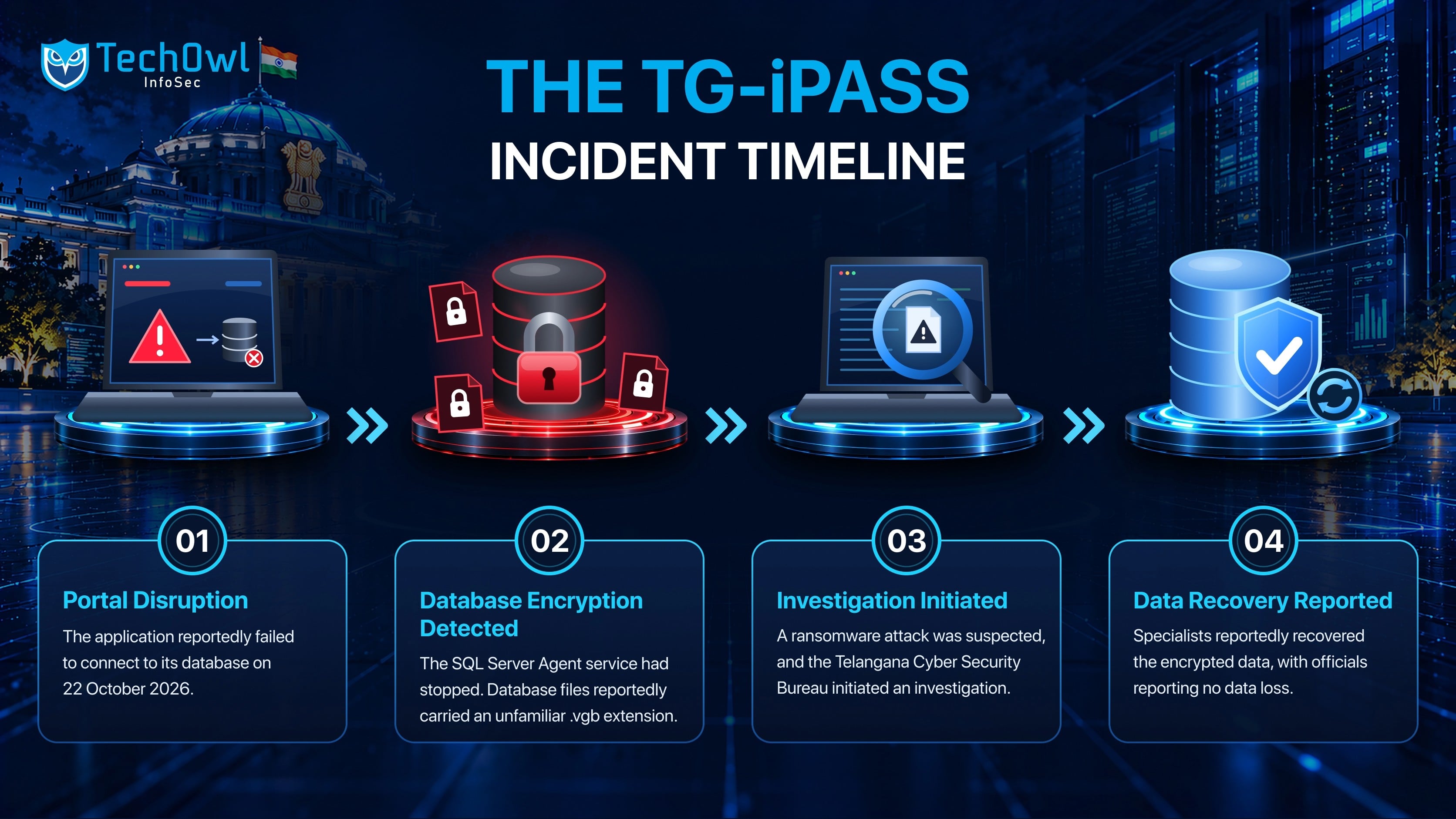
According to reporting by Telangana Today, the disruption began late on 22 October 2026 when the application reportedly failed to connect to its database server.
Initial troubleshooting did not resolve the problem. Further examination reportedly found that the SQL Server Agent service had stopped and could not be restarted.
Subsequent checks indicated that the database and related files had been encrypted. The affected files carried an unfamiliar .vgb extension, and a note containing an email address and machine identifier was reportedly discovered on the server.
These findings led officials to suspect a ransomware attack.
The Telangana Cyber Security Bureau initiated an investigation following a complaint from the Industries Department. A case was registered under Sections 43 and 66 of the Information Technology Act.
At the time of the initial reports, the portal remained inaccessible and the investigation was examining the affected environment.
The Extent of the Disruption
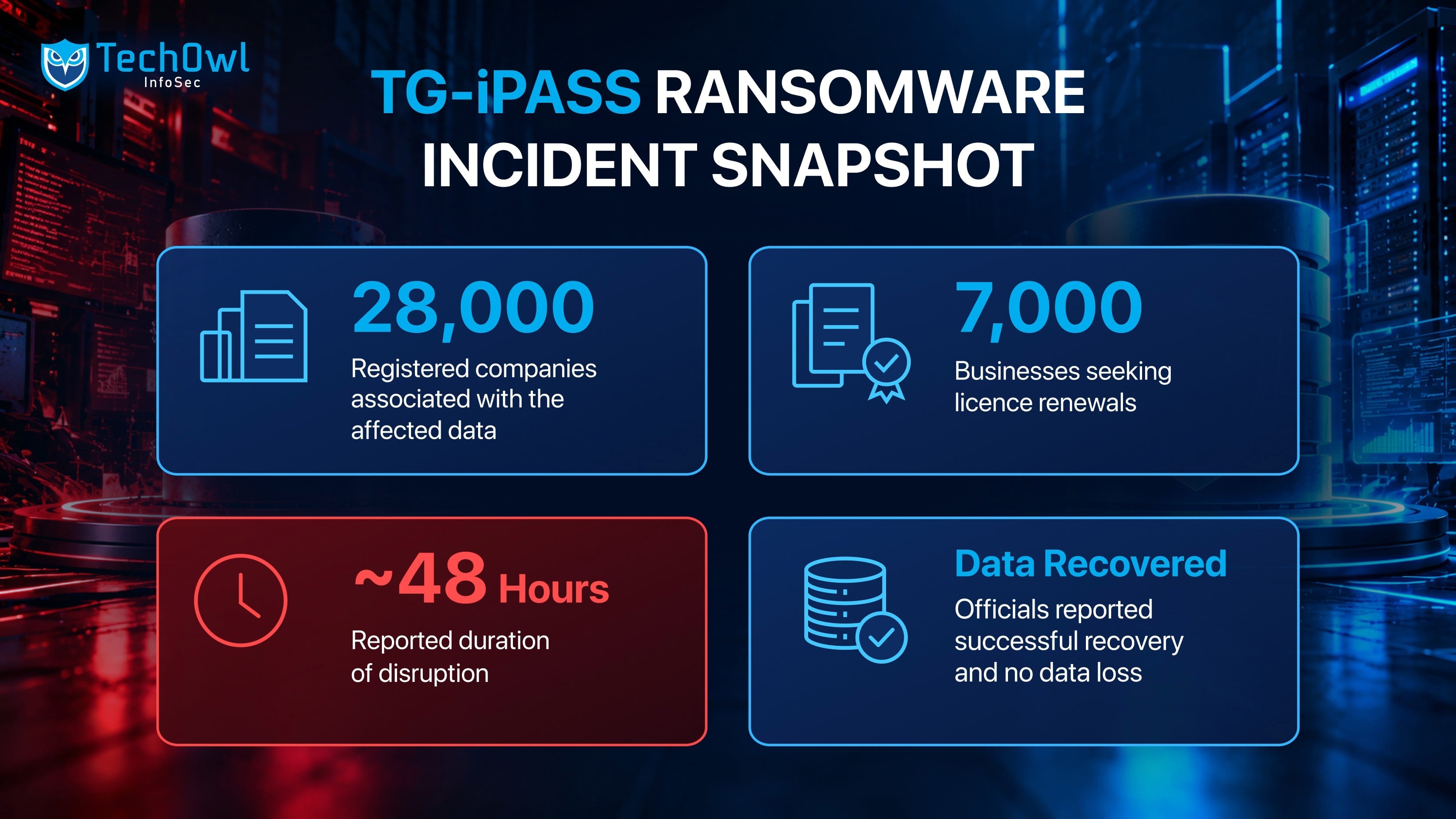
According to The Economic Times CISO, the encrypted data related to approximately 28,000 registered companies and another 7,000 businesses seeking licence renewals.
The disruption reportedly continued for approximately 48 hours, affecting a platform used to process industrial permissions.
For organisations that depend on digital platforms to deliver essential services, an incident of this nature can create operational delays even when the underlying data remains recoverable.
It also demonstrates how a technical failure at the application or database level can initially resemble an ordinary service outage before further investigation reveals a potential security incident.
From Suspected Ransomware to Data Recovery
One of the most significant developments in the TG-iPASS incident was the reported recovery of the encrypted information.
In the subsequent update, officials stated that specialists had successfully decrypted the data and that no data had been lost. The Industries Department also indicated that it was strengthening security measures before returning the portal to routine operations.
This changed the immediate focus from restoring access to encrypted information towards validating the recovery and preparing the affected environment for normal operations.
However, data recovery and incident resolution are not the same thing.
Recovering information addresses the availability problem. It does not, by itself, establish how attackers gained access, whether sensitive information was transferred outside the environment or whether any unauthorised access remains.
The initial reports stated that investigators were examining whether data had been stolen or transferred. The available reporting does not conclusively establish the initial attack vector or confirm data exfiltration.
These questions are important because an organisation can successfully recover its data while still needing to investigate the incident and address the weaknesses that contributed to it.
What a Complete Recovery Should Establish
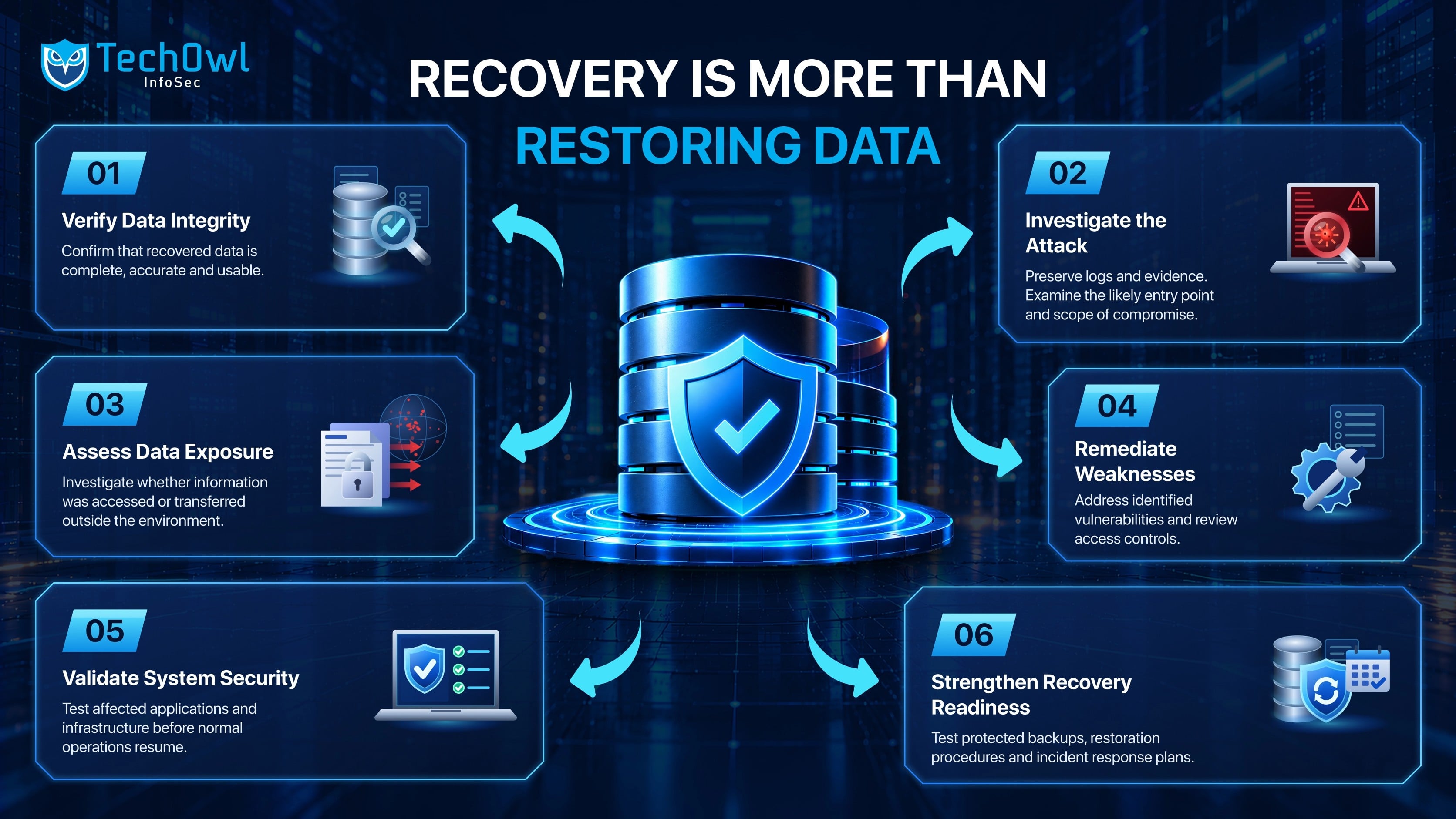
Following a suspected ransomware incident, organisations should consider whether:
-
The affected data has been recovered completely and accurately.
-
Restored applications and databases are functioning as expected.
-
Relevant logs and forensic evidence have been preserved.
-
The likely attack vector and scope of compromise have been investigated.
-
Potential unauthorised access and data exfiltration have been assessed.
-
Identified security weaknesses have been addressed before normal operations resume.
The purpose is to restore not only service availability but also confidence in the integrity and security of the affected environment.
What the Incident Reveals About Ransomware Protection for Businesses
The TG-iPASS incident highlights several considerations for organisations operating critical digital platforms. These lessons apply to government systems and businesses that rely on databases, web applications and interconnected infrastructure.
Ransomware Recovery and Backup Security Must Be Tested
The reported recovery of TG-iPASS data demonstrates why organisations need reliable recovery arrangements.
However, maintaining backups is only the first step. Organisations must also verify that backup copies are available, protected and capable of being restored successfully.
An effective approach to ransomware recovery and backup security includes:
-
Maintaining regular backups of critical data and applications.
-
Protecting backup repositories against unauthorised access or modification.
-
Isolating backup copies from ordinary production access where feasible.
-
Testing restoration procedures regularly.
-
Verifying data integrity before recovered information is used in production.
-
Defining recovery priorities for business-critical systems.
Recovery planning should also establish acceptable recovery time and data loss objectives. These help organisations determine how quickly services must return and how much data loss, measured in time, can be tolerated.
A backup that has never been tested may not provide the level of assurance an organisation expects.
Cybersecurity Incident Response Must Go Beyond Restoring Access
When a system becomes unavailable following suspected ransomware activity, restoring service is only one part of the response.
A structured cybersecurity incident response process should establish what happened, which systems were affected, whether information was exposed and what actions are required to prevent further compromise.
This generally involves containing affected systems where appropriate, preserving evidence, investigating the likely attack vector, assessing the scope of the incident and validating recovery.
The TG-iPASS reporting also highlights the importance of forensic investigation. Examining logs, authentication records and relevant system evidence can help investigators establish the sequence of events and identify potential indicators of compromise.
Organisations should avoid treating the return of an application to service as proof that the underlying security issue has been resolved.
Threat Detection and Response Can Reduce the Time to Investigate
Ransomware incidents can create a significant gap between the initial compromise and the moment an organisation recognises suspicious activity.
Appropriate logging, monitoring and escalation procedures help security teams investigate unusual events and identify potential threats.
Depending on the available telemetry, relevant signals may include unusual privileged access, unexpected database activity, suspicious authentication attempts or attempts to disable security controls.
A Security Operations Center (SOC) can support the monitoring and investigation of these events. Managed SOC services can provide continuous monitoring and alert investigation according to the agreed service scope.
Monitoring does not guarantee that every attack will be detected. Its effectiveness depends on visibility across relevant systems, log quality, detection rules and the ability to investigate and respond to alerts.
The objective is to improve the organisation’s ability to recognise suspicious activity and take appropriate action before the impact expands.
Understanding the Role of Preventive Security Measures
Recovery capabilities are essential, but organisations should also examine the controls that may help reduce the likelihood of similar incidents.
Regular vulnerability assessments and penetration testing can identify weaknesses in applications, databases, networks and supporting infrastructure. Security audits can help establish whether access controls, patch management and other safeguards are implemented effectively.
For internet-facing platforms, organisations also need visibility into the assets they expose. Websites, APIs, cloud services and remote-access interfaces can create additional risk when they are unknown, outdated or improperly configured.
External attack surface management helps organisations identify and monitor internet-facing assets so that potential exposures can be investigated and prioritised.
These activities address different parts of the security lifecycle. They do not establish how the TG-iPASS environment was compromised, and the available reporting does not show that any particular control would have prevented the incident.
They do, however, illustrate why security programmes should combine preventive assessment, monitoring, investigation and recovery rather than rely on any single measure.
The Broader Lesson for Digital Service Providers
The TG-iPASS incident is a reminder that the availability of a digital service depends on more than whether its website responds to user requests.
Applications rely on databases, supporting services, access controls and infrastructure that must remain secure and recoverable. When one critical component becomes unavailable, the effects can extend to the wider service and the organisations that depend on it.
Three questions are particularly important for any organisation operating a critical digital platform:
-
Can the organisation identify a potential compromise? Appropriate logging, monitoring and incident escalation help teams recognise and investigate suspicious activity.
-
Can it recover critical information? Protected backups, tested restoration procedures and defined recovery priorities help reduce the consequences of data becoming unavailable.
-
Can it establish that the restored environment is trustworthy? Forensic investigation, security validation and remediation help determine whether systems can safely return to normal operations.
These questions provide a practical starting point for evaluating cyber resilience.
TechOwl InfoSec supports organisations with cybersecurity capabilities including vulnerability assessment, security monitoring and external attack surface visibility. Such capabilities can form part of a broader security programme when aligned with an organisation’s risk profile and operational requirements.
The emphasis should remain on addressing the actual risks facing each environment rather than assuming that one product or service can resolve every security challenge.
Conclusion: Recovery Is an Important Milestone, Not the Final Answer
The TG-iPASS incident progressed from an application and database disruption to the discovery of encrypted files, a suspected ransomware attack, an investigation and the reported recovery of the affected data.
The reported recovery and absence of data loss are positive developments. At the same time, the full technical cause and extent of the incident should not be assumed without confirmed investigative findings.
For organisations that rely on critical digital services, the lesson is clear: recovery arrangements matter, but they must be supported by effective investigation, security validation and remediation.
Cyber resilience is not simply the ability to restore data. It is the ability to understand what happened, recover safely and reduce the risk of a similar incident occurring again.
As digital services continue to support essential business and public-sector operations, organisations should regularly review their security controls, test recovery procedures and ensure they are prepared to respond when disruption occurs.
Frequently Asked Questions (FAQs)
1. What happened in the TG-iPASS ransomware attack?
The TG-iPASS ransomware attack refers to the reported incident in October 2026 that disrupted Telangana’s industrial approvals portal. Reports stated that the database and related files had been encrypted, making the service unavailable. Officials subsequently reported that specialists had recovered the data, with no data loss reported.
2. What is TG-iPASS used for?
TG-iPASS is Telangana’s single-window industrial approval and self-certification platform. It supports businesses seeking industrial permissions and related clearances through government-to-business services.
3. Was data recovered after the TG-iPASS ransomware attack?
According to The Economic Times CISO, officials reported that specialists had successfully decrypted the affected data and that no data had been lost. The recovery update does not, by itself, establish whether any information had been accessed or transferred outside the system.
4. Was sensitive data stolen during the TG-iPASS incident?
The initial reporting stated that investigators were examining whether data had been stolen or transferred outside the affected environment. The sources reviewed do not conclusively establish that data exfiltration occurred.
5. How can organisations improve ransomware protection for businesses?
Organisations can improve ransomware protection through regular security assessments, secure access controls, appropriate endpoint protection, continuous monitoring, protected backups and a documented incident response plan. Recovery procedures should also be tested regularly.
6. How does a Security Operations Center (SOC) help during a ransomware incident?
A Security Operations Center monitors security events and investigates suspicious activity across the systems within its visibility. Depending on its integrations and capabilities, it can help identify unusual access, investigate potential indicators of compromise and support incident response.
7. Why are ransomware recovery and backup security important?
Protected and tested backups help organisations restore critical information following an incident. Recovery procedures should also verify data integrity and ensure that affected systems are safe before they return to production.
8. What is the role of cybersecurity incident response?
Cybersecurity incident response coordinates the activities needed to contain an incident, preserve evidence, investigate the scope of compromise, remediate identified weaknesses and restore services safely.
9. How do Managed SOC services support threat detection and response?
Managed SOC services can provide ongoing monitoring and investigation of security alerts under an agreed service arrangement. They can improve visibility into suspicious activity, although effectiveness depends on monitoring coverage, available logs and defined response procedures.
10. What should organisations review after a ransomware incident?
Organisations should review the initial access method, affected systems, potential data exposure, access permissions, vulnerabilities, monitoring coverage and recovery procedures. They should also verify that restored data is accurate and that identified security weaknesses have been addressed.


