

Executive Summary
On April 14, 2026, Booking.com confirmed a targeted breach of customer reservation data. How the attackers got in has not been disclosed. During our investigation into the breach, we discovered two critical flaws in Booking's own security infrastructure — systems that were supposed to detect and prevent attacks, but were instead silently failing.
- Customer data confirmed stolen — names, emails, phone numbers, home addresses, reservation details, and booking PINs
- Payment data not accessed — the attackers had targeted access to bookings, not credit cards
- Security alarm system broken — Booking's browser-level security alert system crashes silently on a specific type of attack, meaning those attacks go completely undetected
- Alert system can be flooded with fake noise — anyone on the internet can send fake security alerts into Booking's monitoring pipeline, drowning out real ones
- Entire attack category invisible — a well-known class of web attacks triggers this crash, leaving Booking's security team with no visibility into whether it is happening
- How attackers got in — still unknown — a broken alarm system is precisely what keeps an attack method off the incident report
- Staff login gateway left open — an internal system used by all Booking Holdings employees to log in to company tools was accessible to anyone on the internet, with no password required
- Full list of internal tools exposed — a publicly readable data feed revealed the names of 50+ internal company systems across all Booking Holdings brands
- Staff login process fully documented — publicly — a detailed guide explaining exactly how employee logins work was accessible without any credentials
The Breach: What Booking.com Confirmed
On April 14, 2026, Booking.com confirmed that attackers had broken into its systems and accessed customer reservation data. The company says it detected and stopped the activity — but not before a significant amount of personal information was taken.
| Field | Detail |
|---|---|
| Confirmed date | April 14, 2026 |
| Attack type | Targeted intrusion — deliberate, scoped access, not a broad sweep |
| Data stolen | Names, emails, phone numbers, postal addresses, reservation dates and locations, hotel details, booking PINs |
| Payment data | Not accessed |
| How they got in | Not disclosed |
| Who was responsible | Not disclosed |
| Booking.com's response | Customer notifications sent, booking PINs reset, phishing warnings issued |
| Legal obligations | As a Dutch company, Booking.com is required under EU data protection law to notify the Dutch data protection authority within 72 hours of a confirmed breach |
What Passive Research Revealed
Following the breach disclosure, our team initiated a threat intelligence investigation. The goal: look at Booking.com from the outside — the way an attacker would — and surface the security gaps that created the conditions for this breach, and that continue to enable undetected activity.
Booking's online presence is enormous — thousands of web addresses spanning customer-facing sites, hotel partner portals, mobile apps, and internal company systems. Each is a potential entry point. We began by mapping what is visible from the public internet, using only the information that any browser or web tool receives when connecting to a Booking.com page.
Reading the behind-the-scenes information that Booking.com's websites send to browsers revealed something in their security infrastructure that demanded closer examination.
Finding One: The Broken Security Alarm
Modern web browsers have a built-in security feature that acts like a smoke alarm for websites. When a browser detects that something suspicious is being loaded on a page — a malicious script, an unauthorised resource, something the website's own security policy says shouldn't be there — it fires an alert and sends a report to a server address the website specifies.
That server address is publicly visible in the information Booking.com sends to every browser that loads one of its pages. Following it led us to Booking's dedicated security alert collection service — a system that receives these browser-generated reports and feeds them into Booking's security monitoring pipeline. It is, in effect, the sensor that tells the security team when something is hitting their users.
The Bug: One Attack Type Crashes the Alarm
When we tested Booking's security alert collection service, we found that a specific type of malicious content — where harmful code is embedded directly inside a web link rather than loaded from a separate server — causes the entire service to crash. Silently. With no record, no retry, and no notification to the security team.
This technique — embedding executable content directly inside a web address — is a well-established attack method. It is specifically used to bypass defences that block scripts loaded from external sources. When an attacker uses it against a Booking.com page, the browser correctly detects it and fires an alert. But when that alert reaches Booking's collection service, the service crashes and the alert disappears.
What the attack looks like — and what happens to the alert
POST /[redacted endpoint]
Content-Type: application/csp-report
{
"csp-report": {
"page": "[redacted].booking.com",
"rule-violated": "no inline scripts allowed",
"blocked-content": "embedded malicious code", ← this type crashes the service
"status-code": 200
}
}
HTTP/2 500 — Internal Server Error
{ "message": "Internal server error" }
// The alert is gone. Nothing was recorded. No one was notified.
Every variation of this attack type triggers the same crash. Other attack types are handled correctly — it is specifically this category that the service cannot process.
Why This Matters in the Context of the Breach
A broken security alarm during a confirmed targeted breach whose entry point remains undisclosed is not an operational footnote — it is the central question: how long was the attacker operating before detection, and what exactly did the monitoring miss?
| Impact | What it means |
|---|---|
| Silent detection gap | Any attack using this technique — testing, delivering malicious code, or stealing data — produces security alerts that vanish on arrival. No alarm fires. No one is notified. |
| Alarm flooding | The alert collection service accepts reports from anyone on the internet, for any page, without verifying they are real. An attacker can flood it with thousands of fake alerts, burying genuine ones in noise. |
| Extended time undetected | The breach was described as "targeted" — careful and deliberate. A monitoring gap of this kind directly extends how long an attacker can operate before anyone notices. |
| Entry point still unknown | Booking has not disclosed how attackers got in. A broken alarm system is precisely what keeps an attack method off the incident report. |
What is clear: this vulnerability exists, it covers a category of attacks actively used by threat actors targeting travel platforms, and it was present throughout the entire period the breach occurred. A monitoring gap of this kind does not need to have caused the breach to be dangerous — it is dangerous because it means the next attack using this technique will not be seen either.
How an Attacker Uses This
Root Cause & Additional Observations
Why does the alarm crash?
The crash originates in how the service processes the web address contained in the security alert. When malicious content is embedded directly in a link rather than hosted at a web address, there is no server name or domain to extract — because there is none. The service's code expects a web address it can parse and store, gets nothing, and throws an unhandled error. This is a one-line fix: check for this type of content before trying to process it as a normal web address, and handle it as a known special case.
Fake alerts accepted without question
Security alert systems like this one are intentionally open — browsers need to be able to send alerts without having to log in first. But Booking's system goes further: a verification token that was supposed to confirm the alert came from a real Booking.com session is treated as optional and never actually checked. The result: anyone on the internet can submit fake security alerts directly into Booking's monitoring pipeline — with no account, no credentials, and no connection to a real Booking.com page.
This is not unique to Booking
Finding Two: The Identity Gateway
The broken security alarm is one gap. Continuing to map the external surface revealed a more fundamental exposure — not in the monitoring layer, but in the corporate identity layer that authenticates every Booking Holdings employee across all of its brands.
Booking Holdings — the parent company of Booking.com, Priceline, Agoda, Kayak, and OpenTable — operates a single centralised login gateway for all of its staff. Every employee across every brand uses this system to log in to internal tools: admin dashboards, operational platforms, data systems, and company infrastructure. Think of it as the master front door to everything inside the company.
This system was reachable from the public internet — and its internal management pages were accessible to anyone, with no login required.
The Full Map of Internal Tools — Served on Request
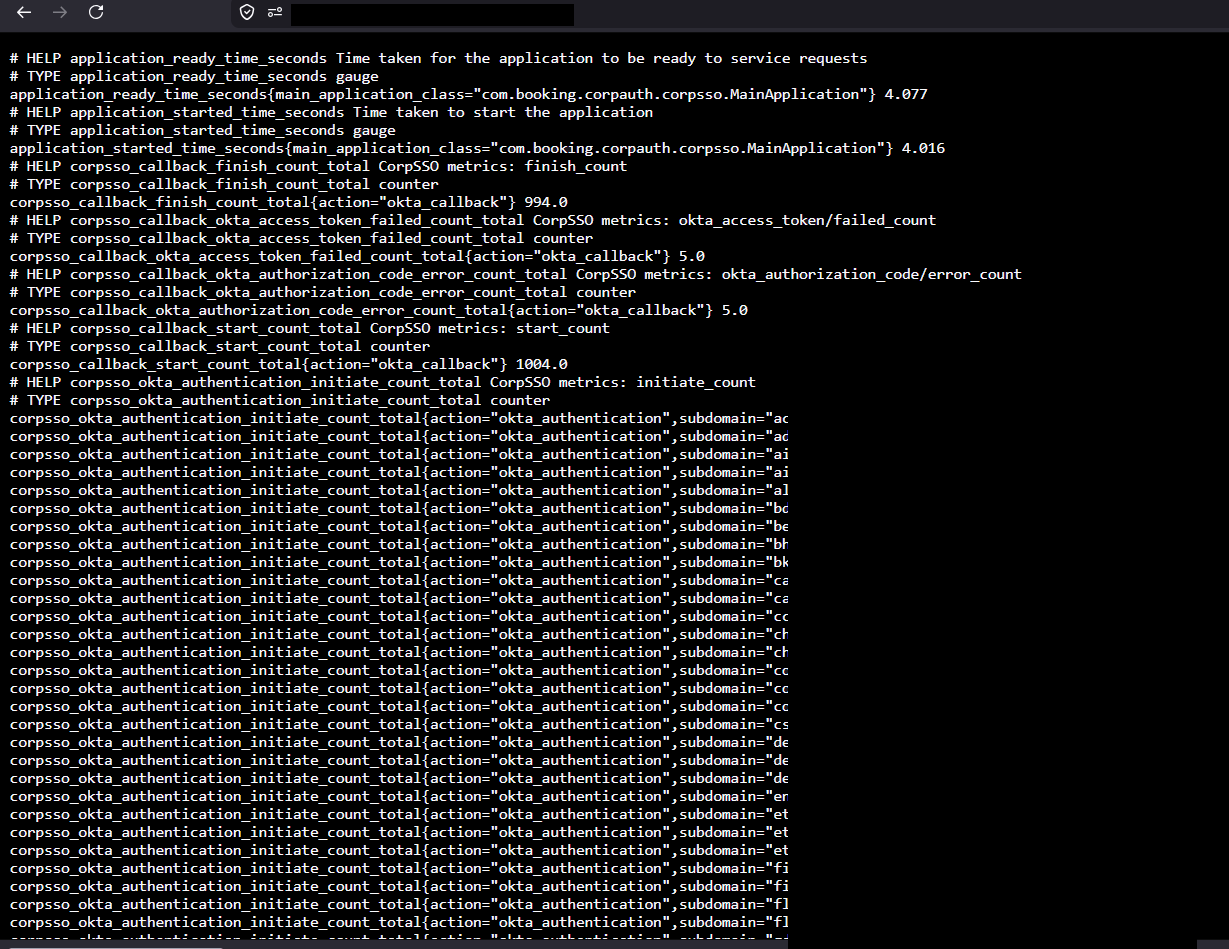
One of the exposed pages contained live statistics tracking every internal company tool that employees log in to through this gateway — listed by name, with login counts. The result was a complete, up-to-date directory of Booking Holdings' internal systems: admin panels, payments platforms, engineering tools, data infrastructure, and operational systems across every brand.
No hacking required. No password needed. The system served the list to anyone who asked.
The Staff Login Process — Fully Documented Publicly
The same system was also running an interactive documentation portal — a complete, step-by-step technical guide to how Booking Holdings employees log in. Every login flow, every endpoint, every parameter an attacker would need to interact with or replicate the authentication process — all publicly browsable, no login required.
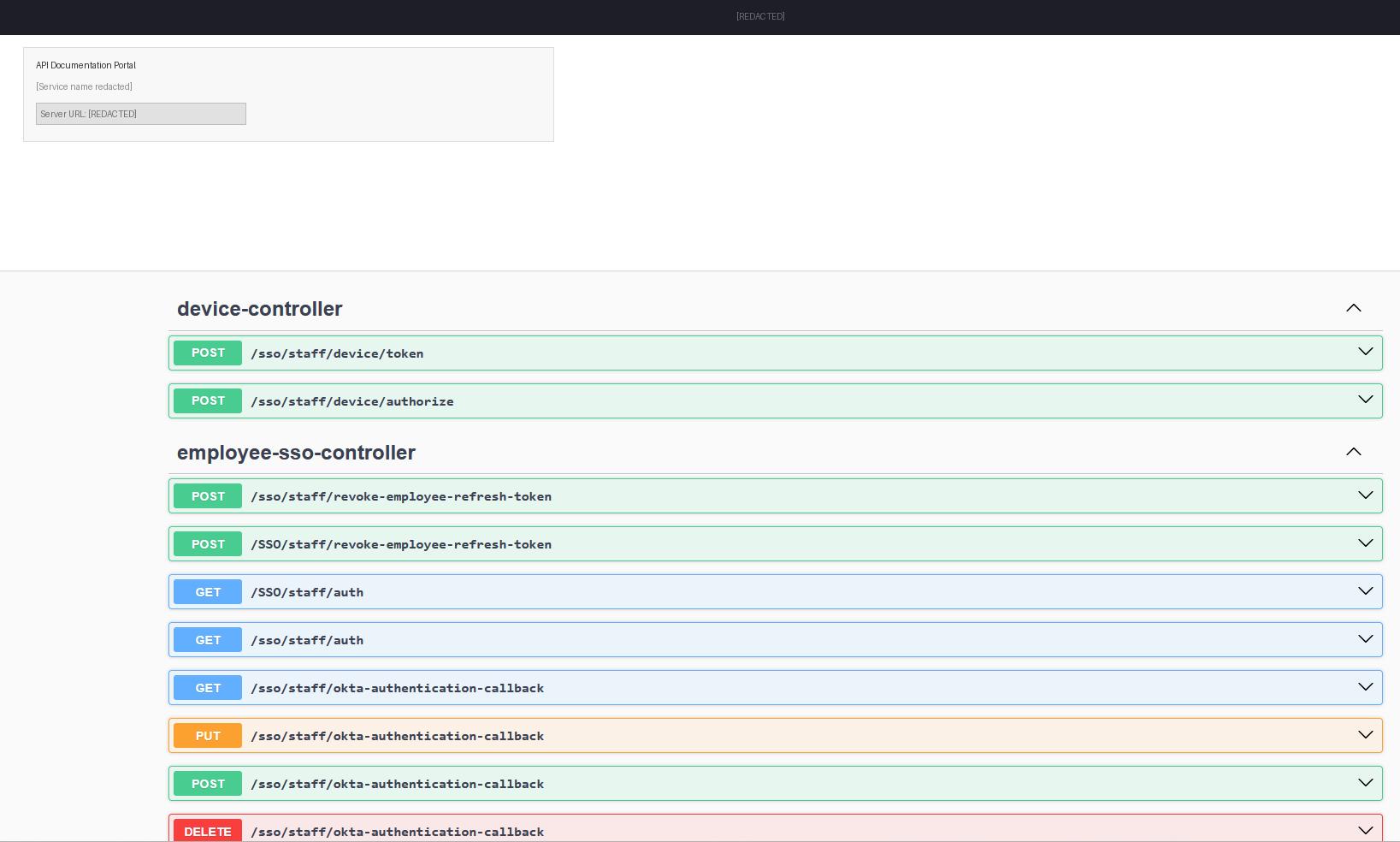
Caption: The complete technical documentation for Booking Holdings' staff login system — publicly accessible with no authentication. Every login flow and its parameters are listed and interactive.
Why This Connects Directly to the Breach
The breach disclosure describes a "targeted" intrusion — deliberate, selective access to reservation data. Targeted attacks at this scale require preparation. The attacker needed to know which internal systems exist, where reservation data lives, and how employee authentication works before they could access booking records selectively rather than blindly. This exposed gateway handed that preparation to anyone who looked.
| What was exposed | How an attacker uses it |
|---|---|
| Full list of internal systems | Identifies exactly which admin panels, data platforms, and operational tools exist inside Booking Holdings — without needing any access to the company itself |
| Complete staff login documentation | Provides the exact technical blueprint for crafting an employee impersonation attack — no guesswork needed on how authentication works |
| Live staff login flow endpoint | The employee device login system is active and responding — a working target for a specific phishing technique that tricks staff into approving an attacker's login session |
| System version and build details | Exact software versions revealed — allows an attacker to identify known security vulnerabilities in the specific versions running before attempting anything |
What Good Security Monitoring Looks Like
Every gap identified in this investigation is detectable, preventable, and addressable — with the right monitoring in place.
Most security assessments focus on what can be directly attacked. Booking's security alarm system was broken in a way that left an entire category of attacks completely invisible. Auditing the monitoring infrastructure itself — the alarm systems, alert pipelines, and detection tools — surfaces these gaps before attackers find them.
Everything found in this investigation was visible using only publicly available information — the data a browser receives when loading a Booking.com page. No hacking, no scanning, no special tools. This type of passive surface mapping reveals what attackers already know about an organisation's infrastructure, before anything is actively exploited.
Verifying that security alerts actually reach the security team — across every possible attack type — is a simple, repeatable test that should run automatically and continuously. If an alert disappears or returns an error, it is a blind spot. This check costs almost nothing to implement and would have caught this flaw the day it appeared.
Internal management dashboards and documentation portals on staff login systems are routinely overlooked in security reviews because they feel like internal tools. When they are internet-facing, they hand attackers everything needed to plan an employee impersonation attack before a single phishing email is sent. These surfaces require the same access controls as any user-facing system.
When a breach is disclosed, the investigation does not stop at the press release. Mapping what the victim's external presence looks like to an attacker, identifying what their security infrastructure looks like from the outside, and correlating with intelligence from threat actor communities provides the full picture that no official advisory ever will.
Disclosure
This research was conducted using publicly visible information — the same data any browser receives when loading a Booking.com page or connecting to a publicly reachable web address. All findings were identified through passive analysis with no unauthorised access to any system.
This writeup is published to raise awareness of two high-impact and underappreciated vulnerability classes: security alert systems that silently fail on entire attack categories, and internal management interfaces left exposed on internet-facing login systems. Both are actively dangerous, present across many organisations, and rarely reviewed during standard security assessments.
Defensive Infrastructure Audit
We test your security alarm systems, alert pipelines, and monitoring infrastructure — the gaps that standard assessments never check.
Attack Surface Intelligence
Passive mapping of your external presence — every web address, exposed service, and piece of infrastructure visible to the public internet.
Identity Infrastructure Review
Staff login gateways and internal management pages reviewed for public exposure — the reconnaissance layer attackers use before any phishing campaign begins.
Dark Web Monitoring
Continuous surveillance of stolen credential markets, threat actor forums, and data leak channels. Know when your organisation is being discussed or targeted — before it becomes an incident.
Breach Context Intelligence
When a breach is disclosed, we investigate — mapping the victim's external exposure, correlating with threat intelligence, and filling the gaps that press releases never address.


