How Scammers Impersonate Legitimate Brokers to Steal Crores
A 63-year-old retired banker lost his life savings. An entire office operated with stolen branding for nine months. Fake Telegram channels promise 2,500% returns in 10 minutes. Here's how investment scammers are weaponizing trusted brand names - and how to protect yourself.
Executive Summary
A retired banker sees a YouTube ad. Looks legitimate - it's for a well-known SEBI-registered stockbroker with 20+ years of history. He joins a WhatsApp group, downloads an app, makes a small investment. The app shows profits. He invests more. Then more. By the time he realizes what's happened, Rs.1.35 crore is gone.
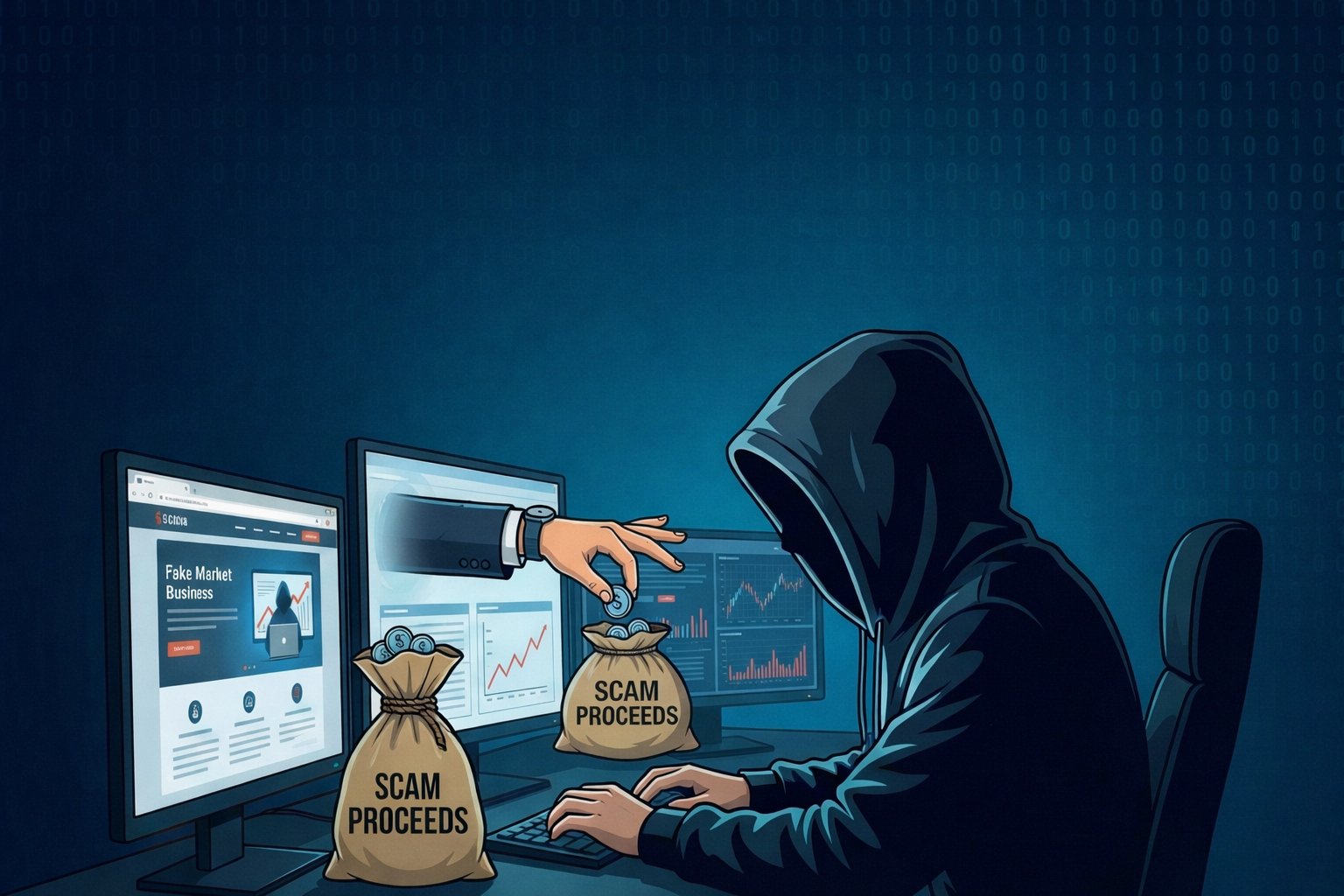
This isn't an isolated case. Scammers are systematically impersonating legitimate brokers across India. Physical offices with stolen branding. Telegram channels with nearly identical usernames. WhatsApp groups promising guaranteed returns. The total damage? Hundreds of crores stolen from investors who thought they were dealing with trusted brokers.
Here's the uncomfortable reality: The legitimate brokers are victims too - their names are being hijacked. But if you can't tell the difference between real and fake, you're the one who loses everything.
How Investment Scams Trap Victims
The step-by-step tactics scammers use to steal your money
The Bait: Social Media Ads
Scammers run targeted ads on Facebook, Instagram, YouTube impersonating legitimate brokers.
"Earn ₹50,000 daily with our expert trading tips!"The Hook: WhatsApp/Telegram
Victims are added to groups with fake "successful traders" sharing profit screenshots.
"Welcome to VIP Trading Group!"The Trap: Fake Trading App
Victims download APK files (not from official app stores) that show fake portfolios.
"Download our exclusive app..."Building Trust: Small Profits
First small investment shows quick "profits" and easy withdrawal to build trust.
"Your ₹5,000 is now ₹8,500!"The Push: Bigger Investment
Scammers pressure for larger amounts with promises of "VIP access" and higher returns.
"Invest ₹5 Lakhs for 300% returns!"The Steal: Withdrawal Blocked
When victim tries to withdraw, scammers demand "taxes", "fees", or "penalties".
"Pay ₹50,000 TDS to release funds" — GONECommon Tactics: Impersonate SEBI brokers • Deepfake celebrity videos • "Limited time" urgency • Fake profit screenshots
By the Numbers
Rs.19,812 crore lost to cyber fraud in India in 2025 alone. That's money from retirement savings, family funds, and hard-earned investments - gone to criminals. (Source: I4C, Ministry of Home Affairs)
77% of all losses are from investment-related fraud. Not phishing. Not card theft. Investment scams are the single biggest threat to Indians' savings. (Source: I4C, Ministry of Home Affairs)
21.77 lakh complaints filed in 2025 - that's approximately 6,000 fraud complaints every single day. This is industrial-scale theft. (Source: National Cyber Crime Reporting Portal)
Rs.52,976 crore lost over six years (2020-2025). And the problem is getting worse - losses in 2025 were nearly triple the 2023 figures. (Source: I4C, Ministry of Home Affairs)
India's Cybercrime Crisis
Official I4C Data | Ministry of Home Affairs
Year-wise Losses (₹ Crore)
Most Affected States
Case Study 1: Jainam Broking Impersonation - Rs.1.35 Crore Lost
December 2025 - Mumbai
Jainam Broking Limited, a SEBI-registered broker (INZ000198735) with 20+ years of history, has been systematically impersonated by scammers. This case follows a playbook that's devastatingly effective.
| Detail | Information |
|---|---|
| Victim | 63-year-old retired banker |
| Location | Mumbai |
| Total Loss | Rs.1.35 crore |
| Entry Point | YouTube advertisement |
How It Happened
Stage 1: The Hook
The victim saw a YouTube advertisement for a well-known broker. It looked professional. It cited real credentials. It promised investment opportunities. He clicked.
Stage 2: The WhatsApp Group
He was added to a WhatsApp group with the broker's name. The group had active discussions, "success stories," and investment tips. It all seemed legitimate.
Stage 3: The Fake App
The group directed him to download an app - not from the Play Store or App Store, but from a direct link. This should have been a red flag. It wasn't.
Stage 4: Building Trust
He invested Rs.80,000. The app showed immediate profits. He withdrew Rs.2.01 lakh - actual money, sent to his bank account. This is the classic scam technique: let victims win early to build trust.
Stage 5: The Escalation
Confident the platform was legitimate, he invested more. "IPOs." "Call options." "Mutual funds." The app showed his portfolio growing - Rs.3.5 crore, then over Rs.10 crore in displayed value.
Stage 6: The Trap Springs
He tried to withdraw Rs.70 lakh. Access blocked. The scammers told him he needed to pay Rs.15 crore for "loan repayment" to unlock his funds.
Think about that: they wanted him to pay more money to access money that never existed. The man retired in 2022. He was specifically targeted because scammers knew he had retirement savings.
Sources: Times of India, Daijiworld
Case Study 2: Jainam Broking Impersonation - Rs.150 Crore Fake Office
November 2024 - August 2025 | Surat, Gujarat
This one is different. This wasn't just a Telegram channel or WhatsApp group. This was a physical office operating with Jainam Broking's stolen branding for nine months.
| Detail | Information |
|---|---|
| Location | Surat, Gujarat |
| Operation Period | November 2024 - August 2025 |
| Estimated Losses | Rs.150+ crore |
| Geographic Spread | Surat, Ahmedabad, Mumbai, Rajkot, Delhi, Jaipur, Ranchi, Kolhapur |
How It Worked
The Setup: Scammers opened an office in Surat with a legitimate broker's hoardings and banners. Promotional materials featured the stolen branding. Local residents referred to it as a branch of that broker.
The Pitch: They offered to let investors trade Rs.50 lakh with just a Rs.5 lakh deposit - 10x leverage. They promised 6-18% monthly returns. They even paid investors a Rs.50,000 monthly "salary."
The Math: 6% monthly returns compound to 101% annually. 18% monthly compounds to 646% annually. No legitimate trading operation delivers these returns. But people believed it because they saw an office, saw familiar branding, received actual payments.
The Collapse: On August 14, 2025, trading terminals froze. Operators vanished. Investors showed up at the office to find it empty. Their money was gone.
Here's what makes this infuriating: a fake office operated for nine months with stolen branding, and nobody - not regulators, not law enforcement - caught it until the scammers decided to cash out.
Sources: Finshots, Business Standard, The420
Case Study 3: Fake Telegram Channels
Still Active - January 2026
These channels are still operating. Right now. With barely any effort to hide what they are.
Scammers create Telegram channels with usernames nearly identical to legitimate brokers - just adding an underscore, hyphen, or slight spelling variation. The difference might be:
-
@brokerresearch (legitimate) vs @broker_research (fake)
-
@stockbroker (legitimate) vs @stock_broker (fake)
What they promise:
-
Rs.20,000 return from Rs.799 investment in 10 minutes
-
Rs.30,000 return from Rs.999 investment in 15 minutes
-
Rs.2,00,000 return from Rs.3,150 investment in 40 minutes
Let's do the math: Rs.799 to Rs.20,000 in 10 minutes is a 2,403% return. Annualized, that's... infinity. It's not real. It cannot be real. Yet people fall for it.
Case Study 4: Zerodha Impersonation - India's Largest Broker Targeted
Ongoing - 2024-2026
Zerodha, India's largest stockbroker with over 7 million clients, has become a prime target for impersonation scams. Scammers are exploiting the trust associated with founder Nithin Kamath's name.
| Detail | Information |
|---|---|
| Brand Impersonated | Zerodha (India's largest broker) |
| Fake Apps Used | VKite, Lumina Max, and others |
| Individual Losses | Rs.50,000 to Rs.2 crore per victim |
| Status | Still Active |
How It Works
The Setup: Victims receive WhatsApp group invitations featuring fake profiles of Zerodha executives - including CEO Nithin Kamath and COO Venu Madhav. The groups promise "exclusive investment opportunities" and "institutional accounts."
The Deception: Fake "Zerodha employees" present investment opportunities with forged documents - including company seals and counterfeit SEBI authorization letters. Victims are directed to download apps like VKite or Lumina Max that mimic the legitimate Zerodha Kite platform.
The Extraction: Apps display fake portfolio growth, phantom earnings, and fabricated IPO allotments. When victims try to withdraw, they're told to pay "service fees" or "taxes" on non-existent profits.
Zerodha has issued multiple public warnings: "We never ask users to join WhatsApp groups or download apps outside of official channels."
Source: Zerodha Official Warning
Case Study 5: IIFL Securities - Rs.18 Crore Fake App Scam
April 2025 - Mumbai
IIFL Securities, one of India's oldest financial services companies, was impersonated through a sophisticated fake app operation.
| Detail | Information |
|---|---|
| Brand Impersonated | IIFL Securities |
| Fake App Name | IIFL Markets |
| WhatsApp Group | K05-IIFL Securities Limited |
| Total Losses | Rs.18+ crore |
| Arrests | 3 suspects arrested |
The gang operated a fraudulent WhatsApp group and counterfeit trading app, luring victims with promises of access to "block trades and IPOs." Case filed on April 22, 2025.
Source: Free Press Journal
Case Study 6: When a Cybercrime Inspector Got Scammed
November - December 2025 | Hyderabad
This case proves that anyone can be a victim - even trained cybercrime professionals.
| Detail | Information |
|---|---|
| Victim | 45-year-old Senior Cybercrime Inspector |
| Location | Rachakonda Commissionerate, Hyderabad |
| Fake App | MAVERICKS Trading App |
| Total Loss | Rs.39.37 lakh |
How Even an Expert Got Fooled
November 24, 2025: The officer was added to a WhatsApp group titled Special Training Program: Deva A Team 13. The group had ~100 members posting fabricated success stories and profit screenshots.
The Trap: Seeing apparent peer validation, he registered on the MAVERICKS Trading App. Initial small investments showed fake profits on the dashboard. He made incremental deposits - Rs.3 lakh, then Rs.5 lakh.
December 16, 2025: He discovered the fraud when the withdrawal function was disabled. Investigators confirmed the profit figures were "entirely fake, generated by backend software with no real market linkage."
If a cybercrime inspector with years of training can fall for these tactics, anyone can. These scammers are professionals.
Source: The420
Case Study 7: Deepfake Videos of Stock Analysts
July 2025 | Mumbai
This case represents the next evolution of investment scams - AI-powered deepfakes.
| Detail | Information |
|---|---|
| Victim Impersonated | Prakash Gaba (73-year-old SEBI-registered analyst) and other stock analysts |
| Method | AI-generated deepfake videos on Facebook/Instagram ads |
| Operation Period | July 1-18, 2025 |
| Arrests | 4 employees of ad-tech firm Valueleaf arrested (October 2025) |
| Syndicate Origin | China-based, operated from Vietnam |
How It Worked
Step 1: Scammers created AI-generated deepfake videos showing well-known Indian stock analysts and business news anchors endorsing fake investment schemes.
Step 2: These deepfakes were run as paid advertisements on Facebook and Instagram - appearing legitimate to users.
Step 3: Clicking ads directed victims to WhatsApp groups operated by overseas scammers, where they were shown fabricated profit screenshots.
Step 4: Victims deposited money, saw fake gains on dashboards, and were blocked when trying to withdraw.
The backend infrastructure was operated from Vietnam, with financial patterns linked to China-based cyber fraud networks using a Hong Kong front company called "First Bridge."
Source: VarIndia
How to Protect Yourself
-
Never trust guaranteed returns: No legitimate broker can guarantee profits. If someone promises fixed returns or unrealistic gains, it's a scam.
-
Never install APK files: Only download apps from official app stores (Google Play Store or Apple App Store). APK files sent via WhatsApp or Telegram are almost always malicious.
-
Verify SEBI registration: Before investing, always verify the broker's SEBI registration at sebi.gov.in/intermediaries.html.
-
Check official websites: Always access brokers through their official websites. Don't click links from WhatsApp groups or Telegram channels.
-
Be wary of WhatsApp/Telegram groups: Legitimate brokers don't conduct business through random WhatsApp groups with "success stories" and investment tips.
-
Watch for urgency tactics: "Limited slots," "Offer expires today," "Join now or miss out" - these are manipulation tactics used by scammers.
-
Never pay to unlock profits: If you're asked to pay "taxes," "fees," or "loan repayments" to withdraw your money, you've been scammed. Stop immediately.
Red Flags - If You See Any of These, Walk Away
-
Guaranteed Returns: No legitimate broker can guarantee returns. Period. If someone promises "10% daily" or "Rs.20,000 from Rs.799 in 10 minutes" - it's a scam. No exceptions.
-
Personal WhatsApp Contact: Real brokers don't conduct business via personal WhatsApp numbers or random Telegram groups.
-
Download Links in Messages: Never download apps from links sent via WhatsApp or Telegram. Only use official app stores. If they can't put their app on the Play Store, ask yourself why.
-
Requests for "Tax" or "Loan Repayment": If you're asked to pay money to "unlock" your profits - you've been scammed. The profits don't exist. The "tax" is just more theft.
-
Too-Good-To-Be-True Returns: If the returns sound impossible, they are. 2,500% in 10 minutes isn't an investment opportunity. It's a robbery.
-
Urgency and FOMO: "Limited slots." "Offer expires today." "Join now or miss out." This is manipulation. Real investment opportunities don't evaporate in 24 hours.
Red Flags: Signs of Investment Scam
If you see ANY of these, STOP and verify with official sources
1. Guaranteed Returns
"100% profit guaranteed" • "Risk-free investment"
2. Pressure Tactics
"Limited time offer!" • "Invest NOW or miss out"
3. Unregistered Platform
APK downloads via WhatsApp • Not on official app stores
4. Personal Accounts
"Transfer to this UPI ID" • Individual bank accounts
5. Withdrawal Issues
"Pay tax to withdraw" • "Processing fee required"
6. Celebrity Endorsements
Deepfake videos • "Recommended by Ambani"
7. Too Good Initial Returns
Investment doubles fast • Easy initial withdrawals
8. WhatsApp/Telegram Only
No official website • "Contact only via group"
VERIFY AT
SEBI Website • NSE/BSE • Helpline 1930
REPORT SCAMS
Dial 1930 • cybercrime.gov.in
The Bigger Picture
Investment fraud is an epidemic in India. Official government data from the Indian Cyber Crime Coordination Centre (I4C) reveals the true scale of this crisis.
Year-by-Year Losses (I4C Official Data)
| Year | Losses | Complaints |
|---|---|---|
| 2025 | Rs.19,812 crore | 21.77 lakh |
| 2024 | Rs.22,849 crore | 19.18 lakh |
| 2023 | Rs.7,463 crore | 13.10 lakh |
| 2022 | Rs.2,290 crore | 6.94 lakh |
| Total (2020-2025) | Rs.52,976 crore | - |
Source: Indian Cyber Crime Coordination Centre (I4C), Ministry of Home Affairs
Most Affected States (2025)
| State | Losses |
|---|---|
| Maharashtra | Rs.3,203 crore |
| Karnataka | Rs.2,413 crore |
| Tamil Nadu | Rs.1,897 crore |
| Uttar Pradesh | Rs.1,443 crore |
| Telangana | Rs.1,372 crore |
These five states account for over 50% of national losses. Source: I4C, Ministry of Home Affairs
Fraud Type Breakdown (2025)
| Fraud Type | Share of Losses |
|---|---|
| Investment/Trading Scams | 77% |
| Digital Arrest Scams | 8% |
| Credit Card Fraud | 7% |
| Sextortion | 4% |
| Other (E-commerce, Malware) | 4% |
Investment scams are the #1 threat - by a massive margin. Source: I4C, Ministry of Home Affairs
Recent Major Busts
| Date | Location | Amount | Details |
|---|---|---|---|
| Dec 27, 2025 | Delhi | Rs.2,200 crore | Delhi Crime Branch arrests fake trading app operators |
| Dec 25, 2025 | Gurugram | Rs.159 crore | Investment fraud bust |
| July 2025 | Surat | Rs.948 crore | Stock market scam; 8 arrested, 2 absconding |
How to Verify Any Broker
-
Step 1: Check SEBI Registration
Visit: sebi.gov.in/intermediaries.html
Search for the broker's name and verify their registration number. -
Step 2: Verify Official Website
Search for the broker on Google. Use only the official website - never links from WhatsApp or Telegram. -
Step 3: Call Official Numbers
Use contact details from the official website only - never from WhatsApp messages or Telegram channels. -
Step 4: Check Exchange Registration
Verify with NSE/BSE if the entity is a registered member. Every legitimate broker has exchange member codes you can verify.
What to Do If You've Been Scammed
1. Report Immediately
-
Cyber Crime Helpline: 1930
-
Online Portal: cybercrime.gov.in
-
SEBI SCORES: scores.sebi.gov.in
2. Preserve Evidence
-
Screenshots of all WhatsApp/Telegram chats
-
Transaction records and bank statements
-
App screenshots showing fake balances
-
Any communication with scammers
3. File FIR
Visit your local police station or cyber cell. Insist on filing an FIR, not just a complaint.
4. Report to Platforms
-
Telegram: Report fake channels at t.me/notoscam
-
YouTube: Report fraudulent ads
-
WhatsApp: Report the numbers
Key Takeaways
| Key Point | Details |
|---|---|
| Brand impersonation is real | Legitimate SEBI-registered brokers are being impersonated - scammers use their trusted names |
| Physical offices can be fake | Scammers set up real offices with stolen branding - seeing a physical office doesn't mean it's legitimate |
| Small differences matter | Fake channels use underscores, hyphens, or spelling variations - always verify through official websites |
| Early withdrawals build trust | Scammers let you win and withdraw early to make you invest bigger amounts later |
| Verify SEBI registration | Always check sebi.gov.in/intermediaries.html before investing with any broker |
| Golden Rule | If someone guarantees returns, it's a scam - no exceptions |
Sources
News Sources
Broker Official Warnings
Official Government Sources
I4C Data Analysis
Disclaimer: This article is intended for public awareness about investment fraud tactics. The case studies referenced are based on publicly reported news. Legitimate brokers whose names have been misused by scammers are victims of brand theft, not perpetrators.