Your Admin Credentials Are on the Dark Web Right Now — Would You Know?
TechOwlMarch 20, 2026
Imagine walking into work on a Monday morning. Every laptop — blank. Every phone — factory reset. Every server — wiped clean. No ransomware note. No malware trace. No warning. Just tens of thousands of devices erased overnight by someone who logged in as your own IT admin. This is not a hypothetical scenario. It happened in March 2026.
Executive Summary
On March 11, 2026, Iran-linked threat group Handala wiped approximately 80,000 enterprise endpoints at a major global medtech company in under three hours — using the organization's own device management platform against them. Zero malware was deployed. The attackers gained access through admin credentials stolen by infostealer malware that had been circulating on dark web markets throughout 2025. After compromising an existing administrator account, they created a new Global Administrator identity and issued mass wipe commands between 05:00 and 08:00 UTC.
Our investigation breaks down this emerging attack pattern — infostealer-to-wiper pipeline via legitimate admin tools — and demonstrates how continuous dark web credential monitoring detects and neutralizes such threats months before government advisories catch up.
In early March 2026, a major global medical technology company with operations spanning 79 countries was hit by a devastating cyberattack. Unlike typical ransomware incidents, no malicious software was deployed. Instead, the attackers leveraged the organization's own enterprise device management tools as the weapon — wiping approximately 80,000 endpoints in under three hours.
Attribution: Handala Threat Group
The Iran-linked threat group tracked as Handala (also known as Handala Hack Team) claimed responsibility for the attack immediately. Threat intelligence researchers assess Handala as a front for Iran's Ministry of Intelligence and Security (MOIS). The group's stated motivations included:
●The targeted organization's 2019 acquisition of an Israeli medical technology firm
●Retaliatory action cited in the context of ongoing Middle East tensions
●Claims of exfiltrating 50 TB of data including design files, hospital records, supplier contracts, and public sector information
Handala's public Telegram statement claiming responsibility for the attack — key figures highlighted. Sensitive identifiers redacted.
Key Finding
This attack was politically motivated, not financially. The threat group did not deploy ransomware or demand payment — the objective was maximum operational disruption through destruction, making it a wiper attack executed through legitimate enterprise tools.
Initial Access: The Infostealer Connection
Following the breach, multiple threat intelligence teams — including our own — uncovered that administrator credentials for the targeted organization had been circulating in dark web infostealer logs throughout much of 2025 — months before the March 11 attack. The credentials were harvested by infostealer malware running on external systems, not within the corporate network itself.
The Critical Gap
These credentials sat in dark web infostealer dumps for months before being weaponized. Continuous dark web monitoring would have detected these exposed credentials at the point of initial compromise — triggering credential rotation and breaking the attack chain before it began.
Attack Chain: Living Off the Land
The the attack is a textbook example of "Living off the Land" (LotL) — abusing legitimate, trusted enterprise tools instead of deploying malware. The entire attack chain relied on identity compromise and administrative misuse of the enterprise device management platform.
STRYKER ATTACK — EXECUTION CHAIN
1
Credential Theft via Infostealer
Infostealer malware on an external system harvests enterprise admin credentials. ~14 credential sets appear in dark web logs throughout 2025 — cloud productivity suite, MDM, and third-party portals.
2
Admin Account Compromise
Attackers purchase or obtain the stolen credentials from dark web marketplaces. They log into the enterprise cloud environment as a legitimate administrator. MFA was either absent, SMS/TOTP-based (bypassable), or not enforced for the compromised account.
3
Privilege Escalation — New Global Admin
A new Global Administrator account is created to ensure persistent elevated access. This provided unrestricted control over the entire enterprise cloud environment, including the device management platform.
4
Mass Device Wipe via the enterprise device management platform
Using the device management platform's native remote wipe command — a legitimate enterprise device management feature — attackers issued mass wipe commands to approximately 80,000 managed endpoints between 05:00 and 08:00 UTC. Laptops, servers, and mobile devices (including employee personal devices enrolled in the corporate network) were erased. No malware signatures, no malicious executables, no payload to detect.
5
Data Exfiltration (Claimed)
Handala claims to have exfiltrated approximately 50 TB of data including design files, enterprise resource planning data, supplier contracts, hospital records, and public sector information. Exfiltration timing relative to the wipe operation is unconfirmed.
Critical Finding
The entire attack was executed using legitimate, trusted enterprise tools. No malware was deployed on the organization's network. No zero-day exploits were used. No custom attack tools were required. The "weapon" was the enterprise device management platform's native wipe functionality — a feature designed to help IT administrators manage corporate devices. EDR, antivirus, and traditional security controls had nothing to flag because every action appeared to come from an authorized administrator.
Pause and ask yourself:
How many admin accounts does your organization have right now?
When was the last time those credentials were checked against dark web dumps?
Would you know if one of them was already for sale?
If you hesitated on any of those — you're not alone. Most organizations can't answer them either. That's exactly the gap this attack exploited.
Operational Impact
The attack caused severe business disruption extending far beyond IT systems:
Impact Area
Details
Global Offices
79 country offices forced offline
Manufacturing
Production lines stopped across multiple facilities
Supply Chain
Electronic ordering systems offline; manual order handling required
Workforce
Employees unable to work for days; personal devices wiped
Shipping
Global shipping and logistics disrupted across 61 countries
Medical Devices
Unaffected — isolated from enterprise IT environment (network segmentation)
What Saved Patient Safety
Notably, network segmentation ensured that patient-facing medical devices and connected products operated on isolated networks separate from the enterprise cloud environment. This architectural decision — made well before the attack — is the sole reason the incident did not escalate into a patient safety crisis. It is a textbook example of why defense-in-depth and segmentation remain foundational security principles.
Why Layered Security Is Non-Negotiable
Identity-based attacks like this one demonstrate why no single security control is sufficient on its own. Each layer plays a critical role — but only when they work together as a coordinated defense. Here's how each layer contributes when properly configured for identity threats:
Security Layer
Role in Identity-Based Attacks
Key Requirement
Dark Web Monitoring
Detects exposed credentials circulating on the dark web — enabling rotation before attackers can use them
Continuous scanning of infostealer logs and dark web markets
SOC / SIEM
Real-time detection of suspicious admin behavior — unusual logins, privilege escalation, mass device actions
Identity-focused correlation rules and 24/7 monitoring
EDR / Endpoint Protection
Detects infostealer malware on endpoints before credentials are harvested — stopping the attack at its origin
Behavioral detection tuned for credential theft patterns
Anti-Phishing
Prevents the initial delivery vector — phishing emails and fraudulent sites that distribute infostealer payloads
Proactive takedown of phishing infrastructure
MFA / Access Controls
Renders stolen credentials useless — even if credentials are exposed, strong MFA prevents unauthorized login
Phishing-resistant authentication (FIDO2) for admin accounts
Each layer in a well-integrated security stack serves a distinct purpose — from preventing infostealer delivery, to detecting exposed credentials, to catching suspicious admin behavior in real time. No single layer is the "silver bullet." The strength lies in coverage across the entire attack lifecycle, so that if one layer is bypassed, others catch the threat.
Where Continuous Monitoring Makes the Difference
Attacks like this follow a predictable lifecycle — from initial credential exposure to full-scale disruption. The key question is: at which stage does your security stack detect the threat? The earlier the detection, the lower the impact.
ATTACK LIFECYCLE — DETECTION OPPORTUNITIES AT EVERY STAGE
✓
Months Before the Attack
Stolen credentials surface on dark web
Enterprise admin credentials harvested by infostealer malware appear in dark web marketplaces and underground forums — months before any attacker acts on them.
DARK WEB MONITORING — CREDENTIALS DETECTED & ROTATED — ATTACK PREVENTED
✓
Weeks Before the Attack
Phishing campaigns deliver infostealer payloads
Infostealers are typically distributed through phishing emails and fraudulent websites. Detecting and taking down these delivery channels stops credential theft at the source.
ANTI-PHISHING & MAIL HEALTH MONITORING — DELIVERY VECTOR BLOCKED
✓
Ongoing
Misconfigurations leave critical gaps
Missing multi-admin approval, weak MFA on admin accounts, and exposed management portals create the conditions that make identity-based attacks possible.
Attacker authenticates from an unfamiliar location at unusual hours. A new Global Administrator account is created. Bulk device management commands are issued. Each of these actions generates detectable signals.
SOC — ANOMALOUS BEHAVIOR DETECTED & ESCALATED
✓
Post-Incident
Stolen data surfaces, brand impersonation begins
Following a major breach, stolen data often surfaces on dark web forums. Threat actors may impersonate the brand, launch follow-up phishing campaigns, or spread misinformation.
BRAND MONITORING & DIGITAL RISK — DATA LEAKS TRACKED & MITIGATED
The Key Insight
What makes a security stack truly effective is having detection capability at every stage of the attack lifecycle — from blocking phishing campaigns that deliver infostealers, to monitoring the dark web for exposed credentials, to detecting anomalous admin activity in real time, to tracking data leaks post-breach. If one layer is bypassed, the next one catches it. That's the difference between a breach headline and a prevented incident.
How Continuous Monitoring Prevents This Attack
This breach was not a failure of technology — it was a failure of visibility. The signals were there — sitting in dark web infostealer logs for months. No one was watching.
Detection Capabilities That Matter
●Dark Web Credential Monitoring — Continuous scanning of dark, deep, and surface web for exposed credentials. Would have detected exposed admin credentials months before the attack, triggering immediate rotation.
●Attack Surface Monitoring — 360-degree visibility into digital infrastructure. Would have identified misconfigurations such as missing multi-admin approval on the device management platform and inadequate MFA enforcement on admin accounts.
●Anti-Phishing & Anti-Rogue Protection — Detects and takes down fraudulent websites and phishing campaigns targeting employees — often the initial vector through which infostealer malware is delivered.
●SOC with Identity-Based Playbooks — 24/7 monitoring for unusual login behavior, privilege escalation, and administrative misuse. A new Global Admin created at 04:00 UTC would trigger immediate investigation.
●Brand Monitoring — Continuous oversight of brand's digital presence. Post-incident, tracks impersonation attempts, misinformation campaigns, and leaked data surfacing on dark web forums.
●Mail Health Monitoring — Proactive monitoring of email infrastructure integrity (SPF, DKIM, DMARC). Ensures email channels cannot be exploited for credential phishing that leads to infostealer infections.
Mitigation and Hardening Guidance
Immediate Actions for All Organizations
Identity & Access Hardening
☐Enforce phishing-resistant MFA on all admin accounts — FIDO2 security keys or platform-native biometric authentication. SMS and TOTP-based MFA are insufficient for Global Admin roles.
☐Enable Multi-Admin Approval for the device management platform — Require a second authorized administrator to review and approve destructive actions such as device wipes and RBAC changes.
☐Implement Just-In-Time admin access — Eliminate standing Global Administrator accounts. Use Privileged Identity Management (PIM) to grant admin roles on-demand with time limits.
☐Deploy Conditional Access policies — Restrict admin actions to trusted networks and compliant devices. Require device compliance for the device management platform portal access.
☐Use Privileged Access Workstations (PAWs) — High-privilege administrative actions should only be performed from dedicated, hardened devices not used for general browsing or email.
☐Audit and rotate all admin credentials — Immediately verify that no admin credentials appear in known infostealer log databases. Rotate any that do.
Continuous Monitoring Requirements
Ongoing Detection
☐Deploy dark web credential monitoring — Continuous scanning for exposed organizational credentials across infostealer logs, paste sites, and dark web marketplaces.
☐Alert on new Global Admin creation — Any new admin account creation should trigger immediate SOC investigation, especially outside business hours.
☐Monitor mass device management actions — Implement anomaly detection for bulk the device management platform commands. 80,000 wipe requests in 3 hours should trigger automated kill switches.
☐Track impossible travel and anomalous login patterns — Detect admin logins from unusual locations, IPs, or time zones that deviate from established baseline behavior.
MITRE ATT&CK Mapping
Technique
Name
Implementation in This Attack
T1078.004
Valid Accounts: Cloud Accounts
Stolen cloud productivity suite admin credentials used for initial access
New Global Administrator account created for persistent access
T1538
Cloud Service Dashboard
the device management platform admin console used to issue mass wipe commands
T1485
Data Destruction
80,000 endpoint wipes via the device management platform native functionality
T1199
Trusted Relationship
Abuse of trusted the enterprise device management platform management platform
T1528
Steal Application Access Token
Infostealer-harvested cloud admin tokens from dark web
T1531
Account Access Removal
Device wipes effectively removed employee access to corporate systems
This Is Not an Isolated Incident. This Is the New Normal.
This attack is not a one-off. It signals a fundamental shift in the threat landscape. Attackers are increasingly "logging in, not breaking in" — using stolen credentials and legitimate tools to bypass every layer of traditional security.
Consider what this means: your organization's biggest threat is no longer a sophisticated exploit or a novel piece of malware. It's an admin credential sitting in a dark web marketplace right now, waiting to be purchased by the next threat actor with a political agenda, a financial motive, or simply something to prove.
The credentials that enabled this attack were available for months. Nobody was looking. By the time government advisories were issued, tens of thousands of devices were already gone. The production lines had already stopped. The supply chain had already broken. The damage was already done.
Here's the uncomfortable truth most organizations don't want to face:
Right now, at this very moment, there are infostealer logs being traded on dark web forums. Some of those logs contain enterprise admin credentials. Some of those credentials belong to organizations that have no idea they've been compromised. Some of those organizations could be yours.
The question is not if credentials get stolen — infostealers are one of the most prolific malware categories in existence. The question is: when they do, will anyone be watching?
So What Would It Look Like If Someone Was Watching?
Let's rewind this attack — but this time, with continuous monitoring in place. Same threat actor. Same stolen credentials. Same intent. Different outcome.
TechOwl SHIELD platform — continuous attack surface monitoring with free
tools including dark web exposure checks, DMARC reports, threat
monitoring, and network security scanning.
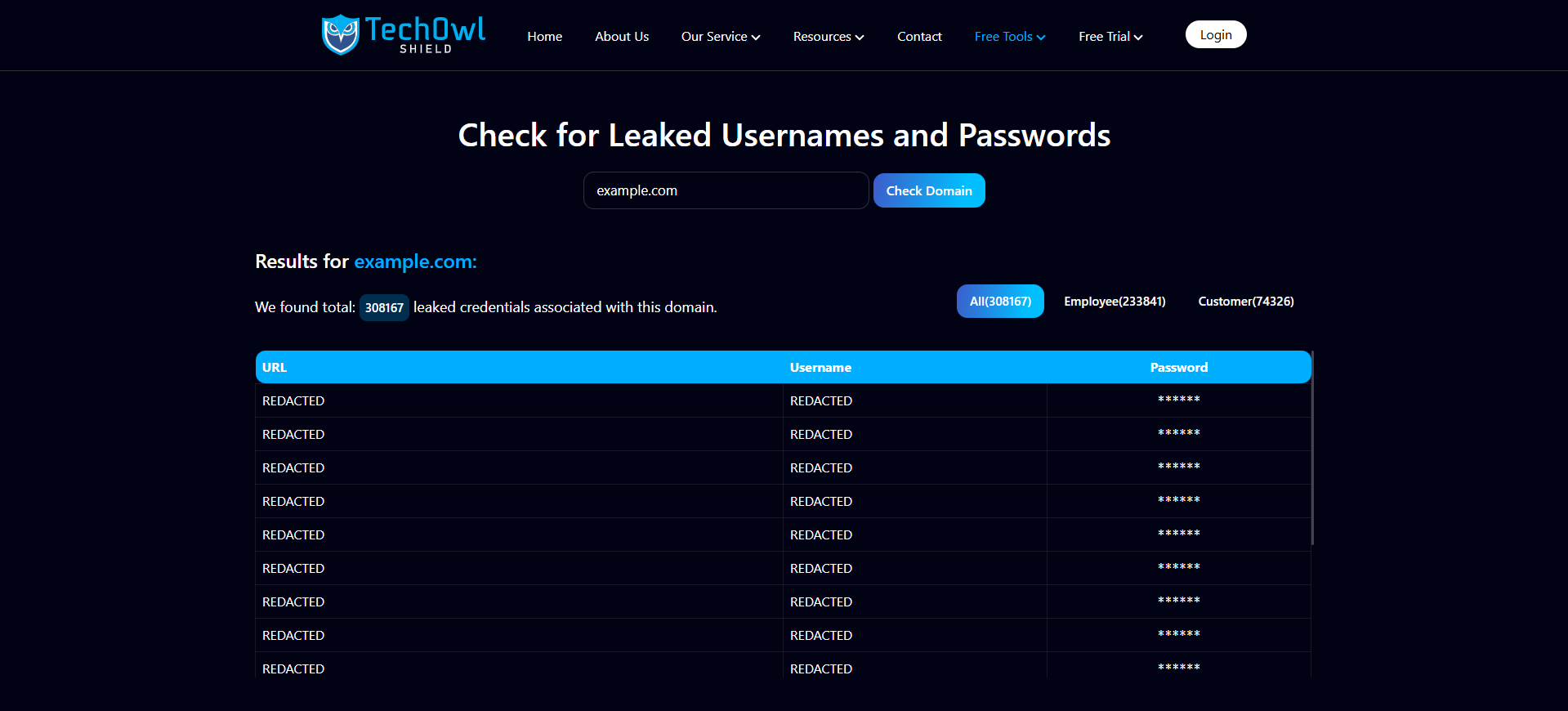
Dark web credential monitoring in action — leaked usernames and
passwords detected and flagged for immediate rotation. Sensitive data
redacted.
THE SAME ATTACK — WITH CONTINUOUS MONITORING
✓
Phishing email carrying infostealer lands in employee inbox
Our anti-phishing engine has already flagged the sender domain as suspicious. Mail health monitoring confirms the email fails authentication checks. The phishing site is taken down. The infostealer is never delivered.
Result: Credential theft never happens.
✓
But let's say the infostealer gets through. Credentials are stolen.
Within days of the credentials appearing in dark web dumps, our dark web monitoring picks them up. The security team is alerted. Passwords are rotated. Tokens are invalidated. The stolen credentials become worthless.
Result: Attacker has dead credentials. No access.
✓
But let's say dark web monitoring missed it too. Attacker logs in.
Our SOC detects the anomaly: admin login from an unrecognized location at an unusual hour. The session is flagged for investigation. When a new Global Admin account is created minutes later, an escalation alert fires immediately. The rogue account is disabled before any damage is done.
Result: Attacker is locked out. Zero devices wiped.
✓
Meanwhile, attack surface monitoring has been working in the background all along.
Our attack surface monitoring had already flagged that the device management platform lacked multi-admin approval for destructive actions. That misconfiguration would have been remediated before any attacker could exploit it.
Result: Even if everything else failed, the wipe command would need a second approval — which the attacker doesn't have.
Four layers. Four chances to stop the attack. Any one of them is enough.
This is not a theoretical exercise. This is exactly how our clients are protected, every day, against exactly this class of threat — while organizations without continuous monitoring are left reading about breaches in the news and hoping they're not next.
Don't Wait for the Advisory
Government advisories are valuable — but they are inherently reactive. They arrive after the breach, after the damage, after the headlines. By then, you're not preventing an incident — you're managing a crisis.
Our continuous monitoring capabilities — dark web scanning, anti-phishing, attack surface visibility, SOC detection, brand monitoring, and mail health — work together across the entire attack lifecycle. So your organization isn't waiting for someone else to tell you that you've been compromised. Because by the time they do, it's already too late.