

Mustang Panda Deploys Updated CoolClient Backdoor with Infostealer Capabilities
Executive Summary
In January 2026, security researchers identified an updated variant of the CoolClient backdoor deployed by the threat actor tracked as Mustang Panda (also known as HoneyMyte and Bronze President). This campaign targets government entities in Myanmar, Mongolia, Malaysia, Russia, and Pakistan with new capabilities including clipboard monitoring, browser credential theft, and cloud service abuse for command-and-control.
Key Findings
- New clipboard monitoring via
GetClipboardDataandGetWindowTextWWindows APIs - Three browser credential stealer variants targeting Chrome, Edge, and Chromium browsers
- HTTP proxy credential sniffing through raw packet inspection
- Cloud C2/exfiltration using hardcoded Google Drive and Pixeldrain API tokens
- DLL side-loading via legitimate signed software
Threat Actor Profile
This threat actor is tracked under multiple aliases across the security industry:
- Mustang Panda
- HoneyMyte
- Bronze President
- Earth Preta
- RedDelta
- TA416
Mustang Panda is an espionage-focused threat actor known for targeting government entities. The group has been observed deploying tools including PlugX, ToneShell, and CoolClient.
Targets
The January 2026 campaign targets government entities in:
- Myanmar
- Mongolia
- Malaysia
- Russia
- Pakistan
Delivery Method
CoolClient is delivered via DLL side-loading, abusing legitimate signed software. Previous campaigns have abused binaries from various software vendors including security products and media players.
Technical Analysis
Infection Chain

Overview of CoolClient execution flow
CoolClient Capabilities
New Features (January 2026)
Clipboard Stealing Mechanism
The clipboard monitoring feature captures:
- Clipboard contents (passwords, sensitive data)
- Active window title (context)
- Process ID
- Timestamp
Captured data is obfuscated using single-byte XOR (key: 0xAC) and written to:
C:\ProgramData\AppxProvisioning.xml
Browser Credential Stealers
Target paths:
Chrome: %LOCALAPPDATA%\Google\Chrome\User Data\Default\Login Data
Edge:   %LOCALAPPDATA%\Microsoft\Edge\User Data\Default\Login Data
DLL Side-Loading Technique
DLL side-loading exploits the Windows DLL search order mechanism. When a legitimate application loads, Windows searches for required DLLs in a specific order. Attackers place a malicious DLL with the same name as an expected DLL in a location that gets searched first.
How It Works
Windows DLL Search Order
1. Directory containing the executable (EXPLOITED)
2. System directory (C:\Windows\System32)
3. 16-bit system directory (C:\Windows\System)
4. Windows directory (C:\Windows)
5. Current working directory
6. Directories listed in PATH environment variable
The malware exploits position #1 in the search order by placing the malicious DLL alongside the legitimate executable.
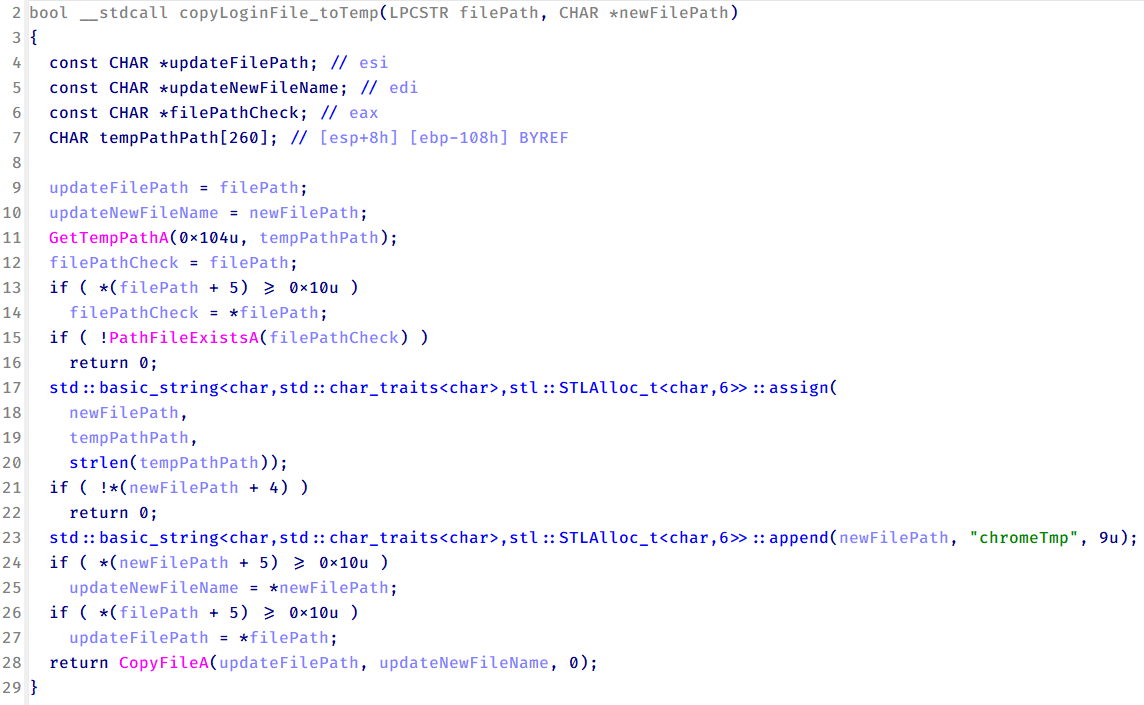
Function that copies Chrome browser login data into a temporary file (chromeTmp) for exfiltration
Why This Technique Is Effective
- Trusted Process: Malicious code executes within the context of a signed, legitimate process
- Bypasses Application Whitelisting: The executable itself is trusted
- Evades Detection: Security tools may not inspect DLLs loaded by trusted apps
- No Exploitation Required: Uses normal Windows behavior, not a vulnerability
Plugins
Command & Control Infrastructure
Domains
account.hamsterxnxx[.]com
popnike-share[.]com
japan.Lenovoappstore[.]com
IP Addresses
113.23.212[.]15   - FTP exfiltration server
45.144.165[.]65   - Malware distribution
Protocol
CoolClient uses TCP as the default C2 protocol (port 443), with UDP as an alternative option.
Cloud Service Abuse
This campaign abuses legitimate cloud services for C2 and exfiltration using hardcoded API tokens:
- Google Drive
- Pixeldrain
Indicators of Compromise
File Hashes (MD5)
CoolClient Core
F518D8E5FE70D9090F6280C68A95998F  libngs.dll
1A61564841BBBB8E7774CBBEB3C68D5D  loader.dat
AEB25C9A286EE4C25CA55B72A42EFA2C  main.dat
6B7300A8B3F4AAC40EEECFD7BC47EE7C  time.dat
Plugins
7AA53BA3E3F8B0453FFCFBA06347AB34  ServiceMgrS.dll
A1CD59F769E9E5F6A040429847CA6EAE  FileMgrS.dll
1BC5329969E6BF8EF2E9E49AAB003F0B  RemoteShellS.dll
Browser Stealers
1A5A9C013CE1B65ABC75D809A25D36A7  Chrome Stealer
E1B7EF0F3AC0A0A64F86E220F362B149  Edge Stealer
DA6F89F15094FD3F74BA186954BE6B05  Chromium Stealer
Scripts
C19BD9E6F649DF1DF385DEEF94E0E8C4  1.bat
838B591722512368F81298C313E37412  Ttraazcs32.ps1
A4D7147F0B1CA737BFC133349841AABA  t.ps1
Network Indicators
account.hamsterxnxx[.]com
popnike-share[.]com
japan.Lenovoappstore[.]com
113.23.212[.]15
45.144.165[.]65
File System Artifacts
C:\ProgramData\AppxProvisioning.xml
Persistence Indicators
Scheduled Task: ComboxResetTask
Service Name: media_updaten
MITRE ATT&CK Mapping
Detection Opportunities
Endpoint Detection
API Monitoring:
User32.dll!OpenClipboard
User32.dll!GetClipboardData
User32.dll!CloseClipboard
User32.dll!GetWindowTextW
File System:
- Monitor creation of
C:\ProgramData\AppxProvisioning.xml - Watch for access to browser
Login Datafiles from non-browser processes
Process Behavior:
Sang.exeexecuting from unusual locations- Processes loading
libngs.dllfrom non-standard paths
Network Detection
- DNS queries to listed C2 domains
- Unusual traffic to Google Drive or Pixeldrain APIs
- FTP connections to
113.23.212[.]15
- MITRE ATT&CK Framework - https://attack.mitre.org/
- Microsoft Windows API Documentation - https://learn.microsoft.com/en-us/windows/win32/api/
Conclusion
HoneyMyte remains a persistent threat, actively deploying an evolved arsenal featuring the enhanced CoolClient backdoor, browser credential stealers, and document exfiltration scripts.
Beyond basic espionage like file theft and persistence, these tools enable advanced user surveillance through keylogging, clipboard capture, proxy credential sniffing, browser data harvesting, and bulk file operations—signaling a clear pivot to real-time activity monitoring.
Organizations must heighten defenses against HoneyMyte's toolkit, including CoolClient and affiliates like PlugX, ToneShell, Qreverse, and LuminousMoth, as part of a broader strategy for long-term system access and intelligence gathering.


