
Linux backdoors were found on email security gateways in South Korea and Taiwan, named and packaged to look like the software already running on them. In Korea that was the SpamSniper anti-spam suite; in Taiwan, ShareTech appliances.
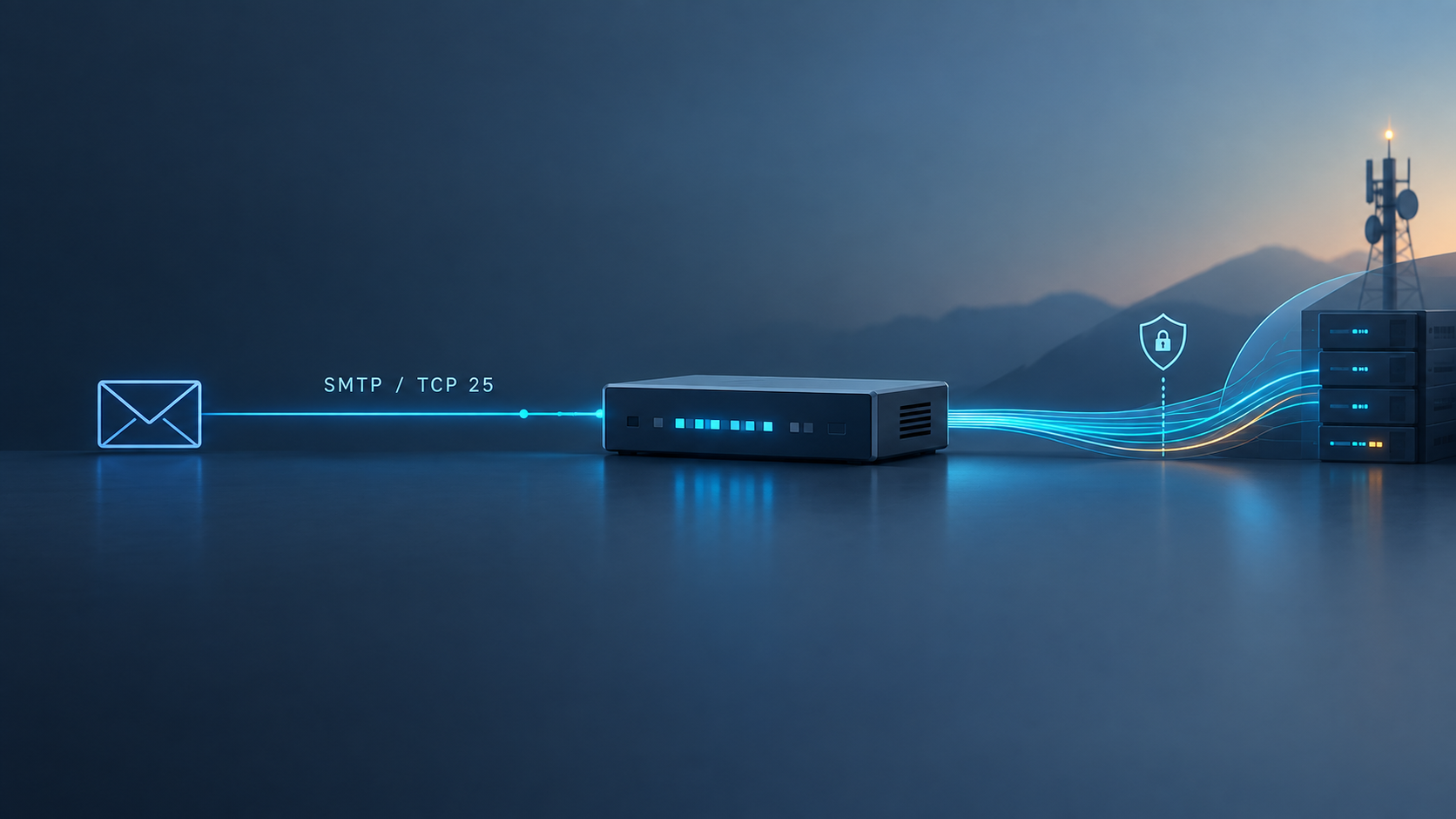
A new implant, AVERAT, talks to its operators over SMTP on port 25, so its traffic looks like ordinary mail. It deletes its own files after starting, and its traffic was routed through hijacked NAS units and CCTV recorders in Taiwan.
There is no patch to apply, and nobody yet knows how the attackers got in. Finding these implants means hunting for them, mainly for processes running from deleted files and for anything other than the mail service talking on port 25.
What happened
New research describes three Linux implants found on mail security and network appliances: a new variant of the passive backdoor BPFDoor, a packet-filtering build of the Rekoobe backdoor, and AVERAT, a modular remote access tool not reported before.
What ties them together is where they were placed. Mail security gateways send and receive email all day, are trusted by the rest of the network, and are rarely inspected closely. Extra mail traffic from a mail gateway gives a defender very little to notice.
Campaign at a glance
| Attribute | Detail |
|---|---|
| Targets | SpamSniper mail gateways in South Korea, ShareTech appliances in Taiwan, telecom-style Linux hosts |
| Associated cluster | BPFDoor is associated with Red Menshen (also Earth Bluecrow, DecisiveArchitect, Red Dev 18), China-nexus, active against telecoms since at least 2021 |
| Initial access | Not established |
| Command and control | SMTP on TCP 25, via compromised consumer and small-business devices in Taiwan |
| Remediation path | Hunting and monitoring; no patchable flaw implicated |
Why target email security gateways?
Most security monitoring looks for unusual behaviour. An email gateway opening mail connections to servers around the internet is normal, so a backdoor that hides its traffic inside those connections is hard to pick out in network logs.
Firewall rules add to the problem. Mail relays are often allowed traffic from port 25 to port 25, and a crafted packet that fits that rule can reach the device before deeper inspection. One of the implants listens for packets of that shape.
This has happened before. In 2023, a different China-nexus group exploited CVE-2023-2868 and later CVE-2023-7102 in Barracuda's Email Security Gateway and kept long-term access to victims. Mail appliances handle sensitive traffic, and most of them cannot run endpoint security agents.
BPFDoor on Korean mail gateways
BPFDoor uses Berkeley Packet Filter, a standard Linux feature for inspecting traffic, to read incoming
packets. It does not open a listening port, so a port scan will not find it. It acts only when it receives a
specific "magic" packet, in this case one carrying the values 0x6693 (UDP), 0x4274 (TCP) and 0x7820 (ICMP).
The Korean variant's hidden strings decode to /var/run/spamsniper.pid, a file named after the
SpamSniper product, and to a list of ten process names it rotates through, such as /usr/sbin/chronyd,
/usr/sbin/rsyslogd -n and [watchdogd].
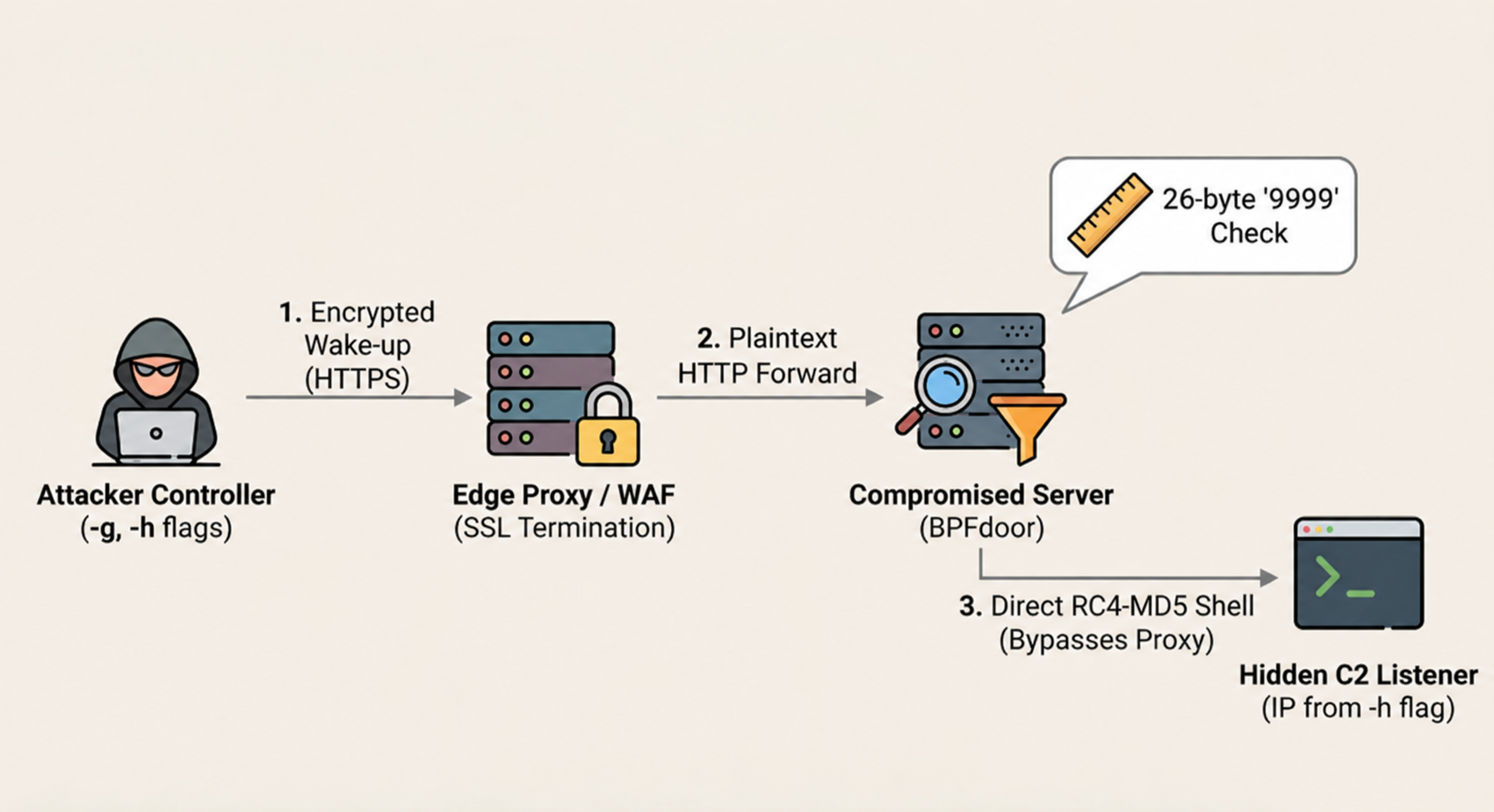
How the wake-up signal gets through the proxy
The updated controller can send its trigger inside a normal HTTPS request
- Encrypted wake-up The operator sends a normal-looking HTTPS request towards the target's web-facing edge. HTTPS
- The proxy decrypts it An edge proxy or web application firewall terminates TLS and forwards the request inward as plain HTTP. SSL offloading
- The backdoor sees the trigger BPFDoor, reading traffic on the internal server, recognises the trigger in the decrypted request. BPF filter match
- Direct shell back The implant opens a connection back to the operator that does not pass through the proxy. reverse shell
Another sample names itself ora_ppmond, which resembles the Oracle database background processes
used on telecom subscriber platforms. A fourth uses paths under /sniper/, the Korean mail product's
install directory. Both give the operator a Tiny Shell session with a command shell, upload and download.
A disguise that only reads as legitimate on hosts actually running that class of infrastructure.
Primary research report, on theora_ppmondprocess name
A Rekoobe build that listens on port 25
Rekoobe is a long-standing Linux backdoor derived from Tiny Shell. This build adds a 26-instruction packet filter that watches TCP, UDP and SCTP over IPv4, and UDP over IPv6, where both the source and destination port are 25, the same pattern the mail-relay firewall rule allows. Its process names copy those of the mail product's own components:
/sniper/bin/crond -nand/sniper/bin/earsd --start/sniper/apache/bin/httpd -k startand/sniper/snipe/bin/snipe-smtpd/usr/lib/polkit-1/polkitd --no-debug, a standard Linux process name
The reverse shell runs as /sniper/autorun/rblsmtpd --start -n 9, the name of a real mail-filtering
daemon, and connects to the operator on port 25. It sets HISTFILE=/dev/null and related
variables so the operator's commands are not saved in shell or editor history.
The ShareTech dropper
On Taiwanese appliances, the installer is a small x86-64 program with no networking code. It is a local
installer, run after the attacker already had access. It sits in /addpkg/sbin/, the appliance's
own add-on package directory, and decrypts its payload with an AES key taken from the SHA-1 hash of the
string "ShareTech", the vendor's name.
Install chain on a ShareTech appliance
From gate check to boot persistence
- Gate check The dropper runs only if a marker file already exists, a precondition set by the operator. /tmp/flag
-
Write the script
A shell script is written to the appliance's storage volume, despite its
.phpextension. /HDD/ms6x2xTo64/updIptable.php -
Copy, run, delete
The dropper and AVERAT are copied into
/sbinunder system-tool names, started, and deleted ten seconds later. /sbin/ntpdate · /sbin/udevds - Watchdog The relaunched dropper recreates its marker file and script every two seconds if either disappears. execProcEnd
- Survive reboot There is no persistence code. The firmware likely relaunches add-on packages at boot. /addpkg/sbin/
/sbin afterwards turns up nothing to hash or submit.AVERAT, the new implant
AVERAT connects out to port 25 and starts like a mail client: it sends EHLO, requests
STARTTLS, then switches to its own encrypted session. The TLS layer is hand-built around a fixed
ClientHello template with a 40-entry cipher list, so every connection should present the same TLS fingerprint.
That is our inference from the design; it has not been confirmed on live traffic.
The implant checks in every 600 to 699 seconds, reporting hostname, user, operating system, network interfaces
and logged-in users. Its only disk artefact is a small hidden state file, /var/lib/.db by default.
- Files: browse, upload, download with resume, and recursive deletion.
- Processes: list with command lines, and terminate.
- Shells: up to ten simultaneous interactive sessions.
- Network: proxy and port-forward channels through the appliance, and runtime changes to its C2 address.
- Extension: load and unload modules at runtime, and reboot the device.
If it receives a command it does not recognise, it shuts itself down, so probing a live implant ends the session. Six samples were analysed. Their configurations fall into two builds, and all six use the same authentication keys, which makes them good material for detection signatures.
The relay devices
The three hardcoded C2 addresses belong to compromised third-party devices on a large Taiwanese broadband network (AS3462), in three different cities: a Synology NAS belonging to a small business, an obsolete ADSL/FTTH business appliance, and a Dahua CCTV recorder. All three are old or unpatched, and probably nobody is watching them.
Each one also runs a PPTP VPN service on port 1723, and all three return the same banner byte for byte. CCTV recorders do not come with a VPN server, so the operator probably installed it. If so, each device works as a relay for implant traffic and also as a way into its owner's local network.
CISA, NCSC-UK and partner agencies described this kind of device in joint advisory AA26-113A (April 2026) as typical of China-nexus covert relay networks, also called operational relay box (ORB) networks. These relays have not been linked to any specific named ORB network.
What we observed on 7 October
We looked up the published domains in public WHOIS, DNS, certificate transparency and scan data. We did not connect to any of the infrastructure.
| C2 hostname | Parent registered | Subdomain first seen | Resolves to (7 Oct) |
|---|---|---|---|
spam.suwaccqi[.]com |
Apr 2024 | 23 Dec 2025 | AS2828, United States |
mx.zxopfds[.]com |
Feb 2025 | 21 Dec 2025 | AS4134, China |
mx1.wwstifsteel[.]com |
Dec 2024 | 5 Oct 2026 | AS702, Germany |
What we found. All three domains were registered at the same registrar, and each has a mail-style subdomain. Two of those subdomains were first seen two days apart, eight to twenty months after the parent domains were registered. All three now resolve to addresses that were not in the original research. None of those addresses has reverse DNS or other domains hosted on it, and none has been seen scanning the internet.
The domains were likely left unused on purpose so they would not be caught by filters for newly registered domains (moderate confidence).
The late-December dates likely show when these C2 servers were switched on (low confidence, based on two data points).
The new addresses are roughly as likely to be new relays as reassigned addresses. Two are in business IP ranges, which fits the relay pattern without proving it (low confidence).
Attribution
BPFDoor and its variants are associated with Red Menshen, a China-nexus group that has targeted telecom providers in the Middle East and Asia since at least 2021. The Korean-language disguises, the telecom-platform process names and the Taiwanese relays are consistent with what is known about that group.
Other explanations are possible. BPFDoor source code has been public since 2022, and other China-nexus groups, including Liminal Panda, UNC3886 and Velvet Ant, also use Tiny Shell. Using the same tools does not make two groups the same group. Red Menshen is a reasonable attribution, but it is based on the malware and the targets, not on infrastructure unique to that group.
Indicators of compromise
Network indicators are defanged. The IP addresses below belong to compromised third-party devices.
| Indicator | Type | Context |
|---|---|---|
mx.zxopfds[.]com |
Domain | AVERAT C2, TCP 25 |
spam.suwaccqi[.]com |
Domain | AVERAT C2, TCP 25 |
mx1.wwstifsteel[.]com |
Domain | AVERAT C2, TCP 25 |
59.125.211[.]65 |
IPv4 | C2 relay, compromised NAS |
122.116.138[.]33 |
IPv4 | C2 relay, compromised SMB appliance |
1.34.200[.]85 |
IPv4 | C2 relay, compromised CCTV recorder |
/var/run/spamsniper.pid |
Path | BPFDoor product-spoofing artefact |
/var/lib/.db, .sencha, .us, .a |
Path | AVERAT state files |
/HDD/ms6x2xTo64/updIptable.php |
Path | ShareTech dropper script |
/addpkg/sbin/update, /addpkg/sbin/agetty |
Path | Dropper and AVERAT staging |
ora_ppmond, /sniper/autorun/rblsmtpd |
Process name | BPFDoor and Rekoobe disguises |
Current resolutions observed by TechOwl
Seen on 7 October 2026. These have not been confirmed as malicious; we suggest monitoring them rather than blocking.
| Indicator | Type | Context |
|---|---|---|
118.250.171[.]118 |
IPv4 | A record of mx.zxopfds[.]com, AS4134 |
216.105.6[.]40 |
IPv4 | A record of spam.suwaccqi[.]com, AS2828 |
195.126.224[.]88 |
IPv4 | A record of mx1.wwstifsteel[.]com, AS702 |
SHA-256 hashes
| Hash | Context |
|---|---|
2bedc26d4b29b435c21962beed7db21188a0219a0d28334bba8b4fb1656d7b15 |
ShareTech dropper |
bf8135f46ecedfe5bd06fcecbb2e721c2367ff765b18f4aa3f868e6597f49e47 |
AVERAT |
4925bcca085ec504f51191645da278d8e96698d91f3c6df44146336c697b4de8 |
AVERAT |
a4379e115d3c4420f5d4b92561022d6e0897990e7297be65c033d47de68e6a6a |
AVERAT |
925c041807d4fb9dfe2ad84f963c2a4c60ea1289f6a0bdccbfb944478ffc2cf2 |
AVERAT |
2fe2dd402ee6f9c578fce6dd4b36daaa407e99133e5dd502f2afca80feb60150 |
AVERAT |
a65048eb30661e27f8edc2dd8d8c77ec87faec1f1750f6e04e7ecaf069a32858 |
AVERAT |
a37ea9897221d4495b538de72b74f2aa1d2ff09b7b6dcedd395aee58931adbf3 |
BPFDoor, SpamSniper disguise |
7e667ba5f9df912e02275d3cfe3809d16f822fe776f4035c84b118ebd925b1b5 |
BPFDoor, SpamSniper disguise |
4435fcd6862921092614dbeaa880e4192352984686ebcd98f0ba13ee8e226ef9 |
BPFDoor, data-plane variant |
a6f3b7f932761fb1fd5e74123f2482e36c65dd13e769af2ce08c65da195bfa7a |
BPFDoor, data-plane variant |
652508a9cf40bee883dc0e5e219dfeba71fe7dac591d01c89f74c21f73b4963f |
BPF Rekoobe |
Detection and response
Because the files delete themselves after launch, scanning the appliance's disk is unlikely to find anything. Look at behaviour instead.
- Hunt for processes running from deleted files. On Linux,
/proc/<pid>/exeending in(deleted)means the program file has been deleted. There are very few legitimate reasons for this on an appliance. - Look for packet sniffing where none is expected. Find out why any host that has no reason to capture traffic has raw packet sockets or BPF filters attached. Check
/proc/net/packetandss -0 -p. - Check process names against the files behind them. A process calling itself
chronyd,rsyslogdor a mail-product daemon should map to that binary. - Watch outbound port 25 per process. Outbound SMTP from anything other than the mail service is suspicious. Where TLS metadata is visible, look for one repeated ClientHello fingerprint after
STARTTLS. - Tighten the "port 25 to port 25" firewall rule to known mail peers where possible.
- Restrict management access to edge devices such as routers, NAS units and CCTV recorders, and replace end-of-life hardware. Devices like these, including ones on your own network, are what relay networks are built from.
- Collect evidence before rebooting. These implants run in memory, so capture process lists, memory and network connections first.
Verdict
| Is there a patch to apply? | No. The research does not point to a vulnerability; these tools were installed after the attackers already had access. |
| Who should act now? | Operators of SpamSniper and ShareTech appliances, and telecoms running Linux infrastructure in the region. |
| Will file scanning find it? | Unlikely. The binaries delete themselves after launch. |
| Best single detection? | Processes whose executable shows as (deleted) on appliances. |
| Is the C2 still live? | All three domains still resolve as of 7 October 2026, to new addresses. |
| What should change? | Include mail gateways and other security appliances in threat hunting, not only servers and laptops. |
The implants were tailored to particular products in particular countries, so the attackers knew what software their targets were running before they deployed anything. Teams that run SpamSniper, ShareTech or similar mail appliances should hunt on those devices now rather than wait for indicators to match.
Sources
- CISA, NCSC-UK and partner agencies, joint advisory AA26-113A on China-nexus covert network infrastructure, Apr 2026.


