
Digital Strike Against Colombia Oil and Gas Network
As the warm afternoon sun bathed Bogotá in golden light on March 30, 2025, life in Colombia’s bustling capital moved along like any other day. But at exactly 4:19 PM local time, something shifted . Not in the streets, but in the digital veins of the country’s energy sector. A storm was coming, and it wasn't from the sky.
A Russian-affiliated hacktivist group known as RuskiNet launched a coordinated DDoS (Distributed Denial-of-Service) attack on Colombia Oil and Gas, an organization that stands at the heart of the country's energy diplomacy and corporate networking. Though the attack didn’t cut the flow of oil or bring power grids to their knees, it sent a clear and calculated message: Latin America’s energy infrastructure is now part of the global cyber battlefield.
The Calm Before the Digital Siege
Colombia Oil and Gas isn’t just another organization it’s a platform that unites the region’s oil and gas titans, hosting international congresses and exhibitions. That day, its website was up and running, laying the groundwork for its upcoming 7th International Congress in Bogotá, scheduled for July.
But as employees prepared for another round of stakeholder engagements, RuskiNet made its move. Within seconds, the group overwhelmed the organization's website, rendering it inaccessible. The DDoS flood had begun.
Who is RuskiNet?

Emerging from the darker corners of pro-Russian cyber ecosystems, RuskiNet had been largely under the radar until now. Their name says it all: a blend of "Ruski" (a colloquial nod to their Russian roots) and "Net" (hinting at their digital domain).
Though lesser-known than giants like KillNet or NoName057(16), RuskiNet operates with growing sophistication. Intelligence analysts believe the group works in tandem with MoroccanCyberForces, extending its cyber influence into countries like the USA, UK, Turkey, Israel, India and now Colombia.
Their motivation? Geopolitical messaging. Their method? Low-cost, high-impact disruption. Their tools? Everything from web-based IP stressors to botnets and application-layer attacks methods designed to be simple yet devastatingly effective.
Inside the Attack
RuskiNet's assault wasn't a mystery shrouded in secrecy. They wanted the world to know. After successfully taking down colombiaoilandgas.co, the group posted:
A Check-host.net verification report showing the website was unreachable across multiple geographies.
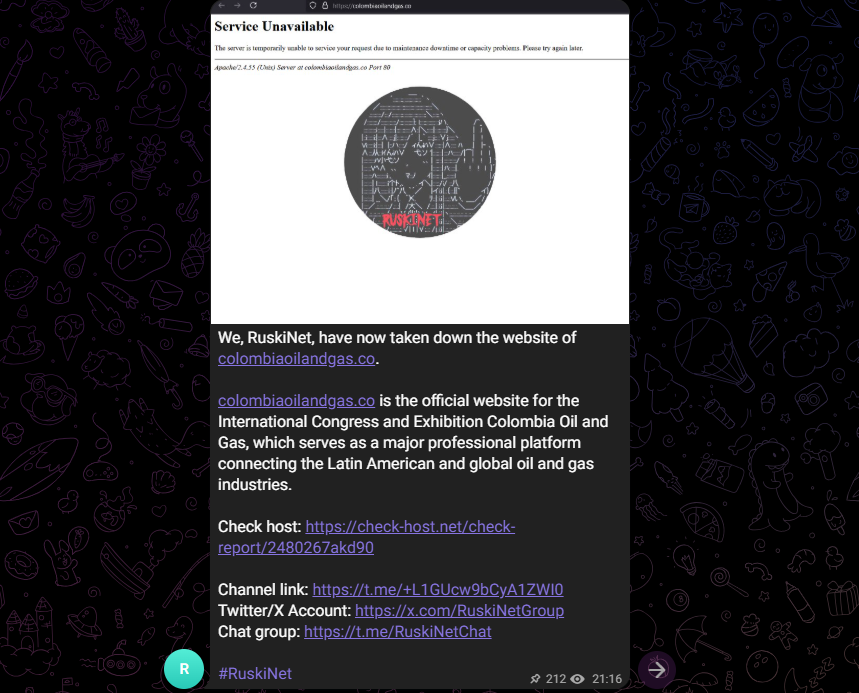
Screenshots and proof on their Telegram channel, following the modern trend of hacktivists who use social platforms to show off their exploits.
It was digital siege warfare in broad daylight, aimed more at public spectacle and intimidation than covert sabotage.
The Power of a Public Facing Target
Unlike direct strikes on oil pipelines or power stations, the choice of Colombia Oil and Gas wasn’t about disrupting supply , it was about symbolism.
The organization represents a hub of domestic and international energy interests. Its public-facing role made it an ideal candidate for a politically charged cyberattack. It didn’t matter that it doesn’t operate refineries or run pipelines. What mattered was visibility, influence, and the potential to spark headlines.
Geopolitics Behind the Screens
Colombia has made no secret of its support for Ukraine, voting to condemn Russia’s invasion at the UN General Assembly and aligning with NATO and Western allies. For Russian-aligned hackers, that made the country a soft but strategic target in Latin America.
And Colombia isn’t alone. A recent uptick in Russian cyber aggression across Latin America has included:
Ransomware campaigns by Conti and LockBit
Disinformation ops to sow anti-Western narratives
Network access sales on Russian dark web forums
The message is clear: countries standing with Ukraine may face retaliation, even across oceans.
Not Just Cyber: A Two-Front War
What makes Colombia’s energy sector especially vulnerable is the intersection of digital and physical threats.
While RuskiNet launched a cyber assault, guerrilla groups like ELN continued their campaign of physical sabotage attacking oil pipelines like Bicentenario and Caño Limón-Coveñas. When hackers and guerrillas strike in tandem, the results can cascade into national-level disruptions.
Measuring the Impact
Fortunately, the DDoS attack caused only temporary website downtime. No operational systems were breached. But make no mistake the damage was real.
For RuskiNet, the mission was accomplished:
They got headlines.
They tested Colombia’s cyber defenses.
They reminded every stakeholder in the Latin American energy sector that no one is off-limits.
Lessons from the Attack
For Energy Companies:
DDoS mitigation must be proactive, not reactive.
Run simulated cyberattacks to stress-test incident response plans.
Deploy advanced monitoring systems that detect threats early.
Isolate public-facing systems from core operational infrastructure.
For Governments:
Enforce cybersecurity regulations for critical infrastructure.
Foster public-private partnerships to share threat intelligence.
Coordinate with allies on sanctions and defensive strategies.
For the Global Community:
Provide capacity-building support to countries under threat.
Collaborate on counter-hacktivist operations.
Push for global norms in cyber conflict accountability.
A New Reality
The RuskiNet attack on Colombia Oil and Gas was a warning shot, not a knockout blow. But it underscores a chilling new truth:
Energy security now demands cyber resilience.
As geopolitical battles move online and alliances shift in real time, Latin America finds itself increasingly entangled in a high-stakes game of digital chess. The RuskiNet case reminds us that the next blackout, breakdown, or breach may not come from a failing grid—but from a line of code, launched continents away.
The question now isn't if another attack will come.
It’s when and whether we’ll be ready.


