
Introduction
Your organisation has security policies, access controls and vulnerability management processes in place. But if an enterprise customer asks for independent evidence of how you protect its data, can you demonstrate that these controls are working as intended?
SOC 2 compliance helps businesses demonstrate how they manage security risks and protect customer information. It is particularly relevant to SaaS companies, cloud service providers and technology businesses that handle sensitive customer data.
As organisations increasingly depend on external service providers, Customers expect clear evidence that their data is protected. They want evidence that appropriate controls have been established, implemented and maintained.
SOC 2 addresses this need through an independent examination based on the Trust Services Criteria developed by the American Institute of Certified Public Accountants (AICPA).
SOC 2 preparation requires effective controls, not just documented policies. Organisations must understand their examination scope, assess risks, implement relevant controls, maintain evidence and address identified weaknesses.
This guide explains SOC 2 compliance requirements, the five Trust Services Criteria, the audit process, the difference between Type 1 and Type 2 reports, and the steps businesses can take to prepare.
What Is SOC 2 Compliance?
SOC 2, short for System and Organization Controls 2, is an independent examination framework used to evaluate controls at service organisations against applicable Trust Services Criteria.
A SOC 2 report provides customers, business partners and other authorised stakeholders with information about how an organisation manages risks related to its systems and services.
It is commonly relevant to:
-
Software-as-a-Service (SaaS) providers
-
Cloud hosting and infrastructure companies
-
Managed IT and cybersecurity service providers
-
Data processing and analytics businesses
-
Fintech platforms and technology-enabled financial services
-
Enterprise software and technology providers
Is SOC 2 compliance mandatory?
SOC 2 is not a universal legal requirement for every business. However, enterprise procurement policies, customer contracts and vendor security assessments may require organisations to provide a SOC 2 report before a commercial relationship can proceed.
For technology businesses seeking enterprise customers, SOC 2 can therefore become an important business requirement.
It is also important to understand that SOC 2 is an attestation report, not a certification in the same sense as ISO 27001 certification. An independent, appropriately qualified CPA firm performs the examination and issues the report.
The report applies to a defined system, scope, criteria and examination period. It does not automatically establish that every product, business unit or security practice within an organisation has been examined.
For the official framework and related resources, consult the AICPA SOC Suite of Services and its SOC 2 and Trust Services Criteria resources.
Why Is SOC 2 Compliance Important for Businesses?
SOC 2 supports both security governance and business assurance. It provides a structured way to demonstrate how relevant controls address risks associated with an organisation's services.
1. Building customer trust
Customers sharing sensitive information with a service provider need confidence that appropriate safeguards are in place.
A SOC 2 report provides independent information about controls within its defined scope. This allows customers to assess a provider's security practices using documented evidence rather than relying solely on general assurances.
2. Meeting enterprise procurement expectations
Enterprise customers frequently evaluate a supplier's security posture before onboarding it. A SOC 2 report can support security questionnaires, vendor due diligence and procurement reviews.
For SaaS businesses pursuing enterprise contracts, this can help address customer assurance requirements and reduce repetitive evidence requests.
3. Improving security risk management
Preparing for SOC 2 encourages organisations to review access management, vulnerability remediation, system changes, monitoring and incident response.
The process can expose weaknesses in control design, inconsistent procedures and gaps in documentation that might otherwise remain unnoticed.
4. Strengthening third-party risk management
Organisations can also use SOC reports when evaluating their own service providers. A vendor's report may offer useful insight into its control environment, although the report's scope, period and exceptions must be reviewed against the buyer's actual requirements.
For more on assessing supplier risks, see TechOwl's Third-Party Risk Management resources.
5. Establishing repeatable security processes
SOC 2 preparation encourages teams to assign control ownership, retain evidence, review procedures regularly and track corrective actions.
The objective is not simply to obtain a report. It is to establish practices that remain effective as systems, teams and business requirements change.
A SOC 2 report does not guarantee that a security incident will never occur. Its value lies in providing structured, independent insight into relevant controls within a defined scope and period.
Understanding the Five SOC 2 Trust Services Criteria
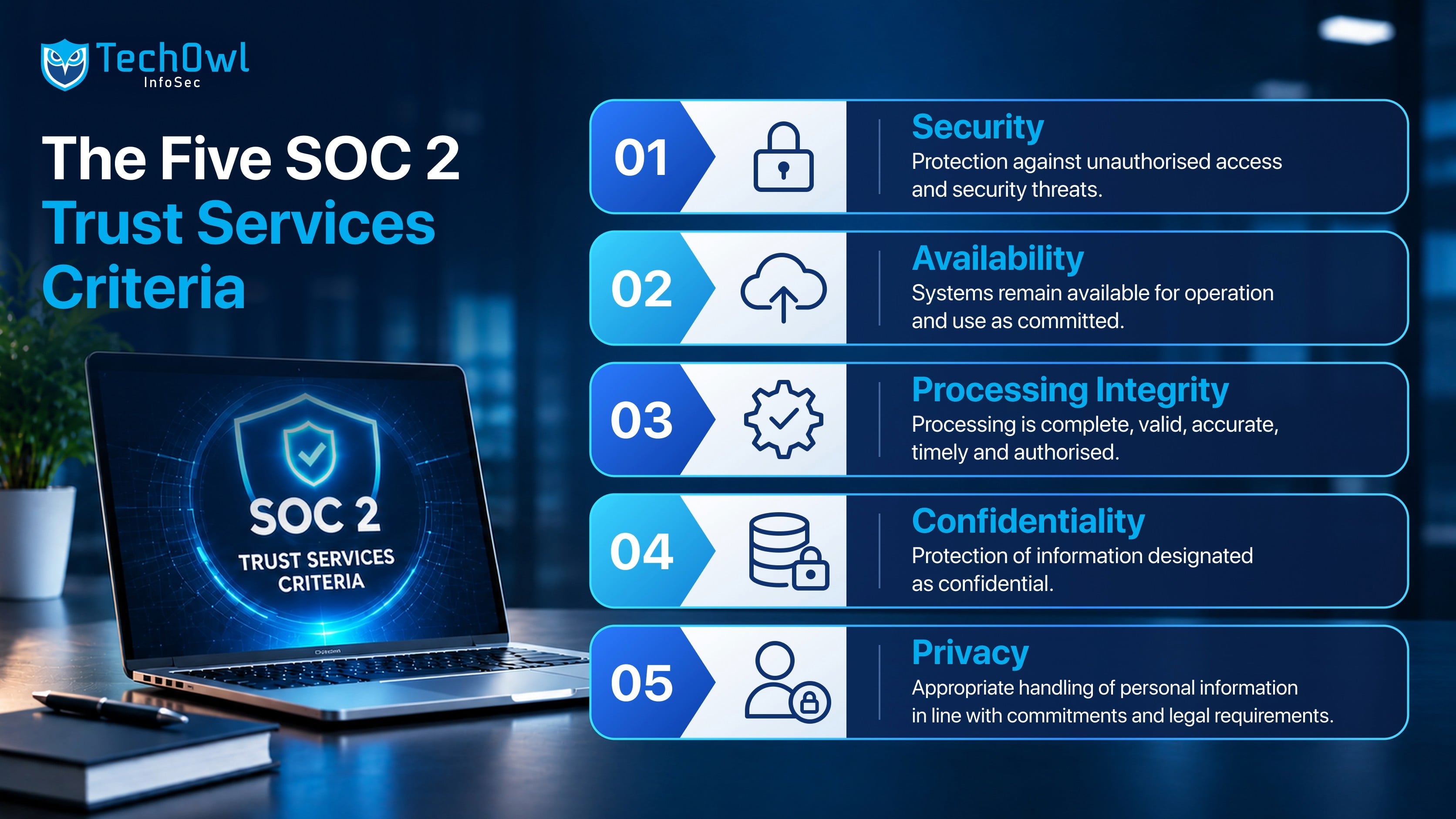
The Trust Services Criteria provide the basis for evaluating controls included in a SOC 2 examination.
Security is the foundational category. The other categories are included according to the organisation's services, commitments, risks and examination scope.
| Trust Services Criteria | What it evaluates | Examples of relevant controls |
|---|---|---|
| Security | Protection against unauthorised access and other security threats | Access management, authentication, vulnerability management and incident response |
| Availability | Whether systems remain available in line with relevant commitments | Backup testing, disaster recovery and availability monitoring |
| Processing Integrity | Whether system processing is complete, valid, accurate, timely and authorised | Transaction validation, processing controls and error handling |
| Confidentiality | Protection of information designated as confidential | Encryption, restricted access, data classification and secure disposal |
| Privacy | Handling of personal information according to applicable commitments and criteria | Privacy notices, retention procedures and personal information access controls |
1. Security
Security focuses on protecting information and systems against unauthorised access, disclosure and damage.
Relevant controls may include identity and access management, multifactor authentication, privileged account management, vulnerability management, security monitoring and incident response.
For example, an organisation should be able to explain how user access is approved, how permissions are reviewed and how access is revoked when an employee leaves.
2. Availability
Availability concerns whether systems remain available for operation and use in line with relevant commitments.
Controls may cover backup management, disaster recovery, capacity planning, resilience testing, business continuity and service availability monitoring.
3. Processing Integrity
Processing integrity focuses on whether system processing is complete, valid, accurate, timely and authorised.
This category may be particularly relevant to platforms handling transactions, calculations, automated workflows, financial information or other business-critical processing.
4. Confidentiality
Confidentiality concerns the protection of information designated as confidential.
Relevant controls may include data classification, encryption, restricted access, secure data transfer, retention rules and secure disposal.
5. Privacy
Privacy addresses how personal information is collected, used, retained, disclosed and disposed of in accordance with applicable commitments and criteria.
Controls may include privacy notices, data subject request procedures, retention schedules and restrictions on access to personal information.
Does every organisation need all five categories? Not necessarily. The applicable categories depend on the services being examined and the commitments the organisation needs to demonstrate.
SOC 2 Compliance Requirements: What Should Organisations Implement?
SOC 2 compliance requirements depend on the organisation's systems, risks, commitments and applicable Trust Services Criteria. There is no single universal control checklist that applies to every business.
However, several control areas are commonly relevant when establishing a SOC 2 control environment.
1. Governance and security policies
Organisations should establish clear security responsibilities and documented policies that reflect how their systems operate.
Typical documentation may include:
-
Information security policy
-
Access control policy
-
Risk assessment methodology
-
Incident response plan
-
Business continuity and disaster recovery plans
-
Change management procedures
-
Vendor risk management policy
-
Data classification and retention policy
Policies should be approved, communicated, reviewed and implemented in practice. A document describing a process does not, by itself, demonstrate that the process is followed.
2. Identity and access management
Access to systems and data should be granted according to business requirements and approved responsibilities.
Organisations should consider:
-
Multifactor authentication
-
Least-privilege access
-
Privileged account management
-
Timely access revocation
-
Periodic access reviews
-
Documented approval of access requests
Evidence may include access approvals, user access review records and documentation showing that unnecessary permissions were removed.
3. Risk assessment and remediation
A structured risk assessment helps identify threats to systems, information and service commitments.
Relevant risks should have appropriate treatment decisions, accountable owners and remediation plans. Risks that cannot be resolved immediately should be tracked and managed through documented mitigation or acceptance processes.
4. Vulnerability and change management
Organisations need processes to identify vulnerabilities, assess their severity, prioritise remediation and verify that corrective actions are effective.
Changes to production systems should follow defined approval, testing, deployment and rollback procedures. Controls should reflect the system's architecture and risk profile.
Security assessments and penetration testing can help identify technical weaknesses that may require remediation.
5. Security monitoring and incident response
Monitoring helps identify suspicious activity, control failures and potential security incidents.
Organisations should define how alerts are reviewed, incidents are escalated, evidence is preserved, stakeholders are notified and corrective actions are tracked.
A Managed Security Operations Centre (SOC) may support monitoring and alert investigation, depending on the organisation's risk and operational needs.
6. Vendor and third-party risk management
External providers can introduce risks through their access to systems, data or business processes.
Organisations should assess relevant vendors before engagement, define security expectations contractually, review available assurance reports and monitor material changes in vendor risk.
See Third-Party Risk Management resources for more information on supplier assessments and ongoing risk visibility.
7. Data protection and resilience
Data protection measures should reflect the sensitivity of information and the services being provided.
Controls may include encryption, backup testing, recovery procedures, data retention management and restrictions on unauthorised disclosure. Where availability is in scope, organisations should also evaluate whether recovery arrangements support their commitments.
The objective is not to implement every possible security measure. It is to establish controls that address relevant risks and demonstrate that they are appropriately designed and operating as intended.
SOC 2 Type 1 vs Type 2: What Is the Difference?
One of the most important decisions during SOC 2 planning is choosing the report type that aligns with customer expectations and business requirements.
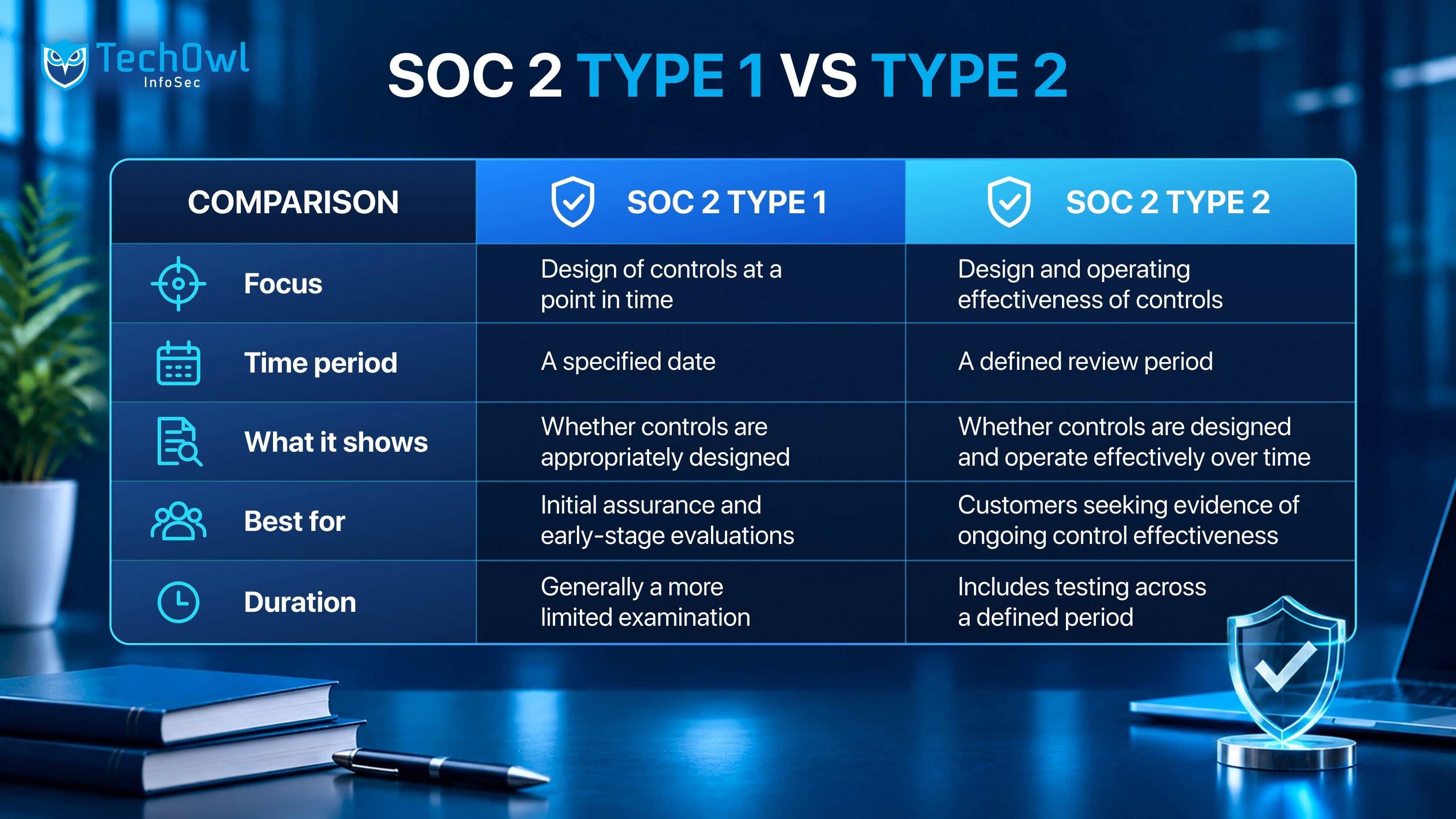
The difference between SOC 2 Type 1 vs Type 2 comes down to what the examination evaluates and the period covered.
Which SOC 2 report should your organisation choose?
A Type 1 report may be a suitable starting point for an organisation establishing its assurance programme, provided it meets customer and stakeholder expectations.
A Type 2 report provides additional insight into how controls operated over a period. This can be particularly valuable to enterprise customers evaluating the consistency of a service provider's security practices.
The right choice depends on customer requirements, contractual commitments, business maturity and the expectations of the independent auditor.
Before beginning, confirm the required report type, scope and examination period with relevant stakeholders and the independent CPA firm.
For additional information, see Microsoft's SOC 2 Type 2 documentation, the AWS SOC compliance FAQs and the AICPA's SOC resources.
The SOC 2 Compliance Process: A Step-by-Step Guide
A structured SOC 2 compliance process helps organisations move from initial planning to a more mature, evidence-backed control environment.
Step 1: Define the scope
Identify the services, systems, infrastructure, locations, personnel and data flows relevant to the examination.
A clear scope prevents teams from overlooking important dependencies or including unrelated systems unnecessarily.
Step 2: Conduct a SOC 2 readiness assessment
A SOC 2 readiness assessment evaluates existing practices against the applicable Trust Services Criteria and intended examination scope.
The assessment should identify:
-
Control gaps
-
Missing or outdated documentation
-
Inconsistent processes
-
Unclear control ownership
-
Evidence deficiencies
-
Risks requiring remediation
The findings help establish which issues require immediate attention and which can be addressed through a planned remediation programme.
Step 3: Perform a risk assessment
Evaluate threats that could affect the confidentiality, integrity, availability or appropriate processing of information within the system.
Prioritise risks according to their likelihood, potential impact and relevance to service commitments.
Step 4: Design and implement controls
Develop or improve controls to address identified risks. Assign control owners, establish review frequencies and document how each control should operate.
Controls should be practical enough for teams to follow consistently and measurable enough to produce reliable evidence.
Step 5: Collect and organise evidence
Evidence may include:
-
Access review records
-
Approved security policies
-
Vulnerability remediation tickets
-
Incident records
-
Change approvals
-
Security awareness training records
-
Backup test results
-
Monitoring logs
Evidence should be accurate, appropriately dated, traceable to the relevant control and retained according to organisational requirements.
Step 6: Remediate gaps and validate controls
Before the examination, verify that implemented controls are functioning as intended.
Track findings through remediation plans, assign accountability and retain evidence of corrective action.
For a Type 2 examination, controls must operate over the agreed review period. Preparation should therefore begin well before audit fieldwork.
Step 7: Complete the independent examination
An independent, appropriately qualified CPA firm performs the SOC 2 examination.
The auditor evaluates the system description, applicable criteria, control design and, for Type 2, evidence of operating effectiveness during the defined period.
The organisation should coordinate evidence requests, respond to queries and address issues identified during the examination.
Step 8: Maintain the control environment
SOC 2 is not a one-time documentation exercise.
Organisations should continue monitoring controls, reassessing risks, updating policies and retaining evidence after the report is issued. Ongoing maintenance supports future examinations and helps keep security practices aligned with changes in the business.
SOC 2 Audit Checklist: Are You Ready?
Use this practical SOC 2 audit checklist to identify areas that may need attention before engaging an independent auditor.
| Area | Questions to consider |
|---|---|
| Scope | Are the relevant systems, services, data flows and dependencies documented? |
| Governance | Are security policies approved, current and communicated? |
| Risk management | Are risks assessed, prioritised and assigned to accountable owners? |
| Access control | Is user access approved, reviewed and revoked when no longer required? |
| Authentication | Are appropriate authentication and privileged access controls implemented? |
| Vulnerability management | Are vulnerabilities identified, prioritised and tracked through remediation? |
| Change management | Do system changes follow documented approval and testing procedures? |
| Monitoring | Are security events and relevant system activities monitored and reviewed? |
| Incident response | Are response procedures, escalation paths and responsibilities defined? |
| Vendor management | Are relevant third-party risks assessed and monitored? |
| Data protection | Do data handling, encryption, retention and disposal controls reflect business requirements? |
| Resilience | Are backup and recovery arrangements documented and tested where relevant? |
| Evidence management | Is control evidence organised, traceable and available for review? |
| Remediation | Do identified gaps have owners, target dates and documented follow-up? |
| Management oversight | Are relevant risks, control performance and remediation progress reviewed? |
This checklist is a preparation aid, not an official or exhaustive AICPA checklist. Applicability depends on the examination scope, selected Trust Services Criteria and the organisation's specific risks.
SOC 2 Compliance for SaaS Companies: What Needs Special Attention?
SOC 2 compliance for SaaS companies is particularly important because customers may rely on a provider to store sensitive information, support critical workflows or maintain access to business applications.
SaaS environments can involve cloud infrastructure, application code, third-party integrations, remote workforces, customer support systems and automated deployment pipelines. Each dependency may introduce risks that need to be evaluated within the examination scope.
Key areas SaaS companies should review
-
Multi-tenant data separation: Controls should prevent unauthorised access between customer environments.
-
Secure software development: Code reviews, testing, approval processes and production deployment controls help manage software changes.
-
Cloud security: Organisations should manage cloud configurations, identities, permissions and infrastructure dependencies.
-
Customer access management: Authentication, authorisation and account lifecycle controls should reflect the sensitivity of the service and customer data.
-
Security monitoring: Suspicious activity should be identified and investigated across applications, infrastructure and relevant services.
-
Incident response: Teams should understand how security events affecting customer information or service availability are handled.
-
Subprocessor oversight: Organisations should understand risks associated with external services that process or access relevant data.
A SaaS company should not assume that its cloud provider's assurance report automatically covers its own application or all of its responsibilities.
The organisation must understand which controls are performed by the cloud provider, which it operates itself and which depend on complementary controls at customers or other service organisations.
A well-defined scope and clear allocation of responsibilities are essential to a credible SOC 2 examination.
Common SOC 2 Audit Preparation Mistakes
Even organisations with mature security tools can encounter difficulties when controls are inconsistent, poorly documented or difficult to evidence.
Treating policies as proof of compliance
A written policy explains what should happen. Operating evidence helps demonstrate whether the process was followed. Both matter.
Starting preparation too late
Control implementation and evidence collection take time. Last-minute preparation can expose missing records, unclear ownership and gaps that require a sustained period of operation to address.
Overlooking third-party dependencies
Cloud services, software vendors and outsourced operations can affect the security of an in-scope system. Their responsibilities and risks should be assessed rather than assumed.
Using tools without defined processes
Security platforms can support monitoring, vulnerability management and evidence collection, but tools alone do not establish an effective control environment. Teams still need procedures, ownership, escalation and follow-through.
Ignoring the report's scope
A SOC 2 report applies to the system, services, criteria and period described in the report. It should not be treated as proof that every product, business unit or security practice is covered.
Failing to maintain controls after the audit
Security practices can deteriorate as systems, employees, vendors and business processes change. Continuous monitoring and periodic reviews help maintain control effectiveness.
How Cybersecurity Services Can Support SOC 2 Compliance
SOC 2 compliance services can help organisations assess their current security posture, identify gaps, strengthen controls and organise evidence before an independent examination.
Depending on the organisation's needs, support may include readiness and gap assessments, risk and control reviews, vulnerability assessments, security monitoring, incident response planning and compliance workflow support.
These activities address different parts of the control environment. Their relevance depends on the organisation's examination scope and identified risks.
Where TechOwl's services fit into SOC 2 readiness
TechOwl's SOC 2 Compliance service is directly relevant to organisations looking for support with SOC 2 requirements and security controls.
Other relevant capabilities include:
-
SOC 2 compliance support: Explore the dedicated SOC 2 Compliance service to understand the available support.
-
Vulnerability Assessment and Penetration Testing (VAPT): Security assessment services can help identify technical weaknesses that may require remediation.
-
Managed SOC: Managed SOC services support security monitoring, alert investigation and incident escalation.
-
External Attack Surface Management: TechOwl Shield helps identify externally exposed assets and potential security weaknesses.
-
Compliance workflows: Complython supports compliance-related workflows and governance activities.
The appropriate services depend on the organisation's existing controls, risk profile and readiness objectives. These capabilities can contribute to a broader security and compliance programme, but they do not automatically establish SOC 2 compliance.
The independent examination and final SOC 2 report must come from an appropriately qualified independent CPA firm.
Preparing for a SOC 2 examination? Visit the SOC 2 Compliance page to explore the service and discuss your organisation's requirements.
Frequently Asked Questions
1. What is SOC 2 compliance, and who needs it?
SOC 2 compliance involves establishing relevant controls against the applicable AICPA Trust Services Criteria and undergoing an independent examination. It is particularly relevant to SaaS providers, cloud service companies, managed service providers and other businesses that handle customer information. Although it is not universally mandatory, enterprise customers may require a SOC 2 report before engaging a provider. See the AICPA's SOC resources for more information.
2. What are the main SOC 2 compliance requirements?
SOC 2 compliance requirements depend on the organisation's system, risks, service commitments and examination scope. Common areas include governance, risk assessment, access control, change management, vulnerability management, security monitoring, incident response, vendor risk management, data protection and evidence retention.
3. What is the difference between SOC 2 Type 1 and Type 2?
SOC 2 Type 1 evaluates the design of controls at a specified point in time. SOC 2 Type 2 evaluates control design and operating effectiveness over a defined period. Type 2 therefore requires evidence that relevant controls operated throughout that period, not simply that they were designed and implemented. See Microsoft's SOC 2 Type 2 overview.
4. How long does the SOC 2 compliance process take?
The SOC 2 compliance process varies according to the organisation's size, system complexity, existing controls, readiness and selected report type. Businesses with established security processes may need less remediation than those building their control environment from the ground up. Type 2 also requires an agreed operating period, which should be planned with the independent auditor.
5. What should a SOC 2 audit checklist include?
A SOC 2 audit checklist should cover examination scope, governance, risk assessment, access controls, vulnerability management, change management, monitoring, incident response, vendor risk, data protection, resilience and evidence management, as applicable. The checklist should be tailored to the organisation's risks and selected Trust Services Criteria rather than treated as a universal list of mandatory controls.
Conclusion: Make SOC 2 a Security Process, Not a Last-Minute Project
SOC 2 compliance provides organisations with a structured way to demonstrate how relevant controls are designed and, where applicable, how they operate over time.
For SaaS providers and technology businesses, it can also help address enterprise procurement expectations and provide customers with independent insight into security practices.
Successful preparation depends on defining the right scope, assessing risks, implementing appropriate controls, collecting reliable evidence and maintaining those controls over time. A readiness assessment can help organisations understand where they stand before committing to an independent examination.
The best preparation starts well before the auditor requests evidence. When control owners understand their responsibilities and security processes operate consistently, the examination becomes a more structured way to demonstrate the work already being done.
Build a stronger foundation for SOC 2 readiness. Explore the SOC 2 Compliance service to learn more about available support.
References and Further Reading
Related TechOwl Resources


