
Introduction
Imagine you're checking your inbox late at night and receive an email that claims your computer has been compromised. The message alleges that the sender has accessed your webcam, recorded inappropriate content, and demands payment in cryptocurrency to prevent public exposure. Alarming? Yes. Real? Fortunately, no. This blog presents a detailed breakdown of a sextortion scam that targeted a corporate mailbox, how it exploited a mail security misconfiguration, and how Techowl Shield helped identify and respond to the threat before any damage was done.
The Suspicious Email: Case Overview
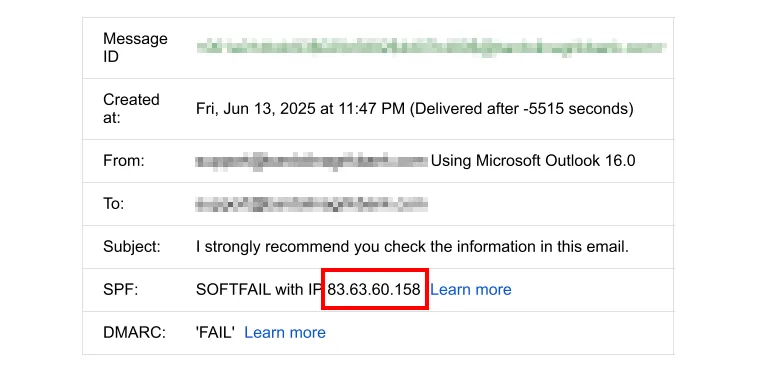
13, 2025. Time: 11:47 PM. An email was delivered to the inbox of a user at AcmeBank. The subject line read: “I strongly recommend you check the information in this email.”
The most alarming part? The sender and recipient were the same — [email protected]
This kind of message can induce panic in any recipient. When it appears you’re receiving emails from your own address, the natural assumption is that your account has been compromised. However, this was not a simple case of visual spoofing. The attacker had sent the message via an actual SMTP server with IP address 83[.]63[.]60[.]158, registered to Telefonica in Spain. The delivery was successful due to a misconfiguration in AcmeBank's DMARC policy, which was set as:
v=DMARC1; p=reject; rua=mailto:[email protected]; pct=50;
Despite the policy being set to reject, the pct=50 directive meant only half of the unauthenticated emails were subject to rejection. This allowed the fraudulent message to bypass DMARC checks and land directly in the inbox.
The content of the message included:
- Claims of webcam access and keystroke logging
- Fabricated allegations of explicit activity
- A demand for $1,450 in Bitcoin to avoid public exposure
Why This Email Was Fraudulent
-
Identical Sender and Recipient Addresses
The use of the same From and To address is a deliberate manipulation technique. It convinces the recipient that the message originated from their own account. However, technical inspection revealed that the message was externally generated.
-
SPF and DMARC Policy Failures
- SPF: SOFTFAIL — the sender's IP was not authorized.
- DMARC: FAIL — yet the message bypassed rejection due to pct=50.
Setting pct=50 is equivalent to implementing a policy and only enforcing it half the time. It weakens domain protection and allows room for attacks to succeed intermittently.
-
Psychological Manipulation
The attacker relied on emotional pressure. By claiming to have sensitive recordings and imposing a strict 48-hour deadline, they aimed to instill fear and prompt hasty decision-making.
-
Untraceable Payment Channel

The demand for cryptocurrency via Bitcoin wallet 1HjhNBHrUYFs3YbUzW3ekFXt3muMVZSwmn is typical in anonymous extortion campaigns.
- Geolocation of SMTP Origin

- IP Address: 83[.]63[.]60[.]158
- Location: Sevilla, Andalucia, Spain
- ISP: Telefonica de Espana
This provided further evidence that the message was external and not generated from within the organization.
How Techowl Shield Helped Detect and Respond
While the fraudulent email successfully landed in the recipient's inbox due to a DMARC misconfiguration, Techowl Shield played a crucial role in identifying the threat and alerting the appropriate teams:
- Header Analysis via DMARC Monitoring: Techowl Shield continuously collects and analyzes DMARC reports sent to [email protected]. The spoofed email was captured in these aggregate reports, and its failure status (SPF: Softfail, DMARC: Fail) was flagged for review.
- Real-Time Alert Generation: The Shield platform’s automated intelligence flagged the anomaly due to a failed DMARC authentication from a suspicious IP not authorized by the sender domain.
- SOC-Level Alerting: An alert was immediately generated and escalated to the client's SOC team through Techowl Shield’s integration, informing them that a failed DMARC message had bypassed rejection and entered the mailbox.
- Visibility and Recommendations: The platform’s dashboard highlighted the event along with remediation steps — primarily recommending adjustment of DMARC policy from pct=50 to pct=100.
Because the alert was generated promptly and the user was trained not to engage with suspicious emails,
no further action was taken by the recipient, and the scam attempt was rendered unsuccessful.
Understanding Sextortion Scams
Sextortion is a form of cyber extortion in which attackers threaten to release fabricated or non-existent explicit content unless a ransom is paid. These scams use fear and shame as tools to manipulate victims, and often rely on bulk emailing rather than targeting individuals specifically.
Mitigation Strategy and Lessons Learned
-
Strengthen Email Authentication Policies Ensure DMARC records are fully enforced by setting pct=100. Example:
v=DMARC1; p=reject; rua=mailto:[email protected]; pct=100;
-
Do Not Engage with the Attacker Responding validates your email as active and increases the risk of continued targeting.
-
Report the Incident Notify your IT security team or SOC. In India, you can report to CERT-In or through your corporate incident response system.
-
Review and Harden Email Infrastructure
- Implement SPF, DKIM, and full DMARC enforcement
- Monitor and log SMTP relay attempts
- Review configurations regularly
-
Conduct Security Awareness Training Educate users on identifying phishing and sextortion emails. Simulated phishing exercises can enhance real-world readiness.
Conclusion
This incident highlights how small misconfigurations like a partially enforced DMARC policy can expose organizations to serious reputational and psychological attacks. While the attackers in this case had no real access, the tactic was effective enough to cause alarm.
However, due to the presence of Techowl Shield, the spoofed message was detected through DMARC report monitoring, alerted via threat intelligence, and brought to the attention of the security team before any harm occurred. Organizations leveraging proactive threat visibility platforms like Techowl Shield are far better equipped to stop such campaigns early and reinforce the security of their email ecosystems.


