

Executive Summary
Overview
AnonSec is a hacktivist group that has been active since 2012. They are known for strongly supporting the Palestinian cause. Based on their activity on Telegram, the group often attacks government websites of countries like Russia, the UAE, Israel, India, the Netherlands, and others. Their goal is to expose governments they believe are oppressive or unfair.
AnonSec mainly uses hacking methods such as SQL injection, remote code execution (RCE), installing web shells, and carrying out DDoS (Distributed Denial of Service) attacks. These methods help them break into and disrupt websites.
The group is driven by political beliefs rather than money. Because of their actions and motives, AnonSec is seen as a serious threat, especially during times of political tension or conflict.
Key Activities
AnonSec's main activity involves working with other hacking groups to jointly target and attack official government websites of various countries.
Motivations
AnonSec's likely motivation is exposing and retaliating against governments that they perceive as corrupt, oppressive, or failing to serve their citizens properly. Their attacks are ideologically driven that is not for profit, but to exploit and publicly shame such governments through defacements, data leaks, and cyber disruption.
Examples : Israel Government Websites (2022 – “OpIsrael”) for Protest against Israel’s actions in Palestine.
Known Aliases
List of names
- UnknownSec.
- AnonSec Team
List of Affiliations
- Rabbit Cyber Team
- Golden Falcon
- AL-Qassam Brigades
- Team Inteid
- Nation Of Saviors
- WebSec
- Dark Cyber Gang
- Ghilan Legion
- Anonymous Jordan
- Al Ahad
- Electronic Army Special Forces
- Arab Ghosts Hackers
- Spider-X
- Vulture
- Ummah League
- HulkSec
- Sylhet Gang-SG
- Captain Error
- Anonymous 71
- NOName057(16)
- AnneSec
- Holy League
- Keymous
- Sumatra Utara Cyber Team
- GARUDA ERROR SYSTEM
- RipperSec
- DARK STORM
List of Members
- Anon7
- Type-0
- ./meicookies
- MR.HAGAN_404CR4ZY
- KosameAmegai
- K4TSUY4-GH05T
- He4l3rz
- Mr.Grim
- Rian Haxor
- ChokkaXploiter
- MungielL
- Nzxsx7
- ./G1L4N6_ST86
- kuroaMEpiKAcyu
- UnknownSec
- Temp3
- Mr.L3gacy
- xRyukz
- RavaFake
- Cubjrnet7
- Calutax07
- ./Mr.Spongebob
Motivation & Ideology.
Beliefs and Motivation
AnonSec's activities are primarily motivated by strong ideological and religious convictions focused on advocating for Muslim communities worldwide. The group portrays itself as digital activists for the Muslim Ummah, demonstrating solidarity with what they perceive as oppressed Muslim populations, with particular emphasis on Palestine and India.
Their operations appear to be driven by opposition to what they characterize as systemic violence against Muslims and perceived international indifference to these issues. Their public messaging reflects these motivations through statements such as:
- "We will not stop until we avenge the lives of the martyrs in Palestine!"
- "Stop the genocide of innocent Muslims in India"
- "We have successfully taken down the Government site of Verkhovna Rada Parliament of Ukraine for the support of Russia"
These statements indicate both religious-political motivations and opportunistic targeting based on geopolitical alliances, as evidenced by their targeting of Ukrainian infrastructure while expressing support for Russia.
Goals and Messaging
AnonSec employs consistent messaging themes across their campaigns, frequently using slogans such as "Hack for Humanity," "United Hacktivists," "Save Palestine," and "Save Muslims." These phrases serve as rallying cries for their operations and reflect their stated objectives.
The group demonstrates persistent solidarity with Palestinian causes, particularly during escalations of conflict involving Israel. In 2014, AnonGhost Team, an entity affiliated with AnonSec, initiated "Operation Save Gaza," specifically targeting Israeli digital infrastructure to protest military operations in Gaza.
Their activism extends beyond direct targeting of perceived adversaries to include international organizations they deem complicit through inaction. This is evidenced by their defacement of United Nations websites, where they criticized what they characterized as institutional failure to address Palestinian humanitarian concerns.
These messaging patterns reveal a consistent narrative framework that guides their target selection and operational justifications.
Activities related to Operation Sindoor.
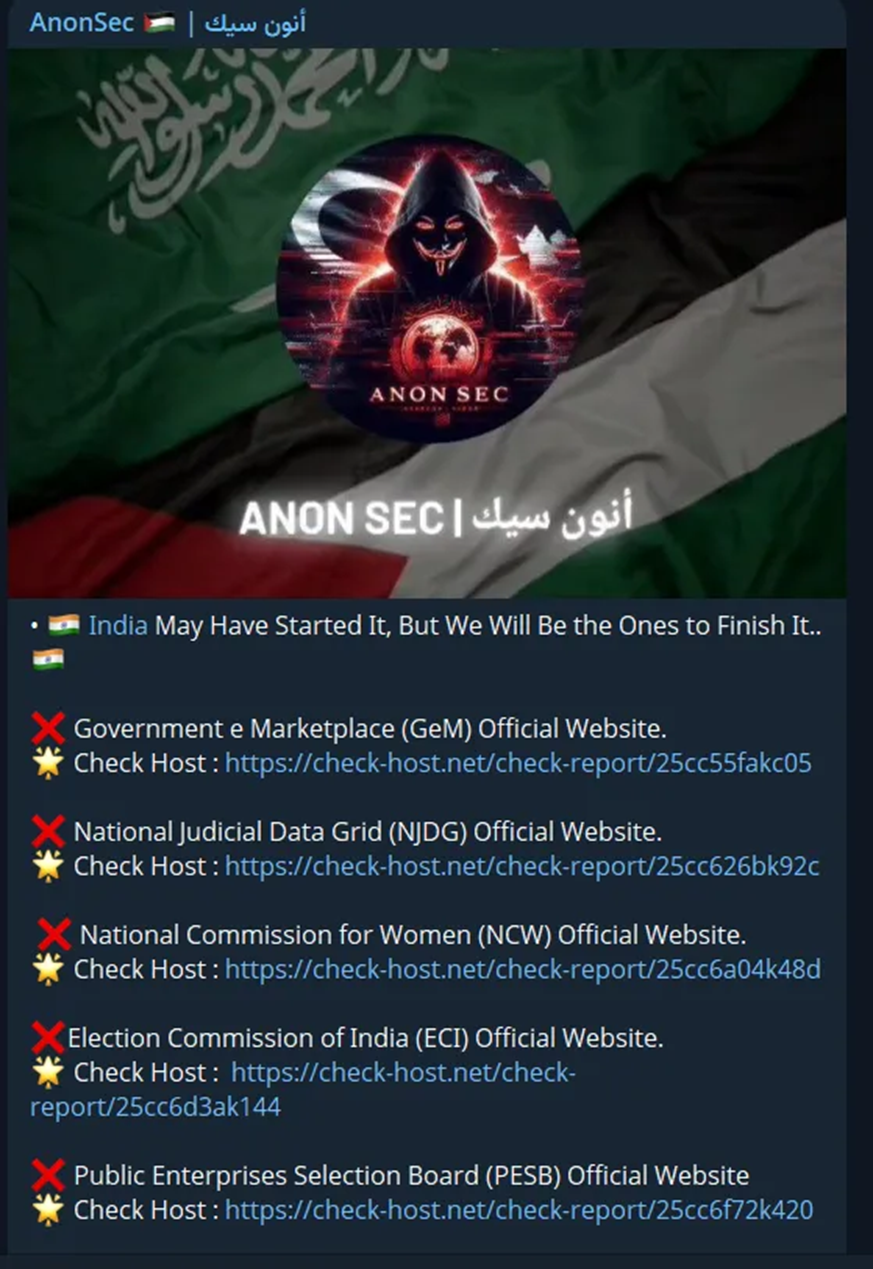
In response to Operation Sindoor , a 2025 Indian military counterterrorism operation targeting militant infrastructure in Pakistan ,AnonSec launched a coordinated cyber campaign against Indian government digital infrastructure. This campaign represented a significant escalation in the group's activities against Indian targets.
Following public disclosure of Operation Sindoor, AnonSec initiated distributed denial-of-service (DDoS) attacks against multiple high-value Indian government websites, including the Government e-Marketplace (GeM), National Judicial Data Grid (NJDG), National Commission for Women (NCW), and the Election Commission of India (ECI). Their propaganda accompanying these attacks featured the message "India May Have Started It, But We Will Be the Ones to Finish It," explicitly connecting their cyber operations to the military action.
This campaign demonstrates AnonSec's pattern of opportunistically leveraging geopolitical tensions to justify and amplify their cyber operations, particularly when these align with their stated ideological positions regarding Muslim communities.
Anonsec in the Spotlight After Member’s Arrest
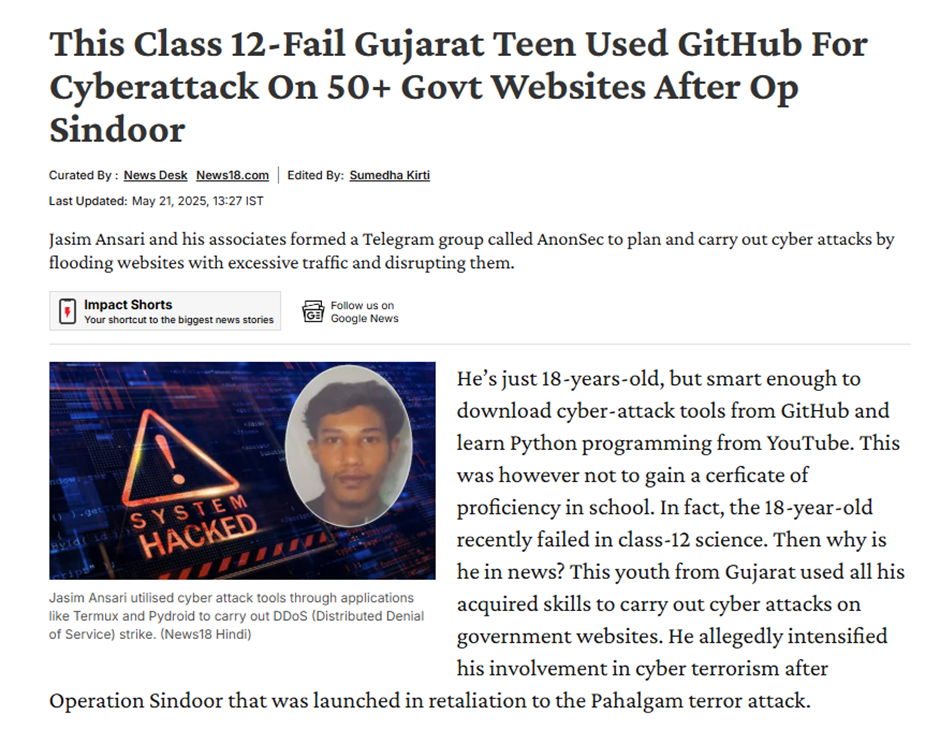
The hacker group Anonsec has recently made headlines after a member, Jasim Ansari, and his associates were arrested for launching cyberattacks against the Indian government. As reported in the news, the group is accused of taking down over 50 government websites. These attacks were allegedly carried out in support of Pakistan amid ongoing tensions between India and Pakistan.
What stands out in this case is that the group members are from Gujarat, India and yet they were targeting their own country's digital infrastructure. The group have used a private Telegram channel to plan and coordinate the attacks. One of the arrested suspects is reportedly just 18 years old. The attacks mainly involved DDoS (Distributed Denial-of-Service) methods to flood and disrupt government websites. To prove the success of their attacks, the group also created and shared Check-Host.net reports.
History
Rise to Public Attention
AnonSec gained international prominence in 2016 following their claimed breach of NASA's internal networks. The group alleged they had accessed sensitive information, including personnel data and flight logs of NASA employees. Their most significant claim involved purportedly gaining partial control of a $222 million Global Hawk drone, which they reportedly attempted to redirect into the Pacific Ocean.
NASA subsequently issued official denials, stating that no credible threat to their systems or data had materialized. Despite these denials, the incident generated substantial media coverage, significantly elevating AnonSec's profile within the global cybersecurity landscape.
In their 2016 self-published manifesto, AnonSec declared their objective was to expose NASA's purported involvement in "chemtrail" operations and geoengineering initiatives. The group specifically identified NASA's climate research missions as targets, including Operation IceBridge and the Aerosol-Cloud-Ecosystem (ACE) program, alleging these scientific programs had undisclosed purposes.
Notable Website DDoS
Mass Defacement Campaign (January 2014)
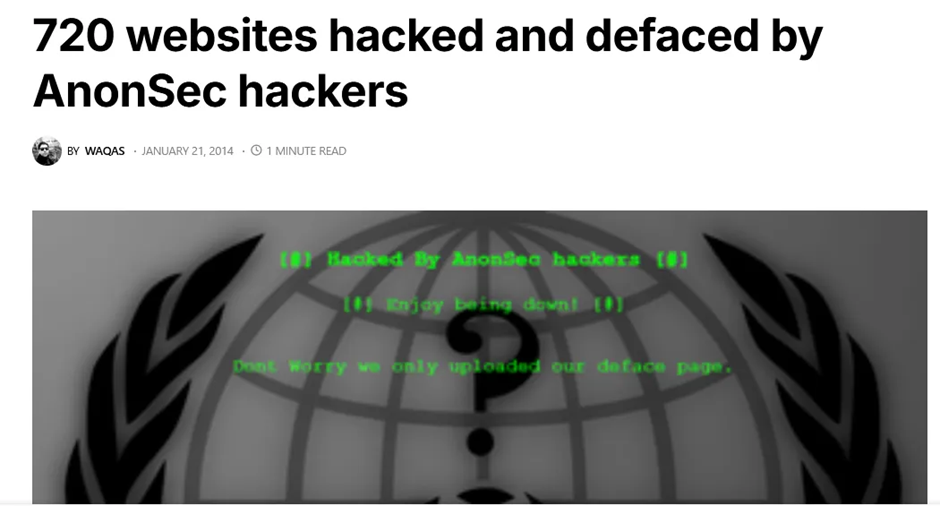
In January 2014, AnonSec executed a large-scale operation, claiming responsibility for compromising and defacing 720 websites across multiple countries. The group implemented a uniform defacement message across all targeted sites:
"Hacked by AnonSec Hackers! Enjoy being down! Don't worry we only uploaded our deface page. Secure your shit! No matter how mafia you are, mess with the best, die like the rest!"
This widespread campaign represented one of their earliest coordinated efforts to establish their presence in the hacktivist landscape and demonstrated their capacity for simultaneous exploitation of vulnerabilities across numerous web properties.
Target Profile
Primary Targets
AnonSec conducts global operations with strategic focus on high-value political, governmental, and infrastructure targets. Their recent campaigns have concentrated on Israel, India, and Ukraine, aligning with geopolitical tensions in these regions.
Countries Targeted in Recent Operations
India
AnonSec has systematically targeted aviation infrastructure across the subcontinent:
- Rajiv Gandhi International Airport (Hyderabad)
- Chennai International Airport
- Rajahmundry Airport
- Devi Ahilyabai Holkar Airport (Indore)
- Sardar Vallabhbhai Patel International Airport (Ahmedabad)
Ukraine
The group has executed a diversified campaign against Ukrainian economic pillars:
- IT Support firm Lan Systems
- Amstor Retail Group
- Niko Group
- Delta Wilmar Ukraine
- Dniprovagonmash (machine-building enterprise)
Hungary
Their European operations have focused on digital governance infrastructure:
- National Trading House
- Open Data Portal
- E-Government Knowledgebase (UNeGovKB)
- National Tax and Customs Administration (NAV)
UAE
Financial and regulatory bodies have been primary objectives:
- Securities and Commodities Authority (SCA)
- National Center of Meteorology (NCM)
- TDRA
- Fujairah Customs
- Abu Dhabi Public Center
- Dubai Customs
Additional targeting has been documented against digital assets in Israel, United Kingdom, United States, Germany, Mexico, Belgium, Finland, and other Western nations. These operations have manifested as website defacements, distributed denial-of-service (DDoS) campaigns, and alleged data exfiltration activities.
Geographical Focus
AnonSec's operational footprint extends across multiple continents, with attack intensity correlating strongly with regions experiencing political instability or where the group seeks to project their ideological narrative. Their campaigns demonstrate strategic geographic concentration:
Middle East
Primary focus on Israel and the United Arab Emirates, with systematic targeting of government digital infrastructure and financial institutions
South Asia
Concentrated campaigns across India targeting critical national infrastructure, particularly aviation networks and government service portals
Eastern Europe
Sustained operations against Ukrainian digital assets, targeting both government and private sector organizations crucial to economic stability
Central Europe
Precision targeting of Hungary's e-governance architecture and public data repositories, disrupting digital public services
Northern Europe
Strategic operations against Finnish institutions, including:
- Helsinki University
- Finnish Financial Services
- Finnish MS Society
Southeastern Europe
Coordinated campaigns against Kosovo's educational and regulatory framework:
- Ministry of Education, Science, Technology and Innovation (MASHTI)
- Kosovo Accreditation Agency (KAA)
- National Qualifications Authority (NQA)
Western Nations
Opportunistic operations against the United States, United Kingdom, and Germany, typically coinciding with significant geopolitical developments or policy announcements related to their ideological concerns
Timeline of their attacks.
2014
Initial emergence marked by widespread defacement campaigns, establishing AnonSec as a significant threat actor through coordinated attacks against hundreds of websites globally.
2016
Strategic escalation with high-profile claims of NASA systems compromise, including alleged access to Global Hawk drone operational data and targeting of climate research programs.
2017–2022
Period of tactical reorientation characterized by intermittent defacements and lower-visibility cyber operations, suggesting possible internal reorganization or capability development.
2023–2024
Significant operational resurgence with sophisticated multi-vector campaigns:
- Systematic defacements of Ukrainian corporate and industrial digital infrastructure
- Coordinated distributed denial-of-service (DDoS) campaigns against Indian government entities
- Strategic disruption of Hungarian public service portals
- Precision targeting of UAE government digital platforms in alignment with broader Middle Eastern geopolitical objectives
- Intensified cyber operations against Israeli digital infrastructure coinciding with public messaging in support of Palestinian causes
2025
Operational acceleration and geopolitical alignment:
- Major involvement in cyber campaigns against India following the Pahalgam attack
- Participation in coordinated hacktivist response to Operation Sindoor, targeting symbolic Indian assets including the Prime Minister's Office and National Judicial Data Grid
- Integration with broader hacktivist coalitions including Keymous+ and Electronic Army Special Forces
- Evolution toward synchronized attacks that deliberately align with real-world geopolitical events
- Increasing focus on high-visibility targets designed for maximum propaganda impact rather than operational disruption
This timeline demonstrates AnonSec's evolution from opportunistic defacements to increasingly sophisticated, geopolitically-aligned campaigns with strategic target selection and timing coordinated with physical world events.
Notable Operations.
Case study on significant campaigns by Anonsec.
Israel
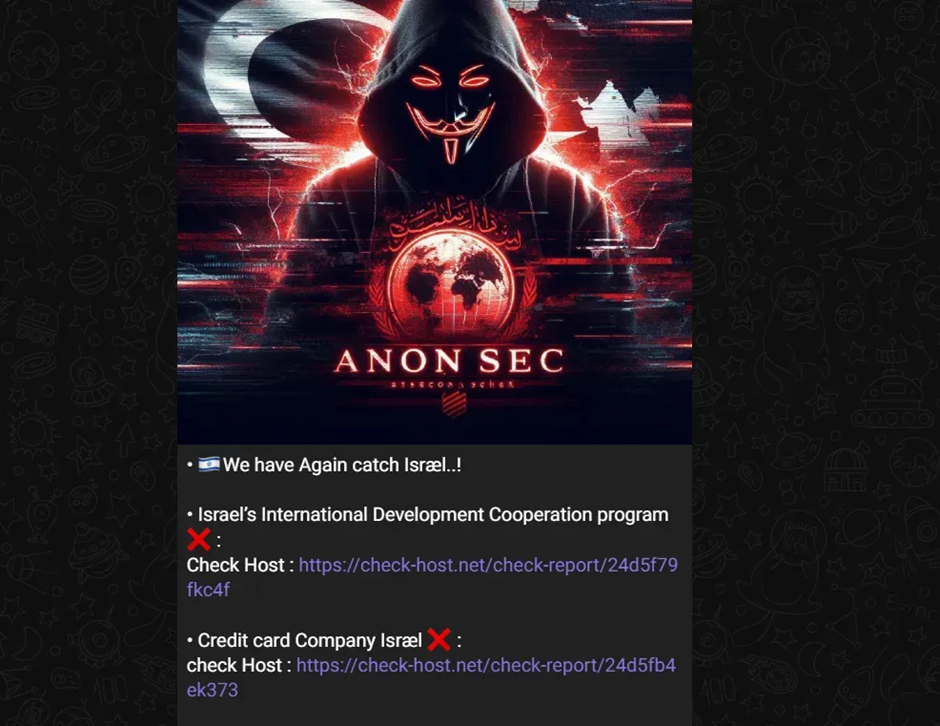
AnonSec launched cyber attacks against Israel to support their pro-Palestine views.
Arabic script encircles a globe graphic, reinforcing the group's self-proclaimed position as defenders of global Muslim interests. The announcement declares specific cyber operations against Israeli targets, claiming successful attacks on Israel's International Development Cooperation program and a financial services provider.
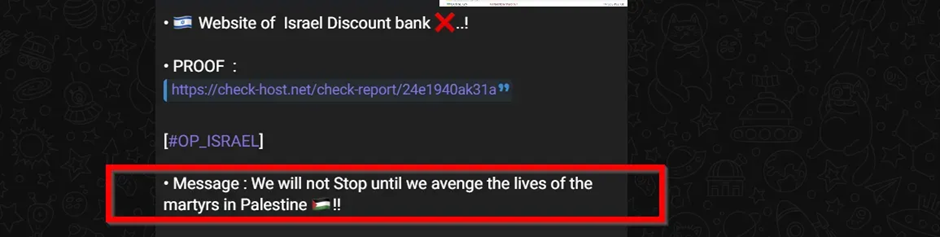
These attacks mostly included hacking websites to display their messages (defacements) and DDoS attacks (making websites slow or shut down). With each attack, they shared messages supporting Palestine.
Ukraine
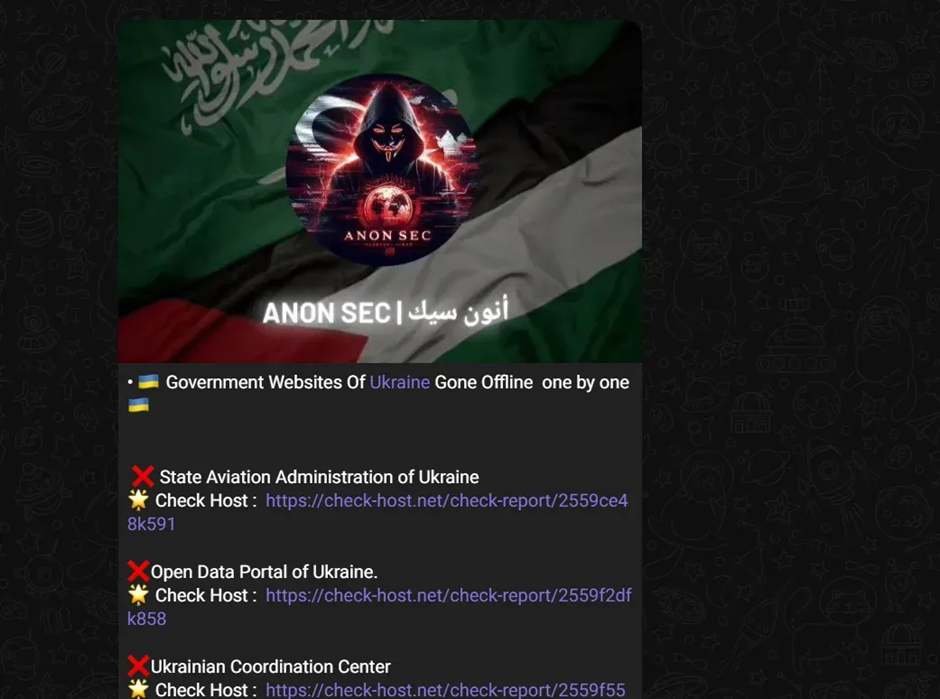
AnonSec’s cyberattacks have systematically targeted multiple critical Ukrainian government websites and institutions. Below are some of the notable attacks:
- State Criminal-Executive Service of Ukraine
- Government Service of Ukraine for Transport Safety
- Public Procurement System of Ukraine Government
- National Police Website of Ukraine Government
- State Audit Service of Ukraine Government
- State Aviation Administration of Ukraine
- Open Data Portal of Ukraine
- Ukrainian Coordination Center
- Hydrometeorological Center (UHMC) in Ukraine
- State Forest Resources Agency of Ukrainn
- State Service of Special Communications and Information Protection
- National Government Agency on Corruption Prevention
- Ministry of Education and Science of Ukraine
- Ministry of Communities and Territories Development
These attacks have led to service disruptions and data breaches, impacting Ukraine's economic infrastructure.
India
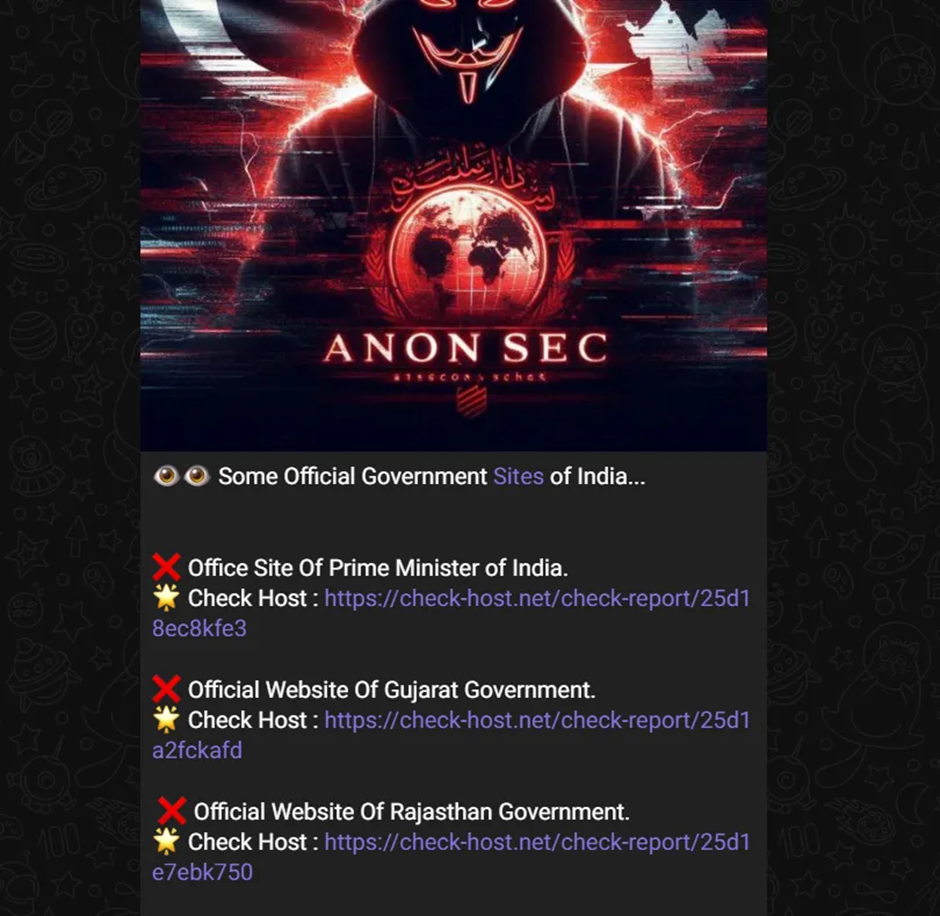
AnonSec has extended its cyber operations to India, with a particular focus on government, educational, and public service domains. These attacks are part of a broader ideological campaign, often driven by political and religious motives. Their operations in India have aimed to disrupt digital infrastructure and spread propaganda.
AnonSec has publicly claimed to have attacked the following key Indian websites, many of which belong to high-profile government, defense, and financial institutions:
- Government e Marketplace (GeM) Official procurement portal for government purchases.
- National Judicial Data Grid (NJDG)
- National Commission for Women (NCW)
- Election Commission of India (ECI)
- Public Enterprises Selection Board (PESB)
- Indian Air Force Portal
- Income Tax Department Portal
- Municipal Governance Portal
- Shivalik Bank
- MUC Bank
The group's predictable patterns of attack have also created opportunities for security researchers to study their methodologies and develop more effective countermeasures, ultimately strengthening digital infrastructure against both unsophisticated and advanced threats.
Media Coverage Evolution
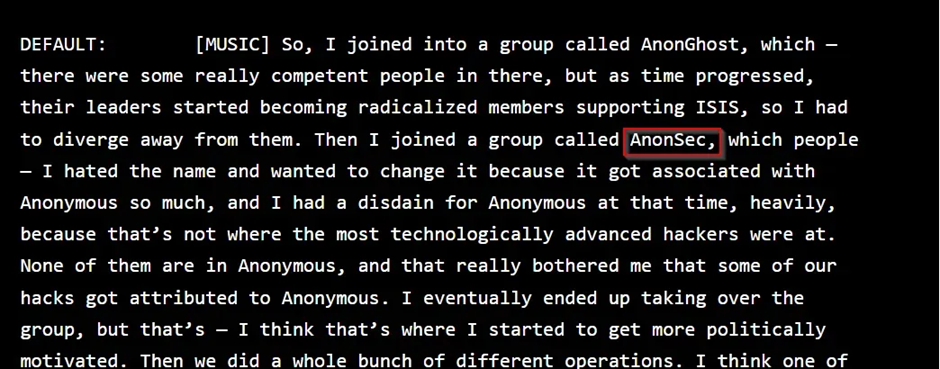
Media portrayal of AnonSec has evolved significantly over time. Initially characterized simply as an "Anonymous offshoot," later coverage increasingly contextualized the group within broader geopolitical narratives. As revealed in the Darknet Diaries podcast interview with an AnonSec member called "Default," the group actually "had a disdain for Anonymous" and was frustrated that their operations were attributed to Anonymous.
Channels used
AnonSec has established a sophisticated communication infrastructure across multiple platforms, with Telegram serving as their primary operational hub since approximately 2021. Their main Telegram channel functions as both a propaganda outlet and operational announcement board, where they regularly post updates on successful attacks, share "check-host" verification links to prove website defacements, and distribute visual evidence of compromised systems. The group maintains separate private Telegram groups for coordination with affiliated hacktivist organizations including Rabbit Cyber Team, Golden Falcon, AL-Qassam Brigades, and the Holy League collective. This network of interconnected channels enables AnonSec to rapidly coordinate large-scale, synchronized attacks against high-profile targets, as demonstrated during their Operation Sindoor response campaign targeting Indian infrastructure.
Beyond Telegram, AnonSec strategically leverages file-sharing platforms like Pastebin to distribute technical documentation and compromised data, while utilizing social media platforms to amplify their messaging to broader audiences. The group has established operational relationships with specialized data-sharing networks frequented by like-minded hacktivist collectives, particularly those affiliated with pro-Palestinian causes like Electronic Army Special Forces and Arab Ghosts Hackers.


