
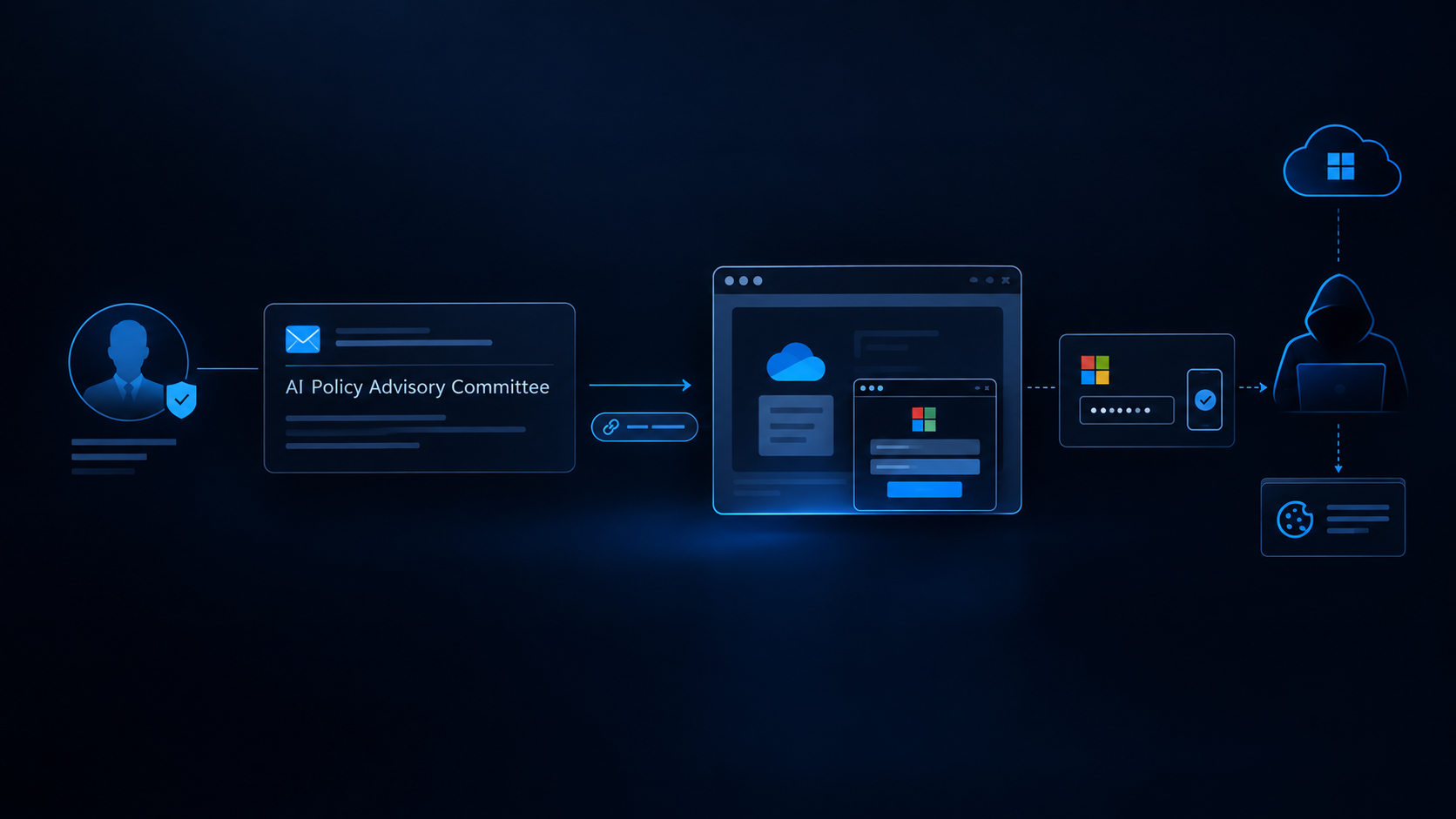
Cybersecurity researchers report that a China-aligned espionage actor tracked as TA419 has been phishing AI policy experts at U.S. think tanks, universities and law firms. The kit is an adversary-in-the-middle (AitM) setup that steals Microsoft 365 session cookies. The activity named in the report runs from February to July 2026, on infrastructure first seen in December 2025.
The first email has no link and no attachment. The malicious URL is sent only after the target replies, so the opening message gives mail filters nothing to flag.
The victim signs in to the real Microsoft service through the attacker's proxy. Password, MFA and conditional access all pass, and the attacker keeps the resulting session. Origin-bound authentication such as passkeys is the control that breaks this.
The report does not say how many people were targeted or whether any account was actually taken over. The China attribution is based on the researchers' assessment.
What happened
On October 1, 2026, researchers published the first public report on TA419. The report covers two sets of phishing aimed at people who work on U.S. AI policy. The first, in February 2026, posed as a senior employee of an AI company. The second, starting July 8, 2026, posed as a former White House official and then as a well-known economist.
This post goes through the published threat report in detail and uses it as its primary source. Where we add our own reading, we say so. We also list what the report leaves unanswered, because for a case like this the gaps matter as much as the findings.
Who TA419 is
Researchers describe TA419 as China-aligned and espionage-motivated. The research team states it has watched the group run regular, targeted credential phishing since at least April 2025, and that this activity had not been reported publicly before the October 1 post.
- Usual targets: individuals at U.S.- and Japan-based think tanks, defense contractors, universities and law firms.
- Usual subject areas: defense, national security, energy, international relations and foreign policy, mostly with a U.S. or Japan connection.
- AI policy: The report treats this as an extension of the same remit. The people who write and advise on AI regulation and export controls are now on the same target list as the people who cover defense and foreign policy.
- Likely purpose: better insight into U.S. AI policy and regulation, at a time of export controls, strategic competition and accusations of model distillation between the U.S. and China.
Timeline
| When | Activity | Detail |
|---|---|---|
| April 2025 | Earliest activity attributed to TA419 | Credential phishing against think tanks, defense contractors, universities and law firms |
| December 2025 | Earliest infrastructure in the indicator list | fileswiftonline[.]cloud, sharehub[.]space |
| February 2026 | AI company employee impersonation | AI policy analyst at a U.S. think tank, subject line about military integration of an AI model |
| March to May 2026 | New chain domains and organization-themed sender domains | U.S. policy think tank look-alikes in March, Japan-Taiwan exchange organization look-alike in May |
| 8 July 2026 | Impersonation of a former White House official | Former senior leader of the White House science and technology policy office |
| July 2026 | Impersonation of an economist | Economist and foreign policy expert. Both July campaigns reuse the same two domains |
| 1 October 2026 | Researchers publish | First public report on the actor |
The lures
The opening emails were deliberately dull. Each one invited the recipient to take part in something that sounds routine in policy circles. In July there were two versions. One invited the target to join an "AI Policy Advisory Committee". The other asked for a contribution to a report from a U.S. Senate committee on AI export controls and supply chains. Neither carried a link or an attachment.
The senders used free-mail addresses built around the impersonated person's name. The three addresses are in the indicator table. The names are real and the people are well known in this field. The accounts are not theirs.
The topics follow the news. The February lure referred to the public debate over U.S. military use of AI models. The July lures leaned on export controls. Our read is that TA419 picks whatever policy argument is live that month, and a future lure will probably do the same.
A target who answered got a second message with a shortened URL, presented as a way to share more information. That link is where the technical side of the attack begins.
The attack chain
Attack chain, end to end
Reply-gated phishing to Microsoft 365 session theft
- Send a clean first message A free-mail account using a real expert's name invites the target to an advisory committee or a report. No link, no attachment. reply-gated
- Wait for the reply Only after the target answers does the operator send a shortened URL that claims to share more information. URL shortener
- Pass the first-stage filter The first actor-controlled domain shows a fake OneDrive loading screen while a Cloudflare Turnstile check runs, then redirects the visitor onward. driftshare[.]co
- Land on the AitM page The second domain proxies the real Microsoft sign-in. A fake OneDrive folder listing appears, and clicking a document raises a fake browser sign-in window (Frameless BitB). globalfileshareplatform[.]com
- Sign in succeeds Password, MFA code and conditional access checks are relayed to genuine Microsoft infrastructure and all pass. A custom script follows the login and submits codes automatically. Entra ID, OfficeHome app
- Keep the session The attacker holds the session cookies. The victim sees a normal, successful sign-in and has no reason to suspect anything. session theft
Why the reply matters
Reply-gating moves the dangerous message out of the part of the process that security tooling watches most closely. A mail gateway sees a short, polite email from a free-mail address. A sandbox has nothing to detonate. URL reputation has nothing to score. The conversation then continues as a one-to-one exchange with a person who already believes they are talking to a colleague.
The attacker also learns something from the reply. The address is live, the person reads their mail, and they are willing to engage with the topic.
The Turnstile step
The first-stage domain does not host the phishing page. It shows a fake OneDrive loading screen and runs a Cloudflare Turnstile check, then forwards the visitor to the second domain. The original report describes the first domain as an initial filter. Our read is that Turnstile keeps most automated scanners away from the credential page, which means a scanner may record only the challenge page and a clean result should not be read as proof that a domain is harmless.
Inside the kit
The AitM page targets Microsoft 365 and Entra ID through the first-party OfficeHome application
(client_id=4765445b-32c6-49b0-83e6-1d93765276ca). It is built on Frameless BitB, an
open-source browser-in-the-browser kit.
The kit contains a browser-in-the-browser (BitB) overlay, an Evilginx phishlet for Microsoft 365, and server-side substitution rules that inject the kit into the proxied pages. The overlay is what produces the fake Chrome sign-in window the victim sees. Analysts note that TA419 extended the open-source kit with its own telemetry and automation module, which tracks and drives the target's progress through the Microsoft sign-in flow, including MFA.
The page the victim loads is the genuine Microsoft /common/oauth2/v2.0/authorize response, relayed in
real time. The proxy injects two scripts into it.
| Script | Origin | What it does |
|---|---|---|
/secondary/script.js |
Adapted from Frameless BitB | Attaches a Shadow DOM and fills it with a OneDrive folder listing of lure documents. The real documents sit in an attacker-controlled OneDrive account, reached through a proxy path that turns a 1drv.ms share link into an embeddable same-origin page. Also loads /primary/script.js. |
/primary/script.js |
Adapted, with the body replaced | Intercepts the target's interaction with the listing. It registers click and touch handlers and watches for OneDrive's own permission-denied banner. Either a click on a document or that banner raises the fake Chrome sign-in window. |
/secondary/observe.js |
Written by TA419 | Telemetry and automation. Reports the victim's position in the login flow to the attacker, which gives a live view of each session. Accepts the "Keep me signed in" prompt and submits one-time codes as soon as they validate. |
The sequence from the victim's side is ordinary. They see what looks like a shared OneDrive folder, click a file, and get a browser-style sign-in popup, which is exactly what OneDrive does when access is needed. Nothing in that flow looks wrong.
Why MFA does not stop it
Behind the overlay, the proxy passes the sign-in to real Microsoft servers. The user's password is correct, the MFA code is correct, and conditional access sees a legitimate sign-in attempt. Microsoft issues a session, and the session cookies pass through the attacker's proxy on the way back. The attacker can then use them to open the account without any further login.
The custom script goes further than standard AitM tooling. Our read is that auto-submitting one-time codes removes the timing problem, because a code that expires in seconds is used before it lapses. Accepting "Keep me signed in" gives the stolen session a longer life. The live view of each sign-in lets the operator see which victims got through and which abandoned the page.
Infrastructure
Every domain TA419 uses for phishing sits behind Cloudflare's CDN, which hides the real hosting IP address. Analysts
state the domains are typically registered through NameSilo and named after file-sharing and cloud services. Examples
in the indicator list include cloudsyncpulse[.]com, onecloudfilesync[.]com and
smartsyncbox[.]com.
The structure is the same each time: a first-stage domain that filters visitors and a second-stage domain that hosts
the AitM page. The July pair was driftshare[.]co and globalfileshareplatform[.]com.
The first-seen dates in the indicator table show new infrastructure appearing in most months between December 2025 and July 2026. January and June are the exceptions. The report lists first-seen dates, so the registration dates themselves may be slightly earlier.
Organization look-alikes
TA419 sometimes registers domains that imitate a specific organization and sends phishing from them.
| Impersonated entity | Domain | First seen |
|---|---|---|
| A Japan-Taiwan exchange organization | tw-koryu[.]org |
May 2026 |
| A U.S. policy think tank | heritiages[.]org, heritiage[.]org |
March 2026 |
| Official website of a senior Japanese government minister | shinjirou[.]info |
February 2026 |
Sending infrastructure
On several occasions in 2026, the first-hop Received header in a phishing email exposed the server that
sent it. Analysts believe these are actor-controlled virtual private servers. One example is
108.61.163[.]187.
All the servers observed shared one self-signed TLS certificate, found on a high ephemeral port. Its
subject and issuer are C=US, ST=Kansas, L=Millsstad, O=Castro Inc, CN=CI. Researchers assess the
certificate is likely associated with a covert network used to anonymize TA419's operations. In other cases the
group sent mail through residential proxy services.
Of everything in the report, the certificate is the most useful pivot for anyone with access to certificate-search data. Domains get replaced every few months. A certificate shared across sending servers is harder to rotate.
Indicators
| Indicator | Type | Role | First seen |
|---|---|---|---|
leparker@mail[.]com |
Attacker-controlled sender | July 2026 | |
hcrediker@mail[.]com |
Attacker-controlled sender | July 2026 | |
hcrediker@outlook[.]com |
Attacker-controlled sender | July 2026 | |
driftshare[.]co |
Domain | First-stage redirect | July 2026 |
globalfileshareplatform[.]com |
Domain | Second-stage AitM | July 2026 |
quickfly[.]online |
Domain | First-stage redirect | May 2026 |
smartsyncbox[.]com |
Domain | Second-stage AitM | May 2026 |
cirrushare[.]co |
Domain | First-stage redirect | April 2026 |
mypublicshare[.]com |
Domain | Second-stage AitM | March 2026 |
goshshare[.]online |
Domain | First-stage redirect | March 2026 |
synchvault[.]co |
Domain | First-stage redirect | March 2026 |
cloudsyncpulse[.]com |
Domain | Second-stage AitM | March 2026 |
onecloudfilesync[.]com |
Domain | Second-stage AitM | February 2026 |
msfile[.]online |
Domain | First-stage redirect | February 2026 |
winsync[.]cloud |
Domain | First-stage redirect | February 2026 |
publicsharefile[.]cloud |
Domain | Second-stage AitM | February 2026 |
fileswiftonline[.]cloud |
Domain | Second-stage AitM | December 2025 |
sharehub[.]space |
Domain | First-stage redirect | December 2025 |
tw-koryu[.]org |
Domain | Sender domain | May 2026 |
heritiages[.]org |
Domain | Sender domain | March 2026 |
heritiage[.]org |
Domain | Sender domain | March 2026 |
shinjirou[.]info |
Domain | Sender domain | February 2026 |
108.61.163[.]187 |
IP address | Likely actor-controlled sending VPS (example from a message header) | 2026 |
b314a1499cd728ca3e54b7150661fd0c7d2279065fe3f570f0f66c395d744460 |
TLS certificate SHA256 | Self-signed certificate, O=Castro Inc | February 2026 |
ATT&CK mapping
This mapping is an independent assessment. Check it against your own taxonomy before reusing it.
| Tactic | Technique | Where it appears |
|---|---|---|
| Resource Development | T1583.001 Acquire Infrastructure: Domains | File-sharing themed chain domains, organization look-alikes |
| Resource Development | T1583.003 Acquire Infrastructure: Virtual Private Server | Sending servers seen in message headers |
| Resource Development | T1656 Impersonation | Former White House official, economist, AI company employee |
| Reconnaissance | T1598.003 Phishing for Information: Spearphishing Link | Rapport-building stage that solicits a reply |
| Initial Access | T1566.002 Phishing: Spearphishing Link | Shortened URL sent after the reply |
| Credential Access | T1557 Adversary-in-the-Middle | Evilginx-based proxy relaying the Microsoft sign-in |
| Credential Access | T1539 Steal Web Session Cookie | Session cookies captured by the proxy |
| Defense Evasion | T1550.004 Use Alternate Authentication Material: Web Session Cookie | Stolen session used in place of a login |
Detection and hunting
The usual email indicators do not help much with the first message, so detection has to come from identity logs, network telemetry and the infrastructure above.
- Look back to December 2025. The earliest indicators date from then. Search DNS, proxy and firewall logs for every domain in the table.
- Mail headers. Search for
108.61.163[.]187in first-hopReceivedheaders. Also look for first contact from free-mail addresses whose display name matches a known public figure, particularly when the message asks for a reply about an advisory committee, a report or export controls. - Certificate pivots. Search certificate datasets by the SHA256 fingerprint and by the
O=Castro Incsubject to find related hosts. - Entra ID sign-ins. Look for successful sign-ins to the OfficeHome application followed within the hour by non-interactive token use from a different network. The query below is a starting point. Field names and table availability depend on your tenant, and mobile users or VPN users will produce noise.
- Scanner results. Turnstile-gated pages can look blank or benign to automated scanners. Do not clear a domain on a clean scan alone.
// OfficeHome sign-in, then token use from a different ASN within 60 minutes
let window = 60m;
SigninLogs
| where TimeGenerated > ago(30d) and ResultType == 0
| where AppId == "4765445b-32c6-49b0-83e6-1d93765276ca"
| project UserPrincipalName, LoginTime = TimeGenerated,
LoginIP = IPAddress, LoginASN = AutonomousSystemNumber
| join kind=inner (
AADNonInteractiveUserSignInLogs
| where TimeGenerated > ago(30d) and ResultType == 0
| project UserPrincipalName, ReuseTime = TimeGenerated,
ReuseIP = IPAddress, ReuseASN = AutonomousSystemNumber,
ResourceDisplayName
) on UserPrincipalName
| where ReuseTime between (LoginTime .. (LoginTime + window))
| where ReuseASN != LoginASN
If you suspect an account was taken
- Revoke the user's refresh tokens and active sessions. Resetting the password alone does not end a stolen session.
- Check for new inbox rules, forwarding addresses and delegated access.
- Review OAuth consents and any MFA methods added recently.
- Review mailbox and OneDrive access logs for the period after the suspected sign-in.
Attribution and confidence
"China-aligned" and "espionage-motivated" are the original report's labels. The public post describes the targeting pattern and the likely intelligence value of the information, but it does not lay out the evidence behind the label or give a confidence level.
TA419 is also a tracking name used by these researchers. Other vendors may track the same activity under different names. We have not found a public cross-vendor mapping.
What we don't know
| Question | Status |
|---|---|
| How many people were targeted? | Not published. |
| Who were they? | Described only by sector and subject area. The report does not name them. |
| Did any account get taken over? | Not stated. |
| What is the evidence for the China-aligned label? | Not set out in the public post. |
| Is the "Castro Inc" certificate tied to one operator? | The report says it likely belongs to a covert network used for anonymization. That network could serve more than one group. |
| Does TA419 overlap with clusters other vendors track? | No public mapping found. |
| What did the attackers do with any stolen access? | The report covers phishing and credential capture only. |
What to do about it
- Move at-risk people to origin-bound authentication. Passkeys and FIDO2 keys are tied to the real sign-in domain, so a proxy on a look-alike domain cannot relay them. SMS codes, authenticator codes and push approvals can all be relayed.
- Start with the people most likely to be approached. Policy analysts, researchers, fellows and small-firm lawyers often have lighter security support than a corporate user.
- Verify out of band. Anyone who receives an unexpected request tied to their field, even a polite one with no link, should confirm it through a different channel before replying.
- Tighten session controls where your licensing allows. Conditional access that requires compliant devices, and token protection where supported, make a stolen cookie harder to use.
- Filter new domains. Newly registered, file-sharing themed domains are a recurring pattern here. DNS filtering that flags them can catch the second hop even when the email looks clean.
- Prepare a response playbook. Session revocation, mailbox rule review and consent audits should be a documented routine before an incident, not worked out during one.
Published October 5, 2026. Based on threat intelligence reporting from October 1, 2026. Indicators are taken from that report and have not been independently verified.
Sources
- Threat Research Team — "Hallucinating Credibility: China-Aligned TA419 Impersonates its Way into US AI Policy Circles", October 1, 2026.


