

Executive Summary
Tycoon 2FA was a $120/month phishing-as-a-service (PhaaS) platform operated by Storm-1747 that used adversary-in-the-middle (AiTM) reverse proxies to bypass MFA on enterprise identity providers including M365, Outlook, Gmail, and SharePoint. The platform targeted 500,000+ organizations monthly, harvested 264,000+ plaintext passwords, and at its peak accounted for 62% of all phishing traffic blocked by major cloud providers.
On March 4, 2026, a coordinated operation involving industry partners, Cloudflare, Europol, and six national law enforcement agencies dismantled the infrastructure — seizing 330 domains and purging 24,000 domain zones from Cloudflare. No arrests were made.
Dark web monitoring confirms that successor platforms — STARKILLER, ph1shy, and FishScale — were already operational before the takedown and immediately filled the market vacuum. The PhaaS AiTM threat model remains active.
MFA Limitations Against AiTM
Traditional MFA (SMS, TOTP, push notification) authenticates the user to the identity provider, but does not verify that the user is communicating directly with the legitimate service. AiTM phishing exploits this by positioning a reverse proxy between the victim and the real login page. The victim completes authentication normally — the proxy intercepts the credentials, MFA token, and the resulting session cookie in real-time.
This is not a misconfiguration. It is an architectural limitation of any MFA method that does not cryptographically bind authentication to the specific origin domain. The PhaaS industry exists because this limitation is commercially exploitable at scale.
Platform Overview
Service Model
Tycoon 2FA operated as a subscription-based PhaaS platform. At $120/10 days ($350/month), operators received access to an admin panel with pre-built phishing templates for major enterprise platforms (M365, Outlook, Gmail, SharePoint). The platform handled AiTM credential interception, automatic MFA bypass, session cookie theft, Telegram bot forwarding of harvested credentials, and campaign analytics. Distribution was via Telegram and Signal channels with dedicated customer support and changelogs.
Threat Actor Profile
Victim Impact
Attack Chain
Attack Chain Detail
Stage 1 — Initial Access: Phishing email delivers a PDF, SVG, HTML, or DOCX attachment embedding a QR code or link. Messages are frequently sent from previously compromised accounts (ATO chaining), bypassing sender reputation checks.
Stage 2 — Bot Filtering: Cloudflare Turnstile CAPTCHA challenge blocks automated security scanners, bots, and sandbox analysis. Only human visitors proceed to the phishing page.
Stage 3 — Anti-Analysis: Client-side JavaScript fingerprints the browser environment. Checks include navigator.webdriver detection, PhantomJS and Burp Suite identification, and dev tools suppression (right-click, F12, Ctrl+U disabled). If any operation exceeds 100ms — indicating debugger attachment — the page redirects to Amazon.com.
Stage 4 — AiTM Proxy: An enterprise login page renders using the target organization's actual IdP branding. The phishing page is a Cloudflare Workers-hosted reverse proxy sitting between the victim and the real authentication servers. All interactions are proxied in real-time.
Stage 5 — Credential & Session Capture: The victim enters credentials and completes MFA normally. The proxy captures the password, MFA token, and session cookie simultaneously. The attacker obtains a fully authenticated session. Password resets alone do not remediate the compromise — the session cookie remains valid.
Stage 6 — Post-Capture Redirect: The victim is shown a fake "Sign-In Blocked" error page and disengages. The attacker retains full session access to the victim's mailbox and connected services.
Takedown and What Replaced It
On March 4, 2026, a coordinated operation by industry partners, Cloudflare, Europol, and law enforcement agencies across six countries dismantled the Tycoon 2FA infrastructure — seizing 330 domains, purging 24,000 domain zones, and terminating all active Workers scripts. No arrests were made. Developer Saad Fridi remains at large.
The disruption eliminated Tycoon 2FA, but the AiTM phishing market did not stop. Multiple platforms were already operational before the takedown and immediately absorbed the displaced demand.
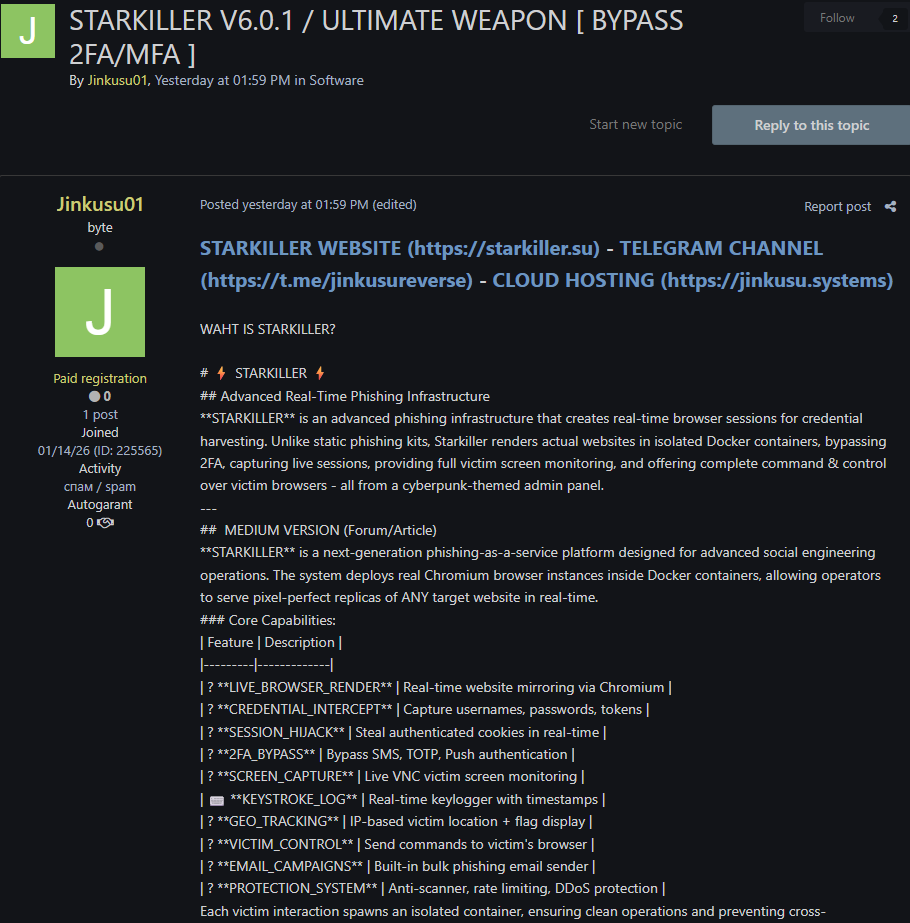
STARKILLER V6.0.1
Posted on exploit.in on January 16, 2026 (six weeks pre-takedown) by Jinkusu01 (account created January 14, 2026). STARKILLER uses a different architecture than traditional AiTM proxies: it launches actual Chromium browsers inside Docker containers, rendering target websites live. Capabilities include real-time browser mirroring, VNC-based victim monitoring, keystroke logging, geolocation tracking, and full C2 control. Bypasses SMS, TOTP, push notifications, and hardware security keys when proxied through the live browser session.
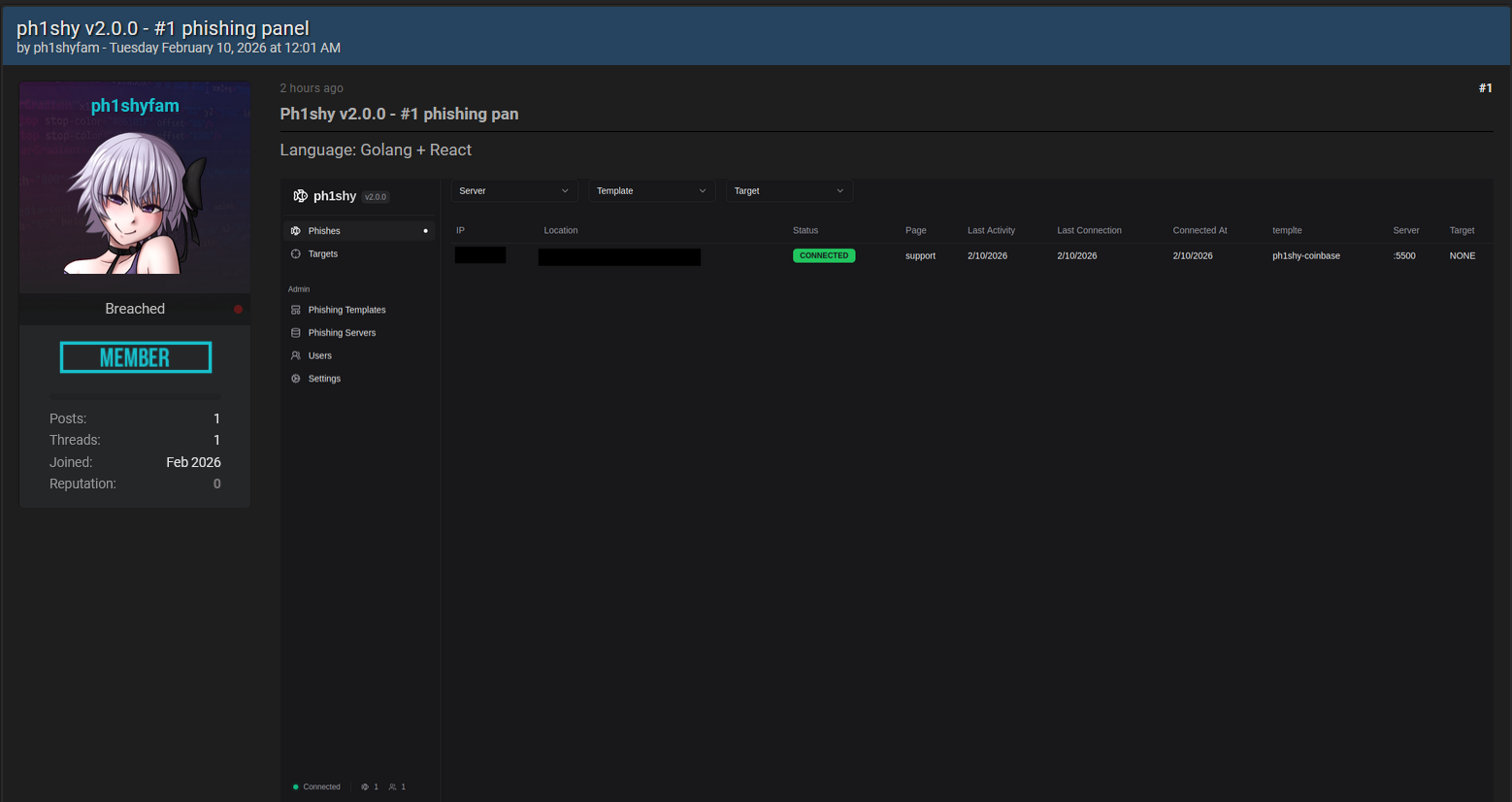
ph1shy v2.0.0
Posted on BreachForums on February 10, 2026 (three weeks pre-takedown) by ph1shyfam. Built with Golang backend and React frontend. Pricing: $1,500 one-time license, $10,000 for source code (crypto only). At the time of the forum post, a live Coinbase phishing template was actively running with a victim connected in the demo.
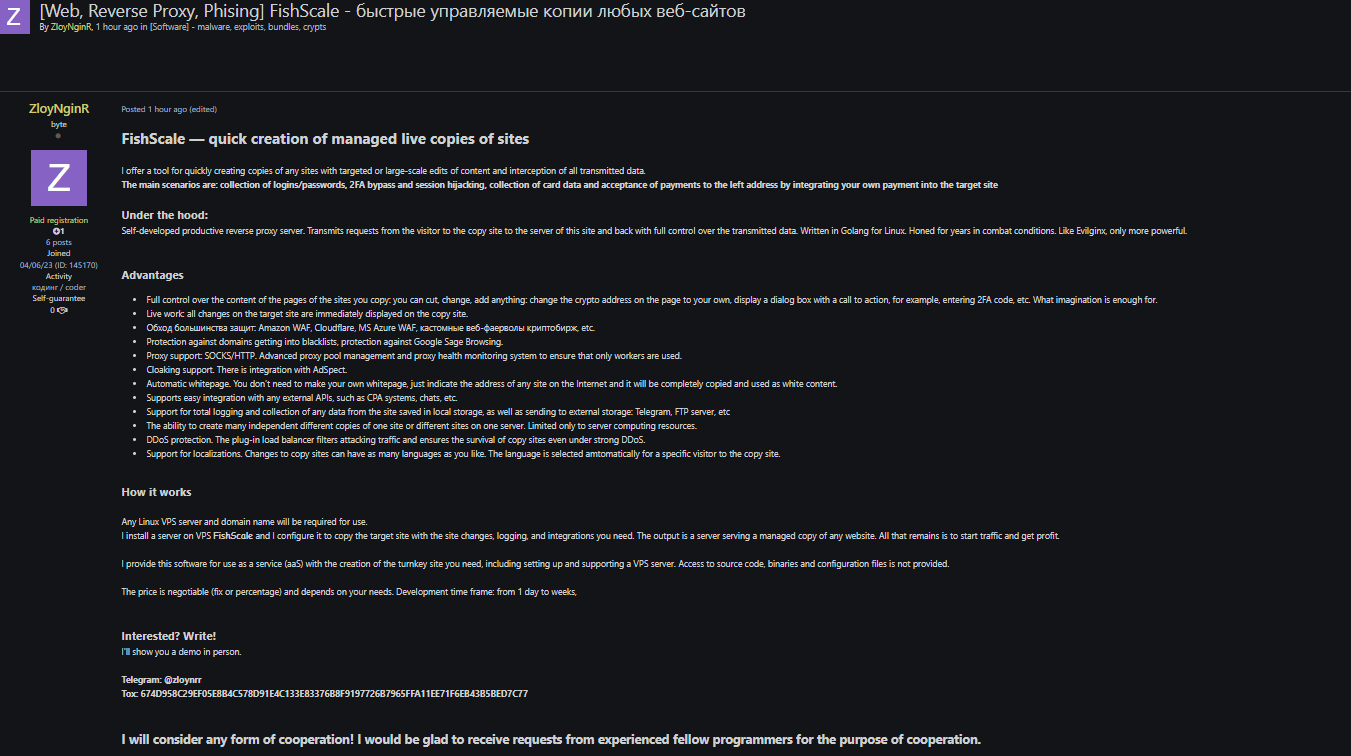
FishScale
Advertised on exploit.in by ZloyNginR (account active since April 2023). FishScale is a Golang-based reverse proxy marketed as a more capable alternative to Evilginx. Features include WAF bypass, request cloaking, and DDoS protection. This platform was not a post-takedown successor — it operated concurrently with Tycoon 2FA.
Defensive Countermeasures
Traditional MFA (SMS, TOTP, push) does not defend against AiTM because authentication is completed successfully — the proxy intercepts the resulting session token. Effective defenses must either prevent credential submission to non-legitimate origins or invalidate stolen session tokens.
Defender's ChecklistMitigation Matrix
Token Binding → Invalidates stolen session cookies
Conditional Access → Blocks auth from untrusted devices/locations
Continuous Evaluation → Terminates compromised sessions in near-real-time
User Awareness → Prevents initial click-through
Indicators of Compromise
9f6d91dda0a3c4d5054e78e90f30d2f0c98c79a03cb16d58819f0cb58d9c3abb
66a5b9c0d963dd910a502749eec42d6660b27aafa09b9ce01d73e3f73754b707
0499fdfcb2fddfd2e5d3f3eab2910ff2854208a8140e514cf5f1f39e12b7c55b
HTML signature: 3c0af39ecb3753c5fee3b53d063c7286019eac3b
CSS fingerprint: pages-godaddy.css + pages-okta.css
JS pattern: _myscr[0-9]{6}.js
PHP endpoint: res444.php
Conclusion
The Tycoon 2FA takedown demonstrates both the effectiveness and limitations of coordinated disruption operations. The infrastructure was eliminated — 24,000 domains purged, 330 domains seized, bulletproof hosting degraded. However, no arrests were made, and the underlying AiTM threat model remains commercially viable.
Dark web monitoring confirms that successor platforms (STARKILLER, ph1shy, FishScale) were already operational before the takedown. The PhaaS ecosystem operates as a market economy — when one supplier is disrupted, demand migrates to alternatives, often with improved capabilities.
Organizations relying solely on traditional MFA remain vulnerable to AiTM phishing regardless of Tycoon 2FA's status. Migration to phishing-resistant authentication (FIDO2/passkeys), combined with token binding and continuous access evaluation, is required to address the architectural limitation that the PhaaS industry exploits.


