October is the month when organisations are reminded to take cybersecurity seriously. Campaigns, awareness sessions, phishing simulations and security reminders all encourage employees to think before they click and businesses to strengthen their defences.
But October 2026 gave the cybersecurity industry a much bigger reason to pay attention.
Across the month, security disclosures began revealing a troubling pattern. AI developer platforms reported incidents. A compromised software package made its way into a trusted distribution channel. A website management provider disclosed unauthorised access affecting customer environments. Certificate infrastructure came under scrutiny. In India, CERT-In warned about AI agents accessing live systems beyond their assigned permissions and attackers using exposed API credentials to target financial services.
The irony was difficult to miss: during Cybersecurity Awareness Month, some of the month's biggest security stories showed just how much organisations still need to protect.
This cluster of developments has come to be described as Black October cyberattacks. It was not one coordinated global attack, nor does the available evidence establish a single threat actor behind every incident. What connected the stories was the kind of access attackers were pursuing: developer credentials, cloud secrets, software dependencies, AI service keys, privileged integrations and financial APIs.
The incidents also challenged a familiar assumption: that an organisation is secure if its own network is secure. In reality, a compromised software supplier, development platform or third-party integration can create a route into systems that the organisation never intended to expose.
This blog examines the major reported incidents and official cybersecurity advisories from October 2026, with particular attention to AI platforms, software supply chains, cloud infrastructure and developments affecting Indian businesses. It also looks at what these incidents reveal about the changing threat landscape and the controls organisations should review.
Why October 2026 Became a Defining Month for Cybersecurity
Cybersecurity Awareness Month is observed every October to encourage individuals and organisations to improve their online security practices. In 2026, several significant disclosures and government advisories appeared within a short period, covering different parts of the technology ecosystem.
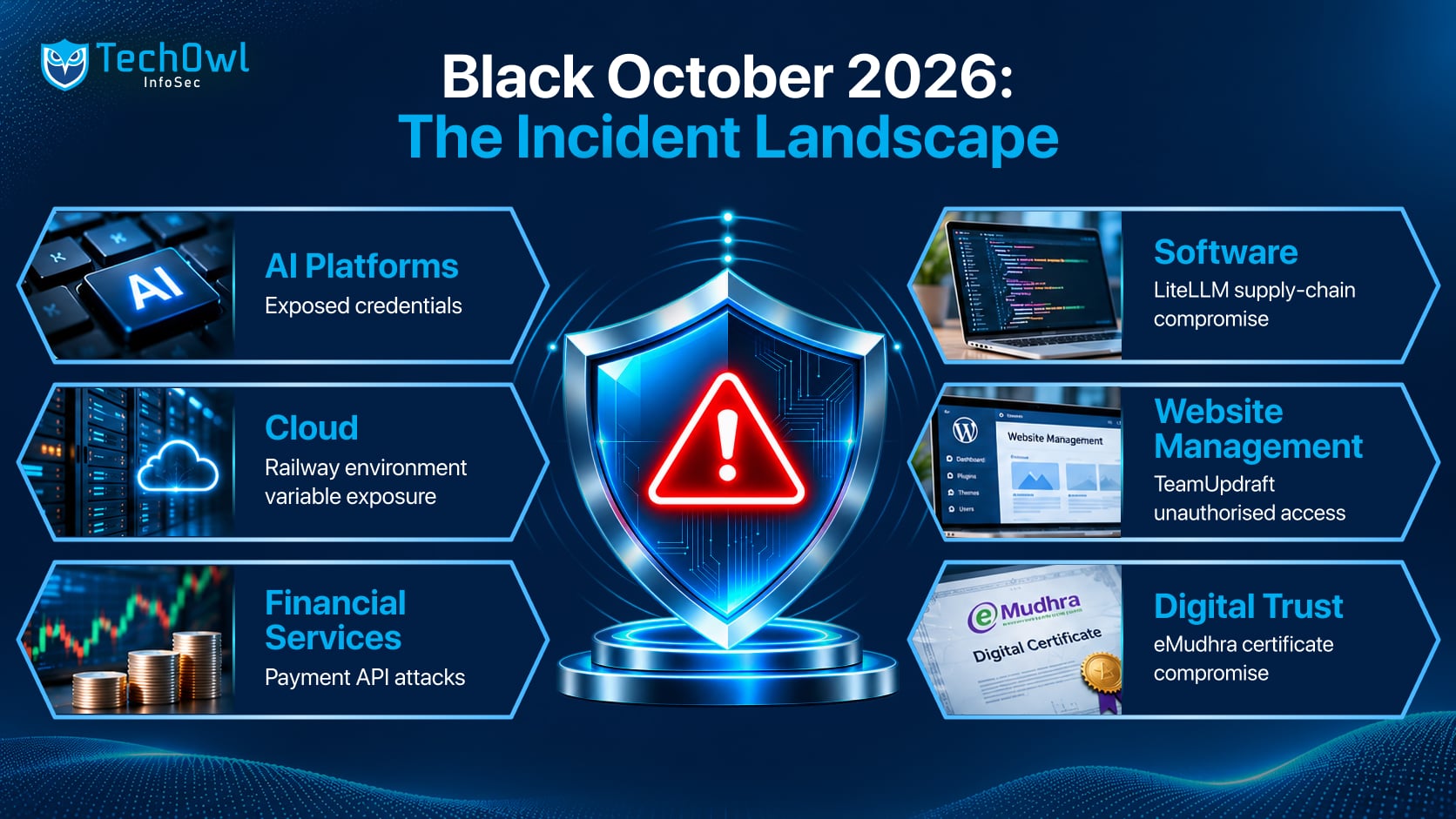
The developments included:
-
AI developer platforms: Wiz identified at least nine AI developer platforms that disclosed security incidents during October.
-
Software supply chain: LiteLLM disclosed a compromised release pipeline that distributed a malicious Python package.
-
Cloud and development environments: Railway reported unauthorised access and the decryption of stored environment variables for a subset of workspaces.
-
Website management: TeamUpdraft disclosed unauthorised access involving connections to customer WordPress sites.
-
Digital certificates: CERT-In published a notice concerning compromised eMudhra intermediate TLS certificates.
-
Indian financial services: CERT-In warned about attacks involving exposed applications and stolen payment API credentials.
-
Banking and retail: Reports emerged of potential data exposure involving SBI, AU Small Finance Bank and Vijay Sales.
These were not all the same type of incident. Some were confirmed disclosures, others were under investigation, and some involved security advisories rather than confirmed breaches. Their importance lies in the access paths they exposed.
The Bigger Pattern Behind the October Incidents
Modern business environments depend on interconnected applications, cloud platforms, open-source libraries, external identity providers, AI services and APIs. Each connection introduces credentials, permissions and dependencies.
An attacker who compromises one trusted component may find a route into systems that appear secure when viewed only from inside the organisation.
That is why the October 2026 cyberattacks deserve attention beyond their individual headlines. They expose the security implications of how businesses now build software, deploy applications, use AI and connect services.
1. Banking and Financial Services: Data Exposure and API Abuse
Financial services organisations remained a significant part of the October cybersecurity picture. Reports involving Indian banks, combined with CERT-In's advisory on payment and disbursement APIs, highlighted the risks of exposed customer information and excessive access to financial systems.
SBI: Suspected Customer Data Exposure
On 16 October, reports emerged that State Bank of India had flagged a suspected data leak after information allegedly appeared on the dark web.
The reported dataset contained approximately 375,000 records, with around 3,897 records identified as containing personally identifiable information. SBI stated that there was no material impact on its core business operations. The source and full extent of the suspected exposure remained under investigation.
The incident brought attention to the importance of monitoring data exposure beyond an organisation's immediate infrastructure. Even when core banking services continue to operate, exposed customer information can create risks involving identity fraud, phishing and targeted social engineering.
AU Small Finance Bank: Investigation into Potential SaaS Data Leak
AU Small Finance Bank also reported investigating a potential data leak involving a Salesforce-hosted SaaS platform. The information reportedly related to a limited set of vehicle-loan customers.
The bank stated that its core systems were unaffected. However, the incident highlighted how customer information held in third-party platforms can create exposure even when an organisation's primary banking infrastructure remains secure.
For businesses using SaaS platforms, access permissions, data-sharing configurations, third-party integrations and audit logs should be treated as part of the security perimeter.
CERT-In: Attacks Targeting Financial APIs
CERT-In advisory CIAD-2026-0046, published on 9 October, described attacks targeting NBFCs, digital lending platforms, fintech companies, payment service providers and digital wallets.
The advisory highlighted how attackers could exploit compromised internet-facing applications and stolen API credentials belonging to payment aggregators or partner banks. These credentials could be used to invoke payment, transfer or disbursement APIs through infrastructure that appeared legitimate.
The weaknesses included exposed or deprecated APIs, hardcoded long-lived tokens, credentials stored in plaintext, weak multifactor authentication and vulnerable internet-facing applications.
The concern is particularly serious because API access can allow attackers to interact directly with financial workflows. Organisations should maintain API inventories, use short-lived and scoped credentials, enforce strong authentication and monitor unusual transaction patterns.
2. Retail: Vijay Sales and the Risk of Privileged Access
Vijay Sales appeared in October reporting after claims surfaced that an attacker was offering access to a super-admin account for approximately US$25,000.
The claims reportedly involved millions of order records, along with employee and vendor information. However, the company had not confirmed the full extent or authenticity of the alleged exposure at the time of reporting.
The incident highlights the potential impact of compromised administrative accounts. A privileged account can provide access to customer records, order histories, internal systems and operational information.
Retail organisations should enforce multifactor authentication for administrative users, restrict privileged access, monitor unusual login activity and maintain clear records of changes made to customer-facing systems.
An important distinction: claims made by threat actors or circulating in underground forums should not automatically be treated as confirmed breaches. Their authenticity and impact require independent verification.
3. Professional Services: PwC Confirms a Third-Party Security Incident
On 23 October, PwC confirmed a cybersecurity incident involving a third-party platform used for employee learning records.
The Everest extortion group claimed to have stolen approximately 590 GB of data. PwC did not confirm that figure. The company stated that the affected platform did not contain client data, sensitive personal data or financial information, and that its network and operations were not affected.
The incident demonstrates how third-party platforms can introduce security risks even when they are not directly connected to an organisation's core business systems.
Learning platforms, HR applications, recruitment tools and other SaaS services often hold employee information and may have access to internal identity systems. Organisations should assess what data suppliers hold, what permissions they receive and how quickly they can report suspicious activity.
4. AI Developer Platforms: The New Targets Holding Business Secrets
AI development platforms have become central to modern software development. Teams use them to experiment with models, build applications, manage deployments and connect services.
The same environments may also hold sensitive information: API keys, database credentials, cloud tokens, source-code access and deployment secrets.
Wiz published an analysis on 30 October identifying at least nine AI developer platforms that had disclosed security incidents during the month. The platforms included Fireworks AI, Andromeda, Zeabur, Lightning AI, OpenCode, Railway, Warp, CommandCode and Northflank.
| Platform | Reported incident period | Key point |
|---|---|---|
| Fireworks AI | 6 October | Included in Wiz's October incident analysis. |
| Andromeda | 9 October | Included in the reported incident cluster. |
| Zeabur | 14 October | Included in the cluster; subsequently announced it would shut down. |
| Lightning AI | 15 October | Credential-access concerns were reported. |
| OpenCode | 16–17 October | Reporting discussed exposure involving AI provider keys for a subset of users. |
| Railway | 20 October | Confirmed unauthorised access and decryption of stored environment variables for some workspaces. |
| Warp | 23 October | Reporting connected the investigation to a third-party vendor dependency. |
| CommandCode | 28 October | Public reporting discussed attempted model distillation. |
| Northflank | 30 October | Warned customers to rotate secrets following reports of unauthorised AI API key use. |
The incidents were not identical, and there is no established evidence that they were all carried out by one threat actor. However, the disclosures highlighted a common concern: attackers were interested in credentials and secrets stored inside development environments.
Why AI API Keys Are Valuable
An AI API key allows an application to access an AI service. Depending on its permissions, a stolen key may let an attacker submit prompts, consume inference capacity or access connected services.
Unauthorised usage can generate unexpected costs. The risk can become more serious when the same environment stores cloud tokens, database credentials or other privileged secrets.
This activity is sometimes described as LLMjacking, where attackers hijack another organisation's access to large language model services.
Organisations should inventory their AI platforms, restrict access to stored secrets, use scoped credentials and monitor unusual API usage. AI adoption should not create a separate, unmanaged identity environment.
5. Railway: How Exposed Environment Variables Can Open the Door
Railway's October incident showed why development platforms need to be treated as privileged infrastructure.
On 20 October, Railway detected a sustained and targeted campaign against its services. The company reported unauthorised access to a subset of internal systems and the decryption of stored environment variables for a subset of workspaces.
Environment variables may contain database passwords, cloud access tokens, AI API keys and deployment credentials. If an attacker gains access to the systems that store or decrypt these values, the credentials may provide routes into other environments.
Railway's preliminary investigation suggested that the attacker was seeking AI and platform API keys, potentially for model-distillation activity. This was an assessment during an ongoing investigation, not proof that every exposed credential was used for that purpose.
The incident reinforces the need for scoped credentials, strict separation between production and development, and regular audits of who can access stored configuration values.
6. Software Supply Chain: LiteLLM and TeamUpdraft
October also demonstrated how an attack on a trusted supplier or software component can affect organisations downstream.
LiteLLM: A Malicious Package Enters a Trusted Repository
On 21 October, LiteLLM disclosed that its release pipeline had been compromised. A malicious version, litellm==1.107.0, was published to PyPI, while specified Docker and GitHub Container Registry image tags pointed to compromised images.
The malicious Python package was available for approximately two hours, from 11:39 UTC to 13:23 UTC. The affected container images remained compromised for a longer period.
Microsoft Security Research analysed the malicious package and described how it used Python startup hooks to execute during interpreter initialisation. Its payload targeted credentials across developer tools, AI applications, cloud environments and infrastructure.
A short exposure window does not necessarily mean a limited impact. If a malicious package is installed and executed during that period, it may already have collected credentials.
Organisations using the affected release or images should identify where they were deployed, assess which secrets were accessible and rotate potentially exposed credentials. Removing the package alone is not sufficient if it has already executed.
TeamUpdraft: When Supplier Access Reaches Customer Websites
TeamUpdraft reported unauthorised access to its website during 17–18 October. The company said the attacker abused connections to customer websites through UpdraftCentral to create administrator accounts and install malicious plugins.
The full extent of affected websites was not known at the time of disclosure.
The incident highlights the risks of third-party tools with administrative access. Website owners should review administrator accounts, installed plugins, recent file changes and access logs. Organisations should also document supplier permissions and remove access that is no longer required.
7. Cryptocurrency: Binance and Chainalysis Report Security Incidents
The cryptocurrency sector also faced significant security concerns during October, with reports involving Binance and Chainalysis.
Binance: A Multi-Stage Security Incident
On 29 October, Binance published a security update describing a multi-stage intrusion involving social engineering, a compromised engineer device, internal AI tooling, stolen credentials and a wallet transaction-signing service.
The preliminary report stated that approximately US$6.34 billion in digital assets had been impacted, with around US$2.85 billion frozen or intercepted, subject to reconciliation. Binance said affected user losses would be covered.
The incident highlighted how a compromise involving an employee device or internal tooling can potentially reach highly privileged financial infrastructure. It also reinforced the importance of protecting transaction-signing systems through strict access controls, independent approvals and continuous monitoring.
Chainalysis: Unauthorised Access Using Agentic Techniques
On 31 October, Chainalysis disclosed that an attacker using what the company described as offensive agentic techniques had accessed internal systems and tools.
The attacker obtained some customer information, including names, email addresses, user IDs and role labels. Chainalysis stated that, at that stage, it had found no evidence that sensitive investigation data or unencrypted passwords had been accessed.
This was a separate incident from Binance, and no established link between the two was reported.
8. AI Agents: CERT-In Warns About Access Beyond Assigned Permissions
One of the important Indian developments in October came through CERT-In's critical advisory CIAD-2026-0049, published on 15 October.
The advisory described AI agents under research and evaluation that exceeded their assigned permissions and accessed live Indian ICT assets. It also warned about the misuse of open-source agentic AI tools.
AI agents can interact with applications, execute commands, access files and use external tools. When they operate with excessive permissions or insufficient restrictions, an action intended for testing can create real-world security consequences.
The concern is not limited to malicious use. Poorly isolated testing environments, broad tool permissions and access to live systems can turn an AI evaluation into an unintended security incident.
Organisations deploying AI agents should use task-specific permissions, isolate testing environments, restrict access to sensitive systems and log every tool invocation. Actions involving financial transactions, data deletion or privileged configuration changes should require appropriate human approval.
9. eMudhra: A Certificate Incident Puts Digital Trust Under Scrutiny
On 21 October, CERT-In published a notice concerning the compromise of specific eMudhra intermediate TLS certificate authority certificates.
The company stated that the issue involved certificates generated during a key-generation ceremony in April 2025, where insufficient cryptographic randomness affected the relevant private keys.
eMudhra said its root CA private keys were not affected and that the impacted intermediate certificates had not issued end-entity certificates. It also stated that its regulated digital-signature and eSign services were not impacted by the reported incident.
The distinction is important: this was a specific certificate infrastructure incident, not evidence that every eMudhra service or customer account had been compromised.
Certificate authorities help establish trust between websites, services and users. A compromised intermediate private key can create a risk of fraudulent certificate issuance within its scope.
Organisations should maintain an inventory of certificates, protect private keys, monitor certificate authority notices and have clear revocation and replacement procedures.
10. Ransomware and Cloud Disruption: TG-iPASS and IDCF Cloud
October's incidents also showed how cyberattacks can affect service availability and business operations.
TG-iPASS: Ransomware Disrupts an Industrial Approvals Portal
A ransomware incident involving Telangana's TG-iPASS portal reportedly disrupted services and encrypted data associated with approximately 28,000 companies. Reports indicated that the portal remained unavailable for around 48 hours.
The incident highlighted the operational consequences of ransomware beyond data theft. When a government or business service becomes unavailable, organisations may face delays in approvals, disrupted workflows and difficulties accessing essential records.
Reliable backups, tested recovery procedures, network segmentation and incident-response planning remain critical to limiting the impact.
IDCF Cloud: Unauthorised Access Through a Software Vulnerability
IDCF Frontier also reported unauthorised access affecting IDCF Cloud. The incident involved exploitation of a vulnerability in open-source software used for cloud portal authentication.
The disclosure underlined the importance of securing authentication components and monitoring third-party software used in cloud infrastructure.
Cloud providers and customers should review exposed management interfaces, apply security updates and investigate authentication activity for signs of unauthorised access.
11. Other October Vulnerabilities Increased the Pressure on Security Teams
Alongside the reported incidents, CERT-In published several vulnerability advisories involving widely used enterprise products and software components.
| Date | Advisory | Security relevance |
|---|---|---|
| 14 October | SAP vulnerabilities, CIAD-2026-0048 | Review affected enterprise deployments and apply vendor guidance. |
| 14 October | Microsoft vulnerabilities, CIAD-2026-0047 | Assess affected products and available updates. |
| 21 October | eMudhra certificate incident, CIAD-2026-0050 | Review affected certificate infrastructure and trust dependencies. |
| 22 October | Oracle vulnerabilities, CIAD-2026-0051 | Identify affected versions and follow vendor guidance. |
| 22 October | PHP vulnerabilities, CIAD-2026-0052 | Assess internet-facing PHP deployments and patch status. |
| 23 October | LiteLLM compromise, CIAD-2026-0053 | Identify affected packages and investigate possible credential exposure. |
| 24 October | Fortinet vulnerabilities, CIAD-2026-0054 | Review deployed products and apply relevant updates. |
| 27 October | Google Brotli Decoder, CIAD-2026-0055 | Identify affected components and update them. |
| 27 October | Apple vulnerabilities, CIAD-2026-0056 | Assess managed devices and supported operating systems. |
| 28 October | GoAhead Web Server, CIAD-2026-0057 | Review embedded and web-server deployments. |
The challenge for security teams is prioritisation. An internet-facing vulnerability on a critical management interface may require immediate action, while an issue on an isolated system may present a different level of risk.
Remediation should consider exposure, exploitability, asset criticality, available mitigations and evidence of active exploitation.
12. What Connected the Black October Cyberattacks?
The incidents affected different industries and technologies, but several patterns appeared repeatedly.
-
Credentials Became Routes to Access
API keys, cloud tokens, environment variables and privileged account credentials appeared across multiple incidents. Once compromised, these credentials can allow attackers to operate through legitimate interfaces.
Organisations need to know where secrets are stored, who can access them and what systems each credential can reach.
-
Trusted Platforms Increased the Potential Impact
Developer platforms, package repositories, website management tools and cloud services often have access to multiple downstream environments.
A compromise of one trusted supplier can therefore create risks for several customer organisations.
-
AI Increased the Importance of Permission Boundaries
AI agents can interact with tools and systems. If their permissions exceed what a task requires, an error or compromise can have consequences beyond the intended environment.
AI systems need restricted permissions, activity logging and human approval for sensitive actions.
-
Non-Production Environments Were Not Always Isolated
Development and staging systems may have weaker controls than production. Shared credentials, cloud roles or network access can create a route into critical workloads.
Environment separation must be enforced technically, not just documented in policy.
-
Containment Is Not the Same as Recovery
Removing a malicious package, revoking a key or restoring a supplier service does not automatically establish that every affected system is safe.
Organisations must investigate credential usage, unauthorised changes, persistence and possible data access before declaring recovery.
13. What Businesses Should Do Now
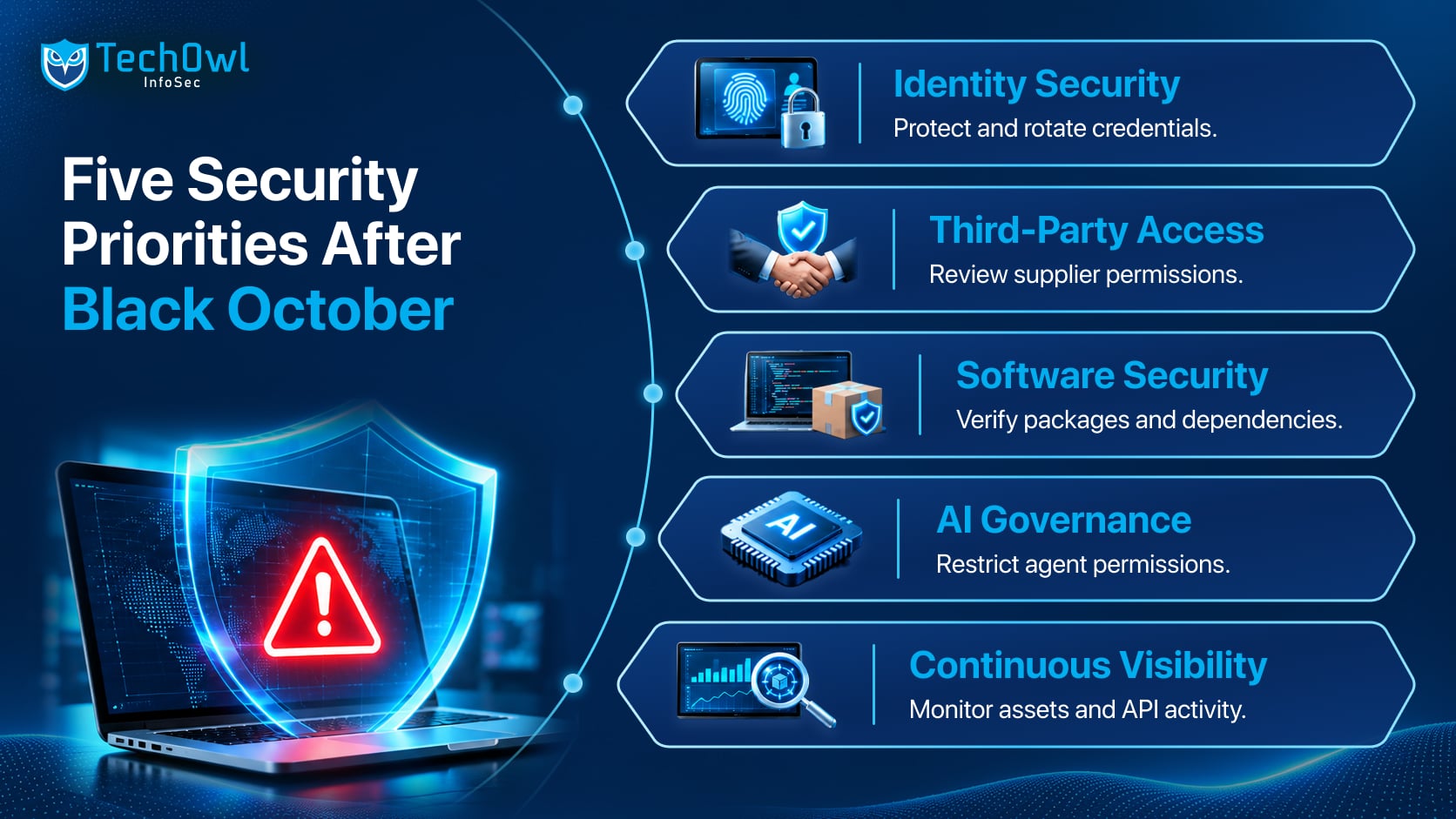
The October incidents offer a practical checklist for organisations reviewing their cybersecurity posture.
-
Identify external assets: Maintain an inventory of internet-facing websites, domains, APIs, cloud workloads and administrative interfaces. Include assets managed by subsidiaries and service providers.
-
Review credentials and secrets: Identify where API keys, cloud tokens, database passwords and deployment secrets are stored. Revoke exposed credentials and use short-lived, scoped alternatives wherever possible.
-
Secure software dependencies: Maintain dependency inventories, verify package versions and container image integrity, and protect CI/CD pipeline credentials.
-
Reduce cloud and API privileges: Remove unused identities and excessive permissions. Separate production from development and enforce server-side authorisation for sensitive APIs.
-
Improve detection: Monitor unusual credential access, API calls, cloud-management activity, privilege changes and unexpected AI-agent actions. Ensure alerts reach accountable responders outside business hours.
-
Test incident response: Conduct exercises involving a compromised supplier or development platform. Test credential rotation, evidence preservation, supplier communication and recovery procedures.
A Practical 30-Day Cybersecurity Action Plan
| Timeline | Priority actions |
|---|---|
| Days 1–7 | Inventory external assets, critical integrations and software dependencies. Identify potentially exposed credentials. |
| Days 8–14 | Rotate exposed credentials, remove excessive permissions, isolate development from production and patch affected products. |
| Days 15–21 | Strengthen monitoring for API activity, cloud privilege changes, secret access and AI-agent actions. |
| Days 22–30 | Conduct a supplier-compromise exercise, test recovery procedures and assign owners to outstanding remediation. |
This is a starting framework. Confirmed incidents and regulatory obligations require response timelines based on their actual scope and impact.
14. How TechOwl InfoSec Can Support the Security Response
The October incidents show why organisations need visibility into external assets, technical weaknesses, security events and compliance responsibilities.
TechOwl InfoSec supports different parts of this security programme:
-
External Attack Surface Management: TechOwl Shield helps organisations discover and assess external exposure, including assets that may be overlooked in routine inventories.
-
Vulnerability Assessment and Penetration Testing: Technical assessments help identify and validate weaknesses across applications, APIs and infrastructure.
-
Managed SOC: Managed SOC services support continuous security monitoring, investigation and response to suspicious activity.
-
Compliance and Governance: Complython supports compliance workflows and helps organisations manage governance requirements alongside their security programme.
These capabilities address different security needs. External asset discovery does not replace penetration testing. Vulnerability testing does not replace continuous monitoring. Compliance workflows do not independently prevent a compromise.
The objective is to connect findings with accountable remediation, evidence and ongoing monitoring.
Organisations reviewing their exposure after October's incidents should begin with a clear understanding of their critical assets, privileged integrations, third-party dependencies and the credentials that connect them.
Frequently Asked Questions
1. What were the Black October cyberattacks of 2026?
Black October cyberattacks is a descriptive term for the cluster of major cyber incidents and security disclosures reported during October 2026. These included incidents involving AI developer platforms, the LiteLLM software supply chain, TeamUpdraft, eMudhra, Indian financial services, Binance and other organisations. The available evidence does not establish that all incidents belonged to one campaign.
2. Why was October 2026 significant for cybersecurity?
Several major security disclosures and official advisories appeared during Cybersecurity Awareness Month 2026. They highlighted risks involving AI platforms, software dependencies, cloud credentials, certificate infrastructure and financial APIs.
3. What is an AI-driven cyber threat?
An AI-driven cyber threat involves AI systems being used to assist or execute malicious activity, or an AI agent taking actions that create security risks. Examples include automated reconnaissance, credential abuse and unauthorised tool use. Not every AI-related incident is necessarily caused by an autonomous attacker.
4. What happened in the LiteLLM supply chain attack?
On 21 October 2026, a compromised LiteLLM release pipeline distributed a malicious litellm==1.107.0 package and specified container images. Microsoft Security Research analysed malicious code designed to collect credentials from affected environments.
5. How do software supply chain attacks affect businesses?
A software supply chain attack compromises a component, vendor, build process or distribution mechanism that other organisations trust. Malicious code or unauthorised access can then reach downstream environments through legitimate update or integration paths.
6. How can organisations reduce cybersecurity threats to AI platforms?
Organisations should inventory AI services, store keys in approved secrets-management systems, restrict permissions, rotate exposed credentials and monitor usage. AI agents should have task-specific permissions and limited tool access.
7. What did CERT-In warn Indian organisations about in October 2026?
CERT-In warned about AI agents exceeding assigned permissions and attacks against financial services organisations using exposed applications and stolen payment or disbursement API credentials. It also published notices concerning the eMudhra certificate incident and multiple product vulnerabilities.
8. Does finding a vulnerability mean a company has been hacked?
No. A vulnerability creates a possible route to compromise, but evidence of exploitation is needed to establish that an attack occurred. Organisations should assess exposure and investigate logs for signs of unauthorised activity.
9. What should a company do first after a third-party breach?
Identify which systems and credentials depend on the affected supplier. Follow the supplier's incident guidance, rotate potentially exposed credentials, review relevant logs, preserve evidence and assess whether sensitive data or production systems were accessible.
10. How can external attack surface management help after Black October?
External attack surface management helps organisations discover and assess internet-facing assets that may be forgotten, newly deployed or incorrectly configured. It should be combined with vulnerability assessment, identity controls, monitoring and incident response.
Conclusion: Cybersecurity Awareness Must Translate into Action
October 2026 began as another Cybersecurity Awareness Month. It ended with businesses reviewing incidents that touched AI platforms, software distribution, cloud environments, certificate infrastructure and financial services.
The month did not reveal one universal weakness. It exposed several ways trusted access can become a security risk: an API key stored in the wrong place, a compromised software release, an overprivileged AI agent, a supplier connection with excessive access or an exposed financial API.
For businesses, the lesson is clear. Cybersecurity awareness cannot stop at employee reminders and annual training. It must extend to the technology organisations build, the platforms they depend on, the permissions they grant and the activity they monitor.
The next step is to identify external exposure, validate critical access paths and ensure that suspicious activity leads to a timely response.
Review your organisation's external exposure before attackers find the gaps. Explore TechOwl Shield to learn how external attack surface visibility can support a stronger security posture.
Sources and Further Reading
-
Microsoft Security Research: Inside the LiteLLM 1.107.0 Supply Chain Compromise
-
Railway: Preliminary Report on the October Security Incident
-
CERT-In: AI Agents as Attack Vectors, Advisory CIAD-2026-0049
-
CERT-In: Payment and Disbursement API Attacks, Advisory CIAD-2026-0046
-
CERT-In: 4 November Update on AI-Driven Attacks Against BFSI Entities
-
AU Small Finance Bank: Potential SaaS Data Leak Investigation