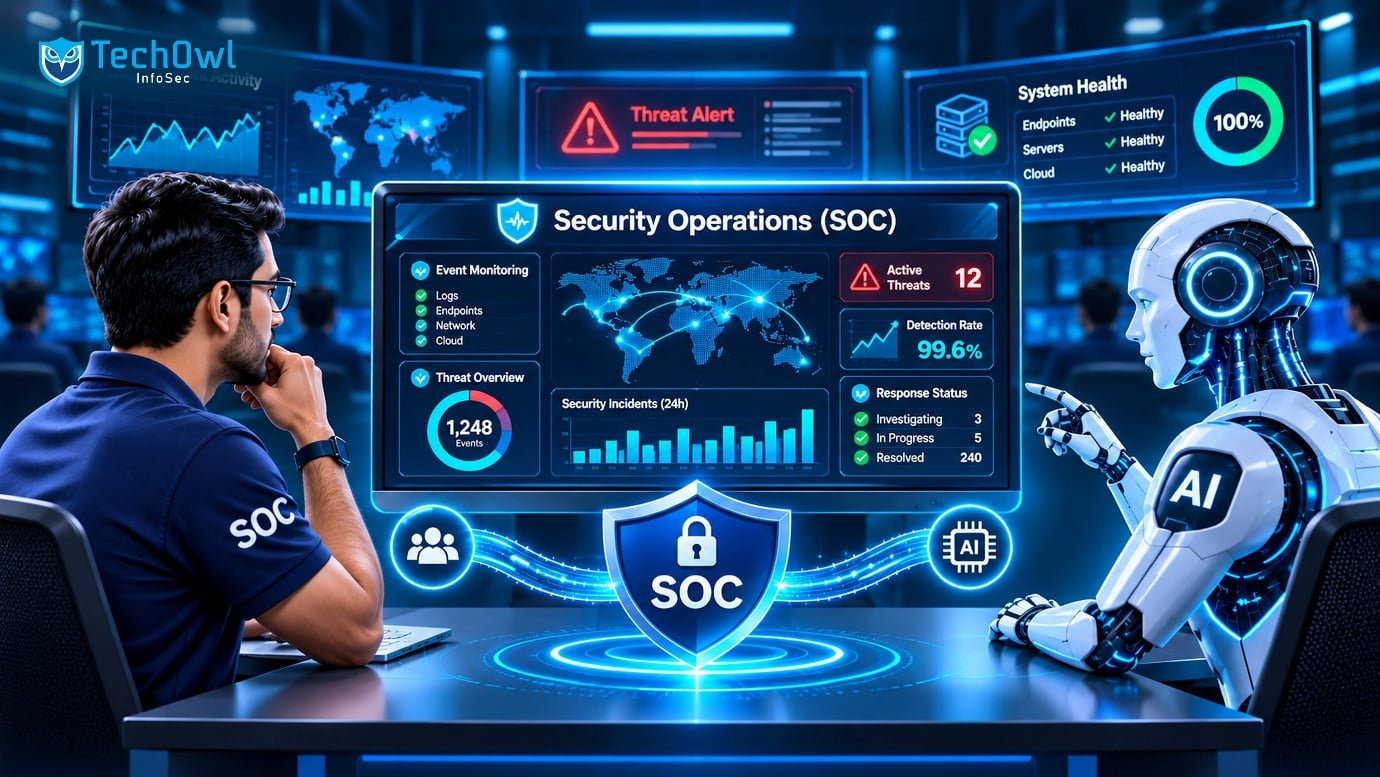
A Security Operations Centre (SOC) may receive thousands of alerts from endpoints, networks, cloud environments and security tools. Each alert needs to be assessed, prioritised and investigated to determine whether it represents a genuine threat.
Now imagine an AI system capable of analysing these alerts, correlating data and producing investigation summaries in seconds. Would that make human security analysts unnecessary?
Not quite.
AI is changing how security teams detect threats, investigate suspicious activity and respond to incidents. It can process large volumes of data, automate repetitive tasks and help analysts identify patterns that might otherwise take hours to investigate. However, cybersecurity decisions often require business context, critical judgement and an understanding of consequences that automated systems cannot reliably provide on their own.
The debate around AI SOC vs Human Analysts is therefore not simply about choosing between automation and people. It is about understanding where each performs best and how they can work together.
A hybrid SOC combines AI-driven capabilities with human expertise, allowing security teams to improve operational efficiency without removing the judgement and accountability required for effective incident response.
What Is an AI SOC?
An AI-powered SOC uses artificial intelligence and automation to support security monitoring, threat detection, investigation and response.
Traditional SOC workflows often depend on analysts reviewing alerts, collecting information from different tools, correlating events and deciding which incidents require immediate attention. AI can streamline many of these activities by processing telemetry, identifying patterns and bringing relevant information together.
Depending on the tools and configuration, an AI-enabled SOC may support:
-
Automated alert triage: Classifying alerts and prioritising those that require investigation.
-
Threat correlation: Connecting related events across endpoints, networks, identities and cloud environments.
-
Investigation assistance: Summarising logs, identifying suspicious activity and suggesting possible attack paths.
-
Threat intelligence enrichment: Adding relevant information about indicators, vulnerabilities and known attack techniques.
-
Response recommendations: Suggesting containment or remediation actions based on available evidence.
-
Workflow automation: Performing predefined, approved actions when specified conditions are met.
AI capabilities vary by platform. Not every SOC automation tool uses generative AI, and not every AI-enabled system can investigate or respond autonomously.
The objective is to reduce the time analysts spend on repetitive tasks while helping them focus on higher-priority security risks.
Human Analysts vs AI in the SOC: Understanding the Difference
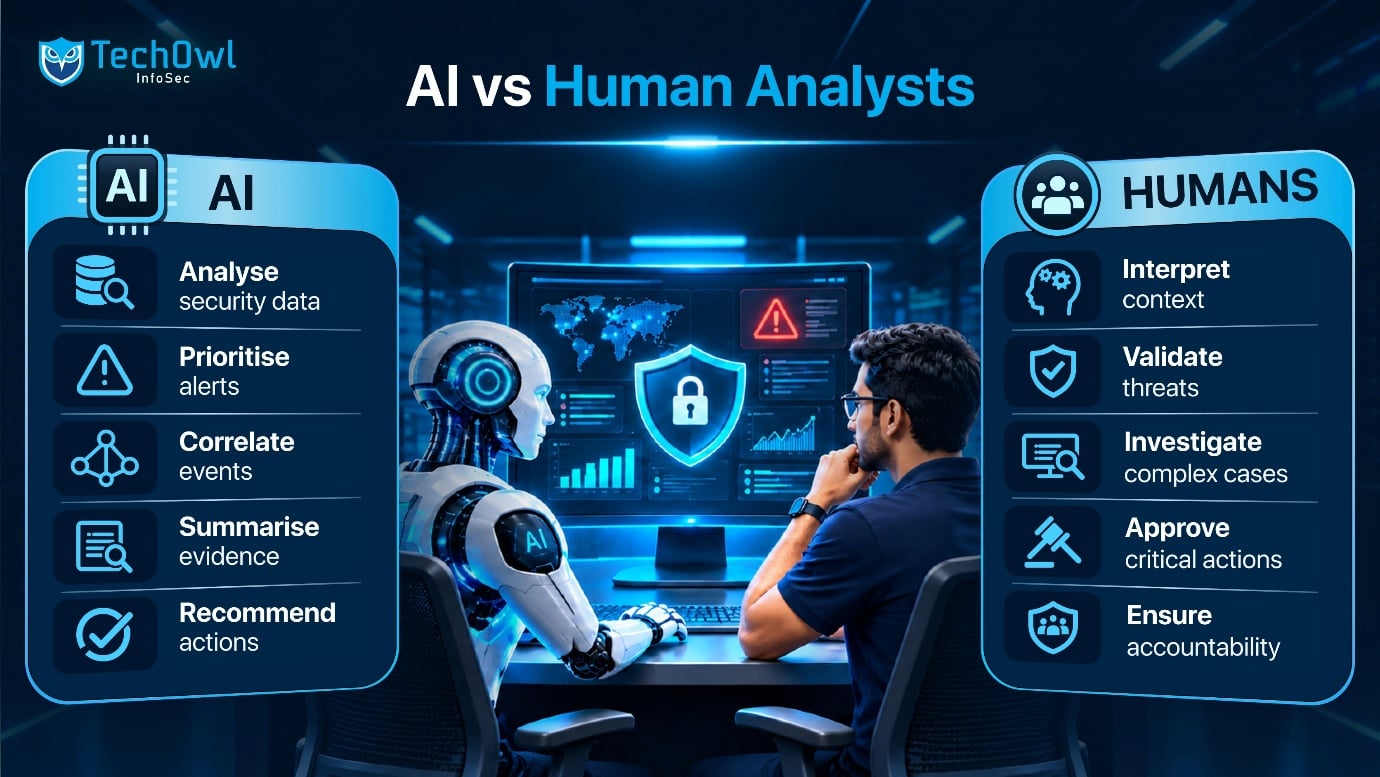
AI and human analysts bring different strengths to security operations. Understanding these differences helps organisations decide which tasks to automate and where human oversight remains essential.
| Capability | AI-powered SOC | Human analysts |
|---|---|---|
| Data processing | Analyses large volumes of telemetry rapidly | Reviews evidence and interprets relevant details |
| Alert triage | Classifies and prioritises alerts using configured models and rules | Validates priorities and investigates ambiguous cases |
| Pattern recognition | Identifies correlations and anomalies across available data | Recognises attack behaviour using experience and contextual knowledge |
| Investigation | Summarises evidence and proposes possible explanations | Tests hypotheses, challenges assumptions and validates conclusions |
| Decision-making | Recommends or performs actions within configured permissions | Evaluates business impact, uncertainty and operational consequences |
| Response | Executes approved automated workflows where supported | Makes or approves complex, high-impact response decisions |
| Adaptability | Depends on data quality, model capabilities and system configuration | Can reason through unfamiliar scenarios and incorporate organisational context |
| Accountability | Requires governance, monitoring and defined ownership | Provides human responsibility, oversight and decision accountability |
Neither approach is sufficient in every situation. AI can improve the speed and consistency of routine analysis, while human analysts provide contextual judgement and validate decisions when the evidence is incomplete or the consequences are significant.
Where AI Performs Best in Security Operations
The greatest value of AI in a SOC often comes from reducing repetitive work and helping analysts process information more efficiently.
1. Handling high volumes of alerts
Security tools can generate alerts for suspicious logins, endpoint activity, network traffic, privilege changes and other events. Reviewing every alert manually can consume substantial analyst time.
AI can classify alerts, group related events and highlight those that meet specified risk criteria. This helps teams prioritise investigations rather than treating every notification as equally urgent.
However, automated prioritisation is only as useful as the underlying data, detection logic and context. A low-priority alert should not be ignored simply because an automated system assigned it a low score.
2. Correlating security events
A cyberattack rarely consists of one isolated event. An attacker may compromise an account, access a system, escalate privileges and attempt to move laterally across a network.
AI can help correlate related signals across available data sources, giving analysts a more connected view of suspicious activity.
This can reduce the time spent switching between tools and manually assembling evidence.
3. Accelerating investigations
An investigation may require analysts to review authentication logs, endpoint telemetry, threat intelligence and historical activity.
AI assistants can summarise relevant records, explain technical findings and suggest additional investigative steps. Analysts can then use these outputs to guide their investigation.
For example, when a user account exhibits unusual login activity, AI may identify related authentication events and highlight changes in access patterns. A human analyst can then determine whether the activity represents legitimate behaviour, compromised credentials or another issue.
4. Automating repetitive response tasks
Certain security workflows can be automated when the conditions and permitted actions are clearly defined.
Examples include enriching an alert with threat intelligence, creating an incident ticket, notifying the relevant team or initiating an approved containment procedure.
For high-impact actions, such as disabling critical accounts or isolating business-critical systems, organisations should establish appropriate approval requirements and safeguards.
AI should make security operations faster without introducing uncontrolled changes to production environments.
Why Human Analysts Remain Essential
AI can process information quickly, but speed alone does not establish that an investigation is accurate or that a response is appropriate.
Human analysts remain important in situations where evidence is ambiguous, attack behaviour is unfamiliar or response decisions could affect business operations.
1. Understanding business context
An unusual login may indicate compromised credentials. It may also result from a legitimate employee travelling, a scheduled maintenance activity or an approved change in working arrangements.
AI can flag the anomaly, but an analyst may need to consider user responsibilities, change records, business schedules and other contextual information before deciding how to respond.
Without that context, an otherwise reasonable automated recommendation could disrupt legitimate activity.
2. Investigating unfamiliar threats
Attackers continually change their methods, use legitimate administrative tools and adapt their behaviour to avoid detection.
AI can help identify deviations from known patterns, but novel attack techniques and incomplete evidence can still create uncertainty.
Experienced analysts can question initial assumptions, formulate alternative hypotheses and investigate activity that does not fit familiar detection patterns.
3. Making risk-based decisions
Not every suspicious event requires the same response.
Isolating an employee workstation may be relatively straightforward. Isolating a production server supporting critical business services may cause significant disruption.
Human analysts can assess the potential impact, coordinate with relevant teams and select a response proportionate to the threat.
4. Validating AI-generated findings
AI systems can produce incorrect, incomplete or misleading explanations. Their outputs may also be affected by poor-quality data, missing telemetry or manipulated inputs.
Analysts must verify important conclusions against available evidence rather than treating AI-generated summaries as definitive findings.
5. Maintaining accountability
Security incidents involve decisions about access, containment, service availability, regulatory obligations and communication.
Organisations need clearly defined responsibility for approving actions, reviewing outcomes and managing exceptions. AI can support these decisions, but accountability must remain with designated people and established governance processes.
Why a Hybrid SOC Is the More Practical Approach
A hybrid SOC combines AI's speed and processing capacity with the judgement and contextual understanding of human analysts.
Instead of asking whether AI should replace people, organisations can determine which tasks are suitable for automation, which require analyst validation and which should remain under direct human control.
Research and industry guidance increasingly emphasise this collaborative model. The SANS Institute's research on AI-human collaboration in modern SOCs examines how AI-assisted capabilities can help security teams manage alert volume while allowing analysts to focus on judgement-intensive work.
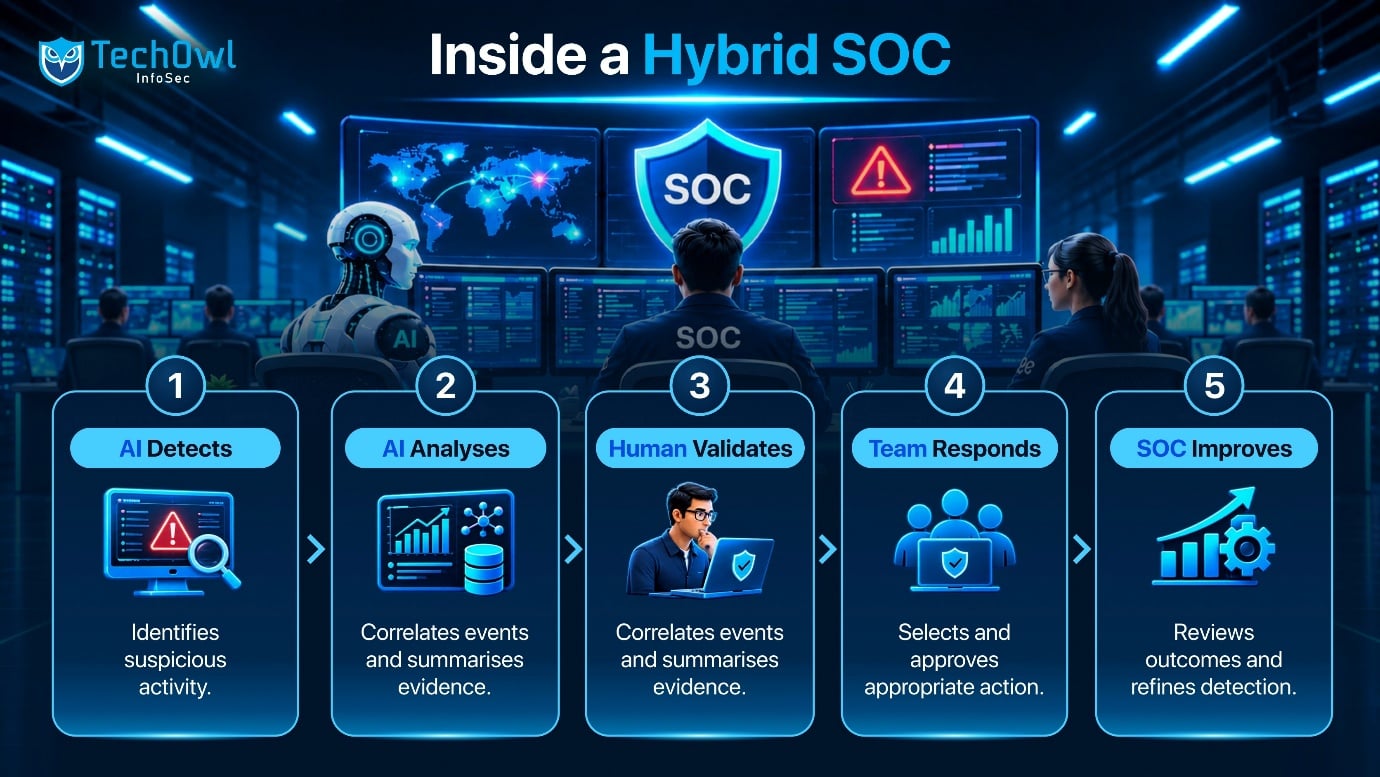
How a hybrid SOC works in practice
Consider a suspected account compromise.
Step 1: AI identifies suspicious activity. The system detects unusual login behaviour and correlates it with other available security events.
Step 2: AI enriches the alert. It gathers relevant information, summarises the evidence and assigns a preliminary priority.
Step 3: A human analyst validates the findings. The analyst reviews the evidence, checks the user's activity and determines whether the alert represents a credible threat.
Step 4: The response is selected. Depending on the severity and confidence level, the analyst may approve containment, request further investigation or allow the activity to continue under monitoring.
Step 5: The outcome is reviewed. The team records the investigation, evaluates the response and identifies improvements to detection rules and workflows.
This approach reduces manual investigation effort while preserving human oversight where it matters.
Implementing a Hybrid SOC: Five Practical Considerations
Adopting AI within security operations requires more than enabling an AI feature. Organisations need to define its responsibilities, limitations and relationship with existing workflows.
1. Start with clearly defined use cases
Identify repetitive, time-consuming tasks that are suitable for assistance or automation.
Alert enrichment, incident summarisation, threat intelligence lookup and ticket creation can be useful starting points. Begin with workflows where the expected benefits and acceptable risks can be measured.
2. Establish automation boundaries
Define which actions AI may perform independently, which require analyst approval and which are prohibited without explicit authorisation.
Use narrowly scoped permissions, preapproved actions and reversible procedures wherever practical. High-impact decisions should receive stronger oversight.
3. Maintain reliable security data
AI cannot produce dependable investigations from incomplete or inconsistent telemetry.
Ensure that relevant logs are collected, timestamps are aligned, asset and identity information is accurate, and security tools provide sufficient context for investigation.
4. Measure performance continuously
Evaluate AI using operational metrics rather than automation volume alone.
Useful measures include:
-
Mean time to detect (MTTD)
-
Mean time to respond (MTTR)
-
Alert false-positive rates
-
Investigation accuracy
-
Escalation quality
-
Analyst workload
-
Incorrect or unauthorised automated actions
Track performance over time and investigate cases where automation creates additional risk or fails to improve outcomes.
5. Train analysts to supervise AI effectively
Analysts need to understand how AI-generated findings are produced, where errors may occur and how to verify recommendations.
Training should cover evidence validation, investigation techniques, automation permissions, escalation procedures and incident response without AI assistance. These practices help preserve analytical capability as automation expands.
The Future of SOC Operations: Human-Led, AI-Assisted
As AI capabilities evolve, security analysts are likely to spend less time on repetitive alert processing and more time on investigation, threat hunting, detection engineering, response planning and oversight.
AI will continue to improve the speed at which security teams process information and coordinate routine workflows. At the same time, the need for human judgement, governance and accountability will remain central to reliable security operations.
The most effective SOC is therefore not necessarily the one that automates the most tasks. It is the one that uses automation where it adds value, validates its outputs and ensures that consequential decisions are made within clearly defined boundaries.
For organisations evaluating AI-powered security operations, the priority should be to build a model in which technology amplifies the capabilities of the security team rather than creating a new source of operational uncertainty.
How Managed SOC Services Support This Approach
A well-structured Managed SOC combines security monitoring, alert investigation, incident escalation and defined response processes. AI-assisted capabilities can improve the efficiency of these activities, while skilled analysts provide investigation, validation and oversight.
The right operating model depends on an organisation's threat exposure, security maturity, technology environment and response requirements.
To understand how continuous monitoring and expert-led security operations can support your organisation, explore Managed SOC services.
Build a security operations strategy that combines automation with human expertise. Review your current monitoring and response processes to identify where AI can reduce repetitive work and where analyst judgement remains essential.
Frequently Asked Questions
1. Can AI replace human SOC analysts?
No. AI can automate repetitive tasks, prioritise alerts and support investigations, but human analysts remain essential for validating findings, understanding business context, investigating unfamiliar threats and making high-impact response decisions.
2. What is the difference between an AI SOC and a traditional SOC?
A traditional SOC may rely more heavily on analyst-led alert review and investigation, often supported by security tools and rule-based automation. An AI-enabled SOC adds capabilities such as automated alert enrichment, pattern analysis, investigation summaries and AI-assisted response recommendations. Actual capabilities vary by platform.
3. What is a hybrid SOC?
A hybrid SOC combines AI-driven analysis and automation with human investigation, decision-making and oversight. AI handles suitable high-volume tasks, while analysts validate findings, investigate complex incidents and supervise consequential actions.
4. What are the risks of using AI in a SOC?
Potential risks include inaccurate AI-generated findings, incomplete context, manipulated inputs, false negatives, excessive reliance on automation and inappropriate response actions. Organisations can reduce these risks through evidence validation, limited permissions, human oversight and continuous performance monitoring.
5. How can organisations introduce AI into their SOC?
Organisations should begin with clearly defined use cases, establish automation boundaries, improve security data quality, measure outcomes and train analysts to validate AI-generated findings. High-impact actions should have appropriate approval and oversight requirements.